
Rice paste on hair is one of those DIY trends that can feel like magic-right up until it doesn’t. I’ve seen people swear it made their hair look thicker and smoother after one use, and I’ve also seen the opposite: dullness, tangles, and that stubborn “coated” feeling that won’t rinse out. The reason for the mixed results is simple: rice paste isn’t really a conditioner. It behaves more like a temporary coating, and coatings can either help your hair glide… or make it grabby and brittle.
So instead of treating rice paste like a universal strengthening mask, let’s talk about what it actually is, what it’s doing on the hair fiber, why it sometimes backfires, and how to get the best outcome if you still want to experiment. I’ll also explain why a pH-balanced, rice-water-based approach-like what Viori uses with Longsheng Rice Water™-tends to be more predictable than playing kitchen chemist.
What Rice Paste Actually Is (And Why That Matters)
Most people lump anything “rice” into the protein category. In practice, rice paste is mostly starch. Starch is made up of two main components-amylose and amylopectin-and those two behave differently once they’re heated, cooled, smeared onto hair, and rinsed (or not rinsed) away.
NOT SURE WHICH PRODUCT IS RIGHT FOR YOU?
TAKE THE QUIZTakes 30 seconds · 134,000+ customers matched
Depending on how you prepare it, rice paste can contain everything from gritty starch granules to smooth gelatinized starch gel. That one difference-grainy versus smooth-can completely change how your hair feels afterwards.
- More intact granules (less cooked, less strained) tend to feel gritty and are more likely to leave residue.
- More gelatinized starch (properly cooked, smoother) is more likely to lay down as a film.
- Cooling the paste can make the starch set up more firmly, which can increase stiffness on the hair.
The “Rarely Talked About” Truth: Rice Paste Acts Like a Biopolymer Coating
Here’s the angle most blogs skip: when you apply rice paste, you’re essentially applying a biopolymer film to keratin fibers (your hair). Think of it like a lightweight, natural “wrap.” If it forms a thin, even layer, it can improve slip and make hair feel thicker. If it deposits unevenly-or dries too hard-it can increase friction, which is where tangles and breakage come from.
So when someone says, “Rice paste made my hair stronger,” what they’re often experiencing is surface reinforcement-less snagging, less flyaway, more body. That’s different from true internal repair of the cortex.
Why It Can Feel Stronger Without Truly “Repairing” Hair
In real life, “strong hair” usually means you can brush it without hearing that snap-snap-snap sound. Rice paste can help with that temporarily, but mostly through mechanics, not miracles.
1) It can add a temporary thickening effect
A thin film can make strands feel slightly more substantial. That can translate to more volume and a fuller ponytail-especially on finer hair.
2) Friction changes can make or break your results
Hair damage often shows up as raised, rough cuticles. If rice paste fills in those rough spots evenly, you may get less friction and fewer tangles. If it clings in patches, you can end up with the opposite: more friction, more snagging, and more breakage during detangling.
The Porosity Paradox: Who Rice Paste Helps (and Who It Punishes)
If you only take one technical concept from this post, let it be this: porosity changes everything. The same rice paste can feel silky on one head of hair and disastrous on another.
Low porosity hair
Low porosity hair doesn’t like heavy coatings. It tends to resist absorption and collect buildup easily. Rice paste often sits on top, and that can lead to:
- a coated, heavy feel
- dullness (residue can scatter light instead of reflecting it)
- roots feeling “dirty” sooner
High porosity or damaged hair
High porosity hair drinks up water fast and loses it just as fast. Rice paste can temporarily smooth and “patch” roughness, but there’s a catch: if the film dries too rigid, hair can feel stiff and brittle. People often label this as protein overload, but the mechanism is usually stiffness + dryness + mechanical stress, not too much protein.
Your Scalp Is Not a Mixing Bowl: The Scalp Side of Rice Paste
Most DIY instructions treat rice paste like it belongs everywhere-roots included. From a scalp-health perspective, that’s where trouble starts. Paste is thick. It can cling around follicles, trap oil and sweat, and mix with shedding skin cells. On some scalps, that shows up as itch, flakes, or “dandruff-looking” debris that’s really just residue plus normal shedding.
Another factor: DIY rice mixtures can unintentionally ferment, and fermentation changes both the chemistry and the feel. The pH can drift, and a sensitive scalp may not love that unpredictability.
pH: The Silent Variable That Makes DIY Results Unstable
Hair behaves best in a mildly acidic environment. When pH is off, the cuticle can swell and lift, which increases frizz, dullness, and tangling. DIY rice paste varies depending on soak time, water quality, storage, and any add-ins-so the pH can be all over the place.
This is one reason a controlled, pH-balanced formula is so valuable. Viori’s FAQs note that rice water at high concentration can disrupt hair and scalp pH if used too often, which is why Viori uses Longsheng Rice Water™ in a safe, pH-balanced amount designed for regular use.
The #1 Reason Rice Paste “Ruins” Hair: It Wasn’t Removed Completely
If rice paste isn’t rinsed out thoroughly, it doesn’t just sit there quietly. Starch residue can tighten as it dries, increase friction between strands, and create the kind of tangles that lead to breakage during brushing.
WHAT CUSTOMERS ARE SAYING
Real reviews for Hidden Waterfall Barra de Champú
Removal matters as much as application. If your hair felt amazing while wet but turned stiff and tangly as it dried, leftover residue is a prime suspect.
Rice Paste vs. Rice Water vs. Viori’s Approach
Not all “rice for hair” is the same experience. The form changes everything.
- Rice paste is starch-heavy, more likely to leave residue, and harder to make consistent from batch to batch.
- Rice water generally has fewer solids and is easier to distribute and rinse, but it can still be overdone if concentration and pH aren’t controlled.
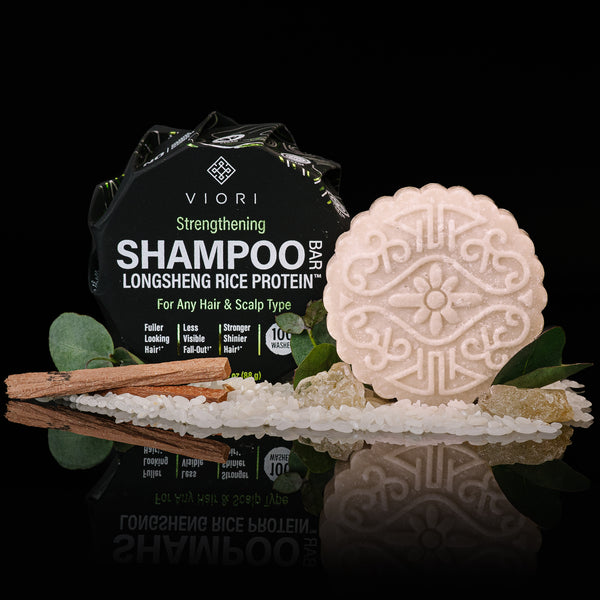
- Viori uses Longsheng Rice Water™ within a broader, pH-balanced system designed for repeatable results. Their formulas are also built to support hair softness, strength, shine, and scalp comfort without the DIY variability.
If You Still Want to Try Rice Paste, Do It Like a Pro
If you’re determined to experiment, treat rice paste like an occasional surface treatment, not your weekly “conditioning replacement.” This approach lowers the chance of buildup, stiffness, and friction-related breakage.
- Keep it off your scalp. Apply from mid-lengths to ends.
- Go thinner than you think. A watery, well-strained mixture is safer than a thick gluey paste.
- Don’t let it dry hard. Rinse before it sets into a stiff cast.
- Rinse longer than usual. Residue is the enemy of slip.
- Condition after. You want softness and glide to bring friction back down.
The Bottom Line
Rice paste isn’t inherently “good” or “bad.” It’s simply unpredictable. When it forms a smooth, flexible film and you remove it properly, it can boost slip, body, and shine. When it dries rigid, deposits unevenly, or lingers on the scalp, it can increase friction, tangling, and breakage.
If your goal is consistent softness, shine, and scalp-friendly performance, you’ll usually get more reliable results from a pH-balanced, rice-water-based routine-and that’s exactly why Viori’s Longsheng Rice Water™ approach tends to feel more stable than a DIY paste that changes every time you make it.


