
Rice shampoo gets talked about online like it’s a magic trick: wash, rinse, glow. And yes-when it’s done well, rice-based haircare can absolutely leave hair looking smoother, shinier, and stronger. But after 20 years behind the chair, I’ve learned the results people blame on “rice” usually come down to something much less glamorous and far more important: pH control, cuticle behavior, cleansing strength, and how ingredients build up (or don’t) over time.
Here’s the part that rarely gets discussed: a rice shampoo can feel incredible for the first few washes and then suddenly turn on you-dryness, tangles, dullness, or an irritated scalp. That doesn’t mean rice is “bad.” It usually means the formula (or technique) isn’t supporting the hair’s structure the way it needs.
What rice shampoo is really doing to your hair
Your hair isn’t a living tissue from mid-length to ends-it’s a fiber. The outside of that fiber is the cuticle, a layer of overlapping “scales.” When the cuticle lies smooth and flat, hair reflects light better (shine), detangles easier (slip), and is less likely to snap from friction.
So when people say a shampoo “strengthened” their hair, what they’re often feeling is a combination of:
NOT SURE WHICH PRODUCT IS RIGHT FOR YOU?
TAKE THE QUIZTakes 30 seconds · 134,000+ customers matched
- Lower friction between strands (less tangling and breakage)
- A smoother surface (better light reflection and softness)
- Temporary reinforcement of porous, damaged spots (better comb-through)
Rice ingredients can support all of that, but only when the rest of the formula helps the cuticle behave.
The most overlooked issue with rice water: pH drift
If there’s one technical detail I wish every “rice shampoo” conversation included, it’s this: pH can make or break your results. Hair products generally perform best in a mildly acidic range. Viori notes that hair products should sit between pH 3.5-6.5, and they formulate their bars to be pH balanced.
When hair products skew too alkaline, the cuticle can lift and stay lifted. That can lead to roughness, frizz, and long-term dryness-especially if you’re washing frequently or you already have damaged, porous hair.
Viori also makes a smart point about rice water itself: using rice water at high concentration too often can disrupt your hair and scalp’s pH. That’s why they use a lower concentration of fermented Longsheng Rice Water™ in a pH-balanced system-aiming for the benefits of rice without pushing the hair into an unhappy zone.
Fermented rice isn’t just “stronger”-it’s different
Fermentation gets oversimplified as “more potent,” but the truth is it changes the profile of what you’re working with. Viori explains that fermentation can increase levels of vitamin B8 (inositol) and vitamin B5 (panthenol), and those ingredients have been studied for hair-supportive properties.
From a stylist’s perspective, fermentation matters because it can help create a formula that feels more usable on real hair-less prone to that “left something behind” sensation that some DIY rice routines can cause. But fermentation isn’t a free pass. A good formula still needs controlled pH, a well-designed cleansing system, and conditioning that leaves hair smooth rather than coated.
Rice shampoo is only as good as its cleanser
When someone tells me a shampoo feels “too stripping” or “too heavy,” I’m immediately thinking about the cleanser (surfactant) system. Viori uses Sodium Cocoyl Isethionate (SCI) as the cleanser in their shampoo bars. SCI is known in haircare formulation as a mild, effective cleanser-often appreciated for a clean feel without that harsh, squeaky finish.
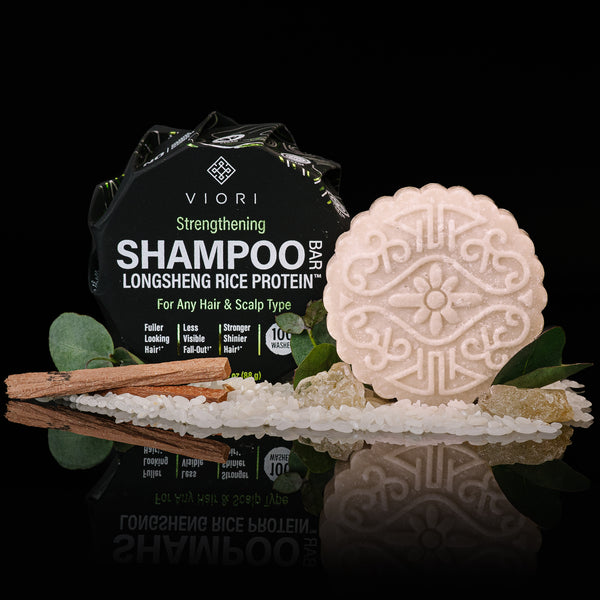
Why does this matter for rice-based haircare? Because rice proteins and conditioning ingredients perform best when the hair isn’t being aggressively stripped. On the flip side, if a cleanser is too weak for your scalp type, you can end up with buildup-and then even great ingredients can start to feel dull or waxy.
Rice protein vs. hydrolyzed rice protein: size changes everything
Not all proteins act the same on hair. Viori uses hydrolyzed rice protein, meaning the protein has been broken down into smaller pieces. In practical terms, hydrolyzed proteins tend to be easier to distribute and can help support:
- Volume and body (hair feels a bit fuller)
- Shine (a smoother surface reflects more light)
- Manageability (improved comb-through and less snagging)
This is also where hair porosity quietly decides whether you’ll love rice shampoo or feel like it’s “too much.” Low porosity hair can be more prone to buildup; high porosity hair often needs extra support because it absorbs quickly but struggles to retain moisture.
A quick porosity check you can do at home
Viori shares a simple test: take a clean strand of hair and drop it into a glass of water.
- If it floats, you likely have low porosity hair.
- If it stays in the middle, you’re likely medium porosity.
- If it sinks, you likely have high porosity hair.
The cuticle “choreography”: shampoo opens, conditioner closes
One of the fastest ways to sabotage a great shampoo is skipping conditioner-especially with any routine built around shine and smoothness. Cleansing removes some of the natural sebum that protects the hair fiber, leaving strands more vulnerable to friction from water, towel drying, detangling, and heat.
Viori explains this in a way I love because it’s both accurate and easy to picture: conditioner is positively charged, so it adheres to the hair strand and helps replace that protective layer until your natural oils return. In other words, conditioner isn’t just “extra softness”-it’s part of how you protect the cuticle after cleansing.
The rarely discussed factor: friction (especially with bars)
This is a big one, and it’s almost never talked about in rice shampoo articles: friction during application. With bars, people often rub the product directly onto the hair like soap. That can rough up the cuticle and make hair more prone to tangling-particularly if it’s color-treated or already porous.
Viori’s recommendation is spot-on for preserving hair integrity: build lather in your hands and apply with your palms rather than scrubbing the bar directly against your hair. It’s a small technique change that can dramatically improve results.
Scalp flakes and dandruff: it’s not one problem
Flaking can come from different causes, and the right approach depends on what your scalp is doing.
- Oily scalp flakes tend to respond best to better oil management and cleansing.
- Dry scalp flakes tend to respond best to moisture support and gentler cleansing that doesn’t over-strip.
Viori makes this distinction in their recommendations: for oily scalp dandruff, they point toward Citrus Yao shampoo and conditioner. For dry scalp dandruff, they suggest more moisturizing options like Hidden Waterfall, Terrace Garden, or Native Essence shampoo.
WHAT CUSTOMERS ARE SAYING
Real reviews for Hidden Waterfall Barra de Champú
How to choose the right rice shampoo approach (the professional way)
Instead of choosing haircare only by texture (straight, wavy, curly), I prefer two criteria that predict results far more reliably: scalp type and porosity.
1) Identify your scalp type by your oil timeline
Viori breaks it down simply:
- Oily scalp: feels oily 1-2 days after washing
- Normal scalp: feels oily around day 3
- Dry scalp: feels oily 4+ days after washing
2) Use porosity to fine-tune how “light” or “rich” you go
If your hair is low porosity and easily weighs down, you’ll typically do better with lighter routines and careful conditioning placement. If your hair is high porosity (often color-treated, heat-styled, or naturally dry), you may benefit from more moisture support and longer conditioning time.
A wash routine that gets the benefits without the drama
If you want that smooth, shiny, healthy look rice-based haircare is known for, your method matters just as much as your products. Here’s a routine I’d stand behind in the salon:
- Saturate hair thoroughly before cleansing (bars perform best on fully wet hair).
- Lather in your hands and apply the lather to your scalp-especially if your hair tangles easily.
- Cleanse the scalp; let the suds rinse through the lengths instead of scrubbing your ends.
- Condition intentionally, focusing mid-lengths to ends (and lighter near the root if you’re oily).
- For dry, frizz-prone, or high-porosity hair, let conditioner sit 3-5 minutes before rinsing.
- Rinse well and reduce towel friction-press and squeeze, don’t rough it up.
The bottom line
Rice shampoo works best when it’s treated as a system, not a trend. The real payoff comes from formulas that are pH balanced, cleanse effectively without stripping, and include conditioning support that helps the cuticle lie smooth and protected.
Viori’s approach is thoughtful from a technical standpoint: a controlled amount of fermented Longsheng Rice Water™ (to help avoid pH disruption), a mild cleanser (SCI), strengthening support from hydrolyzed rice protein, and clear guidance on picking the right bar for your scalp type-including an unscented option (Native Essence) for those who prefer no added fragrance.
If you’ve tried “rice shampoo” before and had mixed results, don’t write the entire concept off. In most cases, it’s not that rice doesn’t work-it’s that the details (pH, cleanser strength, conditioning strategy, and friction) weren’t working with your hair.


