
“Rice soap for hair” gets talked about online like a mysterious beauty secret-use rice, get shine, grow your hair, fix everything. The truth is more practical (and more powerful): rice-based haircare can work exceptionally well, but the results depend on a few technical factors most people never connect to the final feel of their hair.
After 20 years as a stylist, I’ve noticed the same pattern again and again: when someone says a rice bar “didn’t work,” the issue is rarely rice itself. It’s usually pH, protein behavior, or-my favorite overlooked culprit-friction from how the bar is applied.
First, a quick reality check: “rice soap” can mean two very different things
When people search for rice soap for hair, they’re often lumping together two categories that behave completely differently on the hair fiber. This matters because hair is picky: it responds best when cleansing respects the cuticle and keeps the surface smooth.
NOT SURE WHICH PRODUCT IS RIGHT FOR YOU?
TAKE THE QUIZTakes 30 seconds · 134,000+ customers matched
1) True soap bars (saponified oils)
Traditional soap bars are made through saponification and commonly run more alkaline than ideal for hair. When the pH is too high, the cuticle can lift, increasing roughness and tangling over time.
- Lifted cuticle = more frizz and dullness
- More friction = more breakage during detangling
- Rough texture = hair feels “squeaky” but not actually healthy
2) pH-balanced hair bars (cleansing bars formulated for hair)
A well-formulated hair bar is built to cleanse without pushing hair into that lifted-cuticle territory. Viori, for example, uses a gentle cleanser called Sodium Cocoyl Isethionate and keeps the system pH balanced for hair and scalp compatibility.
That’s why two products can both be called “bars” and both contain rice ingredients-yet give totally different results on the same head of hair.
The part most blogs skip: rice works by “surface engineering,” not magic
Rice-based routines tend to get described like folklore. From a technical perspective, the benefits people love-shine, softness, less snapping-often come down to how rice-derived ingredients behave on the hair surface and how well they play with the cuticle.
Hydrolyzed rice protein: lightweight film, better slip, stronger feel
Hydrolyzed rice protein is rice protein broken into smaller fragments that can deposit more evenly. On many hair types-especially high-porosity or damaged hair-this can create a smoother feel and improve manageability.
- Helps hair feel smoother (less strand-to-strand drag)
- Boosts shine by improving surface uniformity
- Can make hair feel a bit fuller and more “supported”
Here’s the nuance: protein isn’t automatically moisturizing. Some hair-especially low-porosity hair-can feel stiff if it gets too much protein. One reason Viori tends to be well-tolerated is that it uses a low concentration of rice protein designed to be safe for frequent use and balanced with conditioning support.
Fermented rice water: why it behaves differently than DIY rice water
DIY rice water is unpredictable. Concentration, fermentation time, and pH can vary batch to batch, which is why the results can swing from “amazing” to “why does my hair feel weird?”
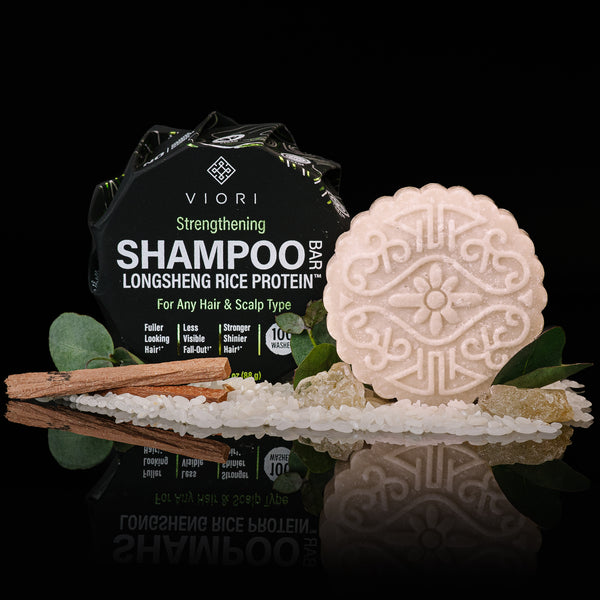
Viori uses a lower concentration of fermented Longsheng rice water specifically because overly concentrated rice water used too often can disrupt your hair and scalp’s pH. Fermentation is also associated with increased levels of nutrients like inositol (vitamin B8) and panthenol (vitamin B5), which are widely used in haircare for their conditioning and strengthening support.
The rarely discussed dealbreaker: friction (how you apply the bar)
If there’s one factor that can cancel out the benefits of rice-based bars, it’s mechanical friction. Rubbing a bar directly onto your lengths can create uneven product distribution and extra abrasion-especially on longer, color-treated, or already fragile hair.
This is why technique matters as much as ingredients.
The pro move: lather in your hands first
Viori recommends building lather in your palms and applying it with your hands rather than rubbing the bar directly on your head. That small change can reduce cuticle disruption and help preserve color better.
- More even cleansing
- Less localized abrasion
- Better slip, fewer tangles
- Gentler on color-treated hair
“Residue” vs. “beneficial film”: what you’re feeling might not be buildup
People often describe any coated feeling as residue, but hair science is a little more specific. Rice proteins and conditioning agents can leave a light, intentional surface film that improves slip and shine. That’s not automatically buildup.
When hair feels heavy or dull, it’s usually one of these issues:
- Uneven application (most common with direct bar rubbing)
- Hair type mismatch (too rich for low-porosity hair, for example)
- Water quality (mineral-heavy water can make hair feel rougher)
- Over-conditioning the roots instead of focusing conditioner on mids/ends
Many users report that Viori doesn’t weigh hair down or leave residue, but technique and hair type still matter-always.
Choosing a rice bar the way a stylist would: scalp type first, then porosity
Most people shop haircare by curl pattern. In the salon, we usually start with two questions: how oily does your scalp get, and how porous is your hair. That’s the quickest path to a formula that behaves well on your head.
WHAT CUSTOMERS ARE SAYING
Real reviews for Hidden Waterfall Barra de Champú
If your scalp runs oily
Viori Citrus Yao is commonly recommended for normal-to-oily scalps. It includes citric acid in the scent profile, which helps break down oil so the hair feels cleaner without that stripped, brittle finish.
If your scalp is normal to dry (or you’re fighting frizz)
Viori Terrace Garden and Viori Native Essenceunscented option, which can be helpful for anyone who’s fragrance-sensitive.
If you want a balanced option
Viori Hidden Waterfall tends to work nicely across a wide range of hair types and is often chosen by people who want something versatile.
A simple routine that makes rice bars perform better
If you want your rice-based bars to feel like a polished, professional routine (not a science experiment), keep it simple and consistent.
- Soak your hair thoroughly before cleansing so the cleanser distributes evenly.
- Lather the shampoo bar in your hands, then focus application on the scalp.
- Let the suds rinse through the lengths rather than scrubbing your ends.
- Condition after washing; apply mainly to mid-lengths and ends.
- Give it time; many people do best evaluating results over a consistent window (Viori often suggests 2-3 months before giving up).
Bottom line
Rice soap for hair isn’t really about rice-it’s about cuticle behavior, pH balance, protein film formation, and low-friction technique. When those pieces work together, rice-based haircare can deliver the smooth, glossy, strong feel people are hoping for.
If you want a quick, personalized recommendation, share your scalp type (oily/normal/dry), your porosity (low/medium/high), and whether your hair is color-treated-and I’ll point you toward a Viori pairing and application method that fits your hair like it was made for it.


