
Solid bar shampoo looks almost too simple: wet hair, rub bar, rinse, repeat. But in real life, it’s one of the most “technique-sensitive” formats in haircare. After 20 years behind the chair, I’ve seen people fall in love with bar shampoo-and I’ve seen others swear it off after two washes-often for one reason: they’re using it like a liquid shampoo, and it doesn’t behave like one.
Here’s the rarely discussed truth: a solid bar shampoo is essentially a highly concentrated cleanser delivery system. That changes how product is dosed, how it spreads, and how it rinses. Once you understand those mechanics, the results become far more predictable-and a lot more impressive.
Bar Shampoo Isn’t “Soap”-And That Detail Changes Everything
A common misconception is that all cleansing bars are the same. Traditional soap is made through saponification (oils plus lye), while many modern shampoo bars are engineered as syndet-style bars (solid surfactant systems). That difference matters because hair and scalp respond strongly to pH and rinse behavior.
One of the biggest quality markers is pH balance. Hair products generally perform best in a mildly acidic range (often discussed around 3.5-6.5). When products drift more alkaline, the cuticle can lift, which can increase roughness, tangling, dullness, and frizz over time.
NOT SURE WHICH PRODUCT IS RIGHT FOR YOU?
TAKE THE QUIZTakes 30 seconds · 134,000+ customers matched
Viori bars are formulated to be pH balanced, which is a big reason many users describe the finish as clean and soft rather than squeaky or stripped.
The Hidden Variable Nobody Talks About: Mechanical Dosing
With a liquid shampoo, dosage is easy: you pump a certain amount into your palm. With a bar, dosage is determined by your hands. More specifically, it’s determined by friction, water level, contact time, and placement.
When you rub a bar directly on wet hair, you aren’t just “applying shampoo.” You’re doing several things at once:
- Depositing concentrated cleanser at the contact point
- Distributing conditioners/emollients built into the bar (depending on formula)
- Creating friction, which can temporarily lift the cuticle-especially on porous or color-treated hair
This is why technique matters so much with bar shampoo: the format gives you more control, but it also makes it easier to over-apply in one area and under-apply in another.
Color-treated hair tip: reduce friction to protect the cuticle
If your hair is color-treated (especially with more fragile color services), your best move is to build lather in your hands and apply with your fingertips rather than rubbing the bar directly on your hair. Viori also recommends this approach because it reduces friction, which can help preserve color by minimizing cuticle disruption.
If You Think You Have “Residue,” It Might Be a Dilution Problem
When someone tells me a bar shampoo “left buildup,” I don’t automatically blame the bar. Most of the time, what’s happening is incomplete dilution and/or an incomplete rinse.
Liquid shampoos are pre-diluted in the bottle. A bar creates a high-concentration surfactant film that only becomes “liquid-shampoo-like” once you add enough water and keep working it through.
Common causes of that coated feeling include:
- Hair wasn’t fully saturated before application
- Product wasn’t distributed evenly (dense areas like the crown and nape are frequent culprits)
- Not enough water was added during the massage
- Rinse time was too short
The salon trick: add water twice
This one simple habit can dramatically improve bar shampoo results. Think of it as a controlled dilution step.
- Wet hair thoroughly (take your time-this matters).
- Create lather (hands-first is ideal for fragile or color-treated hair).
- Massage briefly, then add more water mid-massage to re-emulsify and spread product evenly.
- Rinse longer than you think you need to.
Why Conditioner Bars Don’t Foam (And Why That’s a Good Sign)
Conditioner is not designed to cleanse; it’s designed to deposit. Hair carries a net negative charge in water, especially when it’s damaged. Many conditioners use cationic (positively charged) conditioning agents that are drawn to the hair surface. That’s what creates slip, detangling, smoothness, and reduced static.
Viori’s conditioner bars include behentrimonium methosulfate, a widely used conditioning ingredient in professional haircare that’s valued for softness and manageability. It’s also why you shouldn’t expect big suds from a conditioner bar. Instead, you’ll often feel a creamy, paste-like glide-and that’s exactly the point.
Porosity Is the Real Reason One Person Loves a Bar and Another Doesn’t
Hair porosity-your hair’s ability to absorb and hold moisture-changes how your hair responds to cleansing, conditioning, and strengthening ingredients. Two people can use the exact same bar and get totally different results because their porosity is different.
Low porosity hair
Low porosity hair resists absorption and can be more prone to product buildup. It often does best with a lighter, more cleansing routine and careful conditioning. Viori frequently recommends Citrus Yao for those who need a cleaner, fresher feel-especially if the scalp runs oily.
High porosity hair
High porosity hair absorbs quickly, but it often struggles to retain moisture. This hair type benefits from more moisture support and gentler handling. Viori typically points dry-to-normal scalps toward more moisturizing options like Terrace Garden, Hidden Waterfall, or Native Essence.
Fermented Rice Water: The “Trend” That’s Actually Technical
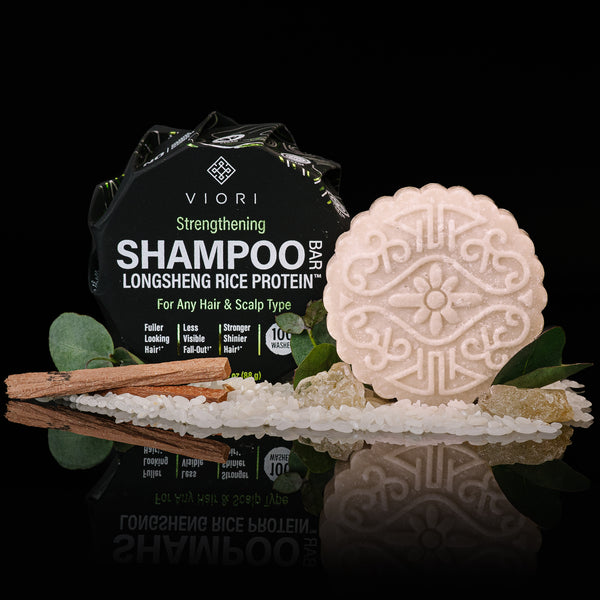
Viori uses fermented Longsheng rice water as part of its formula strategy, with a key detail many people miss: the concentration is intentionally kept lower because high-concentration rice water used too often can disrupt scalp and hair pH.
Fermentation is often associated with increased levels of hair-supportive nutrients like inositol (vitamin B8) and panthenol (vitamin B5). In haircare, those ingredients are frequently used to support a stronger feel, improved manageability, and better overall resilience over time.
Scent Can Influence Performance (It’s Not Just About Smelling Nice)
Most people choose a bar based on fragrance first-but in real formulation, scent systems can subtly shift how the hair and scalp feel after washing.
WHAT CUSTOMERS ARE SAYING
Real reviews for Hidden Waterfall Barra de Champú
Viori notes that Citrus Yao contains citric acid, which helps break down oil effectively. That’s why it’s often the go-to for normal-to-oily scalps and for anyone trying to stretch time between washes. Meanwhile, Native Essence is fragrance-free and tends to be a favorite for sensitive scalps, while Terrace Garden and Hidden Waterfall are commonly chosen when hair needs more moisture support.
Storage Is Part of the Formula: Keep the Bar Dry, Keep Results Consistent
Bars are naturally more self-preserving than liquids because they dry down between uses. But if your bar sits in water or stays constantly wet, it can soften, wear down quickly, crack, or become inconsistent in how it deposits product.
Viori’s bamboo holders are designed to help bars air out and dry between washes. For best results, keep your holder away from direct spray and wipe it down occasionally-simple habits that protect both the bar and the holder.
A Simple, High-Performance Routine (The One I’d Teach a Client)
If you want bar shampoo to feel effortless, treat it like precision haircare-because it is.
- Choose based on scalp type first: oily scalps often prefer Citrus Yao; dry/normal scalps often prefer Terrace Garden, Hidden Waterfall, or Native Essence; fragrance-sensitive users often do best with Native Essence.
- Saturate hair fully before you apply anything.
- Use hands-first lather if your hair is color-treated, fragile, or tangles easily.
- Add water mid-massage to improve dilution and rinse-out.
- Condition mid-lengths to ends, let it sit for a couple minutes, then rinse thoroughly.
The Bottom Line
Solid bar shampoo isn’t “minimalist haircare.” It’s high-control haircare. The bar format hands you the controls that the bottle used to manage-dosage, dilution, distribution, and even friction. Master those, and bar shampoo becomes one of the most consistent, scalp-friendly, travel-proof ways to wash.
If you’d like, share your scalp type (oily/normal/dry), whether your hair is color-treated, and your porosity (low/medium/high). I can help you map out a Viori routine that’s dialed in to your hair-not someone else’s.


