
When people say “bamboo hair bar,” most of the conversation stops at sustainability-less plastic, a cleaner-looking shower, and a more minimalist routine. All of that can be true. But in the salon, I’ve seen something else decide whether someone sticks with hair bars long-term: the science of how the bar, the bamboo, and your shower environment interact.
In other words, the “bamboo” part isn’t just decoration. It can change how fast your bar dries, how long it lasts, how it feels on the hair, and even whether your holder ends up with mildew. Once you understand that, using a hair bar-especially a thoughtfully formulated one like Viori-gets a whole lot easier (and far more consistent).
First, what does “bamboo hair bar” actually mean?
This phrase gets used a few different ways, and mixing them up is where a lot of frustration starts. In real life, “bamboo hair bar” typically points to one (or more) of these ideas:
- A hair bar stored on a bamboo holder (the most common meaning)
- A bar formulated with bamboo extract (more about hair/scalp benefits)
- A bar with bamboo-inspired design or story (more about the experience-scent, motifs, ritual)
All three can matter, but if you’re troubleshooting issues like a mushy bar, fast wear, or that “something feels off” moment, the most important factor is usually storage and drying.
NOT SURE WHICH PRODUCT IS RIGHT FOR YOU?
TAKE THE QUIZTakes 30 seconds · 134,000+ customers matched
The rarely discussed truth: your bamboo holder controls longevity
Most people blame the bar when it gets soft, crumbly, or seems to disappear too quickly. But the biggest variable is almost always the same: how long the bar stays wet between washes.
Failure mode #1: the bar never fully dries
If your bar sits in a puddle, stays tacky, or lives in constant steam, it stays partially hydrated. That changes the bar’s structure and makes it dissolve faster with every use. Eventually, you may also see early crumbling.
With hair bars, a little breaking near the end of the bar’s life can be normal-many bars naturally start to break once they get quite thin. What’s not normal is a bar turning soft and fragile early on, and that almost always traces back to perpetual moisture exposure.
Failure mode #2: the bamboo stays damp and starts to mildew
Bamboo is a plant material. When it’s left untreated (which is common in eco-minded designs), it needs a bit more care. Not because it’s “bad,” but because it can hold moisture-and moisture invites problems.
Viori’s bamboo holders are designed to let bars air out and dry between uses, which helps prevent disintegration and reduces mold risk. But placement matters just as much as design.
The shower microclimate: what’s sabotaging your bar
This is the part almost nobody talks about: your shower is a microclimate. Even if your bar never gets hit directly by water, the combination of humidity, heat, and lingering steam can keep it from drying properly.
To get reliable performance, you want to improve what I think of as the bar’s drying kinetics-how quickly it returns to a hard, stable state between uses.
- Keep the holder out of the direct spray zone.
- Avoid placing it high up where steam collects (remember: heat rises).
- Make sure air can move under and around the holder.
- Don’t park the holder on a flat ledge where water pools.
That one adjustment-better airflow and less constant humidity-often makes a hair bar feel “expensive” instead of finicky.
Why Viori shampoo bars feel different (in a good way)
A shampoo bar isn’t simply bottled shampoo without the water. It’s a solid system, so it behaves differently during application and requires slightly different technique.
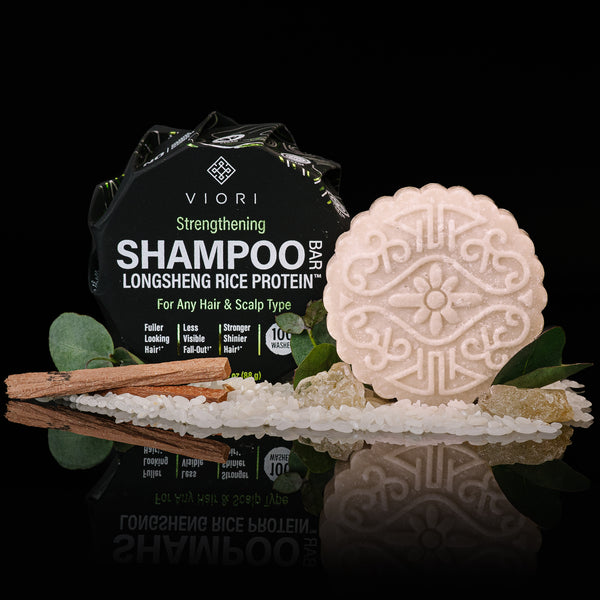
Viori uses Sodium Cocoyl Isethionate (SCI) as the cleanser in their shampoo bars. In the professional world, SCI is known as a milder cleansing option that still produces satisfying foam. That balance matters because overly harsh cleansing can leave hair feeling rough and the scalp feeling reactive.
Another detail that matters more than most people realize is pH balance. Hair and scalp generally do best within a moderately acidic-to-near-neutral range. When products skew too alkaline, the cuticle can lift more easily-leading to roughness, frizz, tangling, and quicker color fade over time. Viori emphasizes pH-balanced formulations, which supports smoother cuticle behavior with repeated use.
The color-treated hair trap: it’s often friction, not the formula
If you’re color-treated, technique matters. A common mistake is scrubbing the bar directly onto the hair and scalp like you’re sanding something clean. That mechanical friction can lift the cuticle and create unnecessary wear on the hair shaft.
Viori recommends a color-friendlier approach that I also prefer in the salon: build lather in your hands and apply with your palms, instead of rubbing the bar directly on your head.
It’s a small change, but it’s one of the quickest ways to improve feel, reduce tangling, and help protect your color.
Conditioner bars don’t “lather” like shampoo-and that’s the point
If you’re expecting a conditioner bar to foam, it can feel confusing at first. Shampoo bars lather because they contain a cleanser designed to foam. Conditioner bars are built around ingredients that deposit and smooth, so what you’ll usually see is more of a creamy, paste-like slip.
Viori explains this clearly: the conditioner isn’t meant to be sudsy. It’s meant to coat the hair, improve glide, and support overall scalp and strand comfort.
My best advice is simple: apply thoroughly from mid-lengths to ends, let it sit a couple of minutes, then rinse well. Most people get better results when they slow down slightly and give the conditioner time to “settle” onto the hair.
WHAT CUSTOMERS ARE SAYING
Real reviews for Hidden Waterfall Barra de Champú
The scalp angle people miss: flakes aren’t always “oily dandruff”
Not all flakes come from excess oil. A lot of “dandruff complaints” I hear are actually dryness and irritation-often made worse by over-cleansing or using products that don’t support the scalp barrier.
Viori’s recommendations account for that difference:
- For oily scalp dandruff, Viori often recommends Citrus Yao shampoo and conditioner.
- For dry scalp dandruff, Viori often recommends more moisturizing options like Hidden Waterfall, Terrace Garden, or Native Essence shampoo.
- For the very common combo of oily scalp + dry ends, a split routine can help: use Citrus Yao shampoo at the scalp and a more moisturizing conditioner on the ends.
That “treat the scalp and ends differently” strategy is one of the most salon-consistent ways to get balanced, predictable hair.
A simple, technically correct bamboo hair bar routine
If you want the clean, soft, lightweight results hair bar users rave about, keep it straightforward and focus on the system.
- Shampoo: Lather the Viori shampoo bar in your hands first, then apply to the scalp and roots.
- Condition: Apply the Viori conditioner bar through mid-lengths and ends; let it sit briefly before rinsing.
- Dry the bars: Store each bar on its own bamboo holder so it can fully air out (Viori recommends one bar per holder).
- Place smart: Keep holders out of direct spray and away from the steamiest zones of the shower.
- Maintain bamboo: Wipe the holder down occasionally; if your bathroom runs humid, consider curing it as Viori suggests to help prevent moisture problems.
The real takeaway
A bamboo hair bar routine isn’t just a product swap-it’s a move to a solid-state haircare system. When the bar is well-formulated and pH balanced, when your technique minimizes friction, and when bamboo storage allows full drying, the results can feel surprisingly professional: clean scalp, soft lengths, less residue, and a bar that actually lasts.
If you’d like, share your hair type (fine/coarse, straight/wavy/curly), scalp pattern (oily by day 1-2 vs day 4+), and whether you color your hair. I can help you choose the best-fitting Viori bars and the ideal bamboo holder placement for your specific shower setup.


