
If you’ve ever left the salon with rich, glossy color and then watched it turn dull, brassy, or “off” after a handful of washes, you’re not imagining it. Color-treated hair behaves differently-because the hair fiber itself has changed. And the real secret to keeping color looking expensive isn’t just buying something labeled “color-safe.” It’s choosing (and using) a cleanser that protects the cuticle day after day.
After 20 years behind the chair, here’s the most honest way I can put it: the best professional shampoo for color-treated hair is the one that manages cuticle lift, swelling, friction, and scalp oil without pushing you into harsher washing habits. Most advice online focuses on ingredients in isolation. What matters more is the full system-your scalp type, your color type, your technique, and whether your shampoo leaves the hair surface smooth or rough over time.
Why color fades (it’s more “hair physics” than people realize)
Color loss isn’t just about “strong shampoo.” It’s about what repeated washing does to a porous, processed fiber. Each wash is a combination of water exposure, cleansing chemistry, and mechanical action-and all three can speed fading if they’re not handled well.
1) Cuticle lift and swelling create the escape route
When hair gets wet, it swells. If a cleanser leaves hair in a more alkaline state, the cuticle tends to lift more, and that increased permeability makes it easier for color molecules to migrate out. This is one reason pH balance is so important for color-treated hair: keeping the environment hair-friendly supports a tighter, smoother cuticle over time.
NOT SURE WHICH PRODUCT IS RIGHT FOR YOU?
TAKE THE QUIZTakes 30 seconds · 134,000+ customers matched
Viori bars are formulated to be pH balanced, which is one of those details that doesn’t sound exciting until you realize how directly it impacts the feel, shine, and longevity of color-treated hair.
2) “Clean” isn’t the same as “compatible”
There’s a kind of clean that’s great for an oily scalp-and a kind of clean that quietly wrecks color-treated lengths. If shampoo removes too much sebum and too many surface lipids, hair can feel squeaky, tangle more easily, and look dull faster. Even when pigment loss is minimal, a rougher surface scatters light, so the color reads flatter and less vibrant.
Viori uses Sodium Cocoyl Isethionate (SCI) as the cleanser in its shampoo bars. In professional terms, SCI is widely considered an effective cleanser that can still feel relatively mild-an important balance for hair that’s been colored, lightened, or chemically treated.
3) The factor almost nobody talks about: friction
If there’s one color-fading accelerant that’s consistently underestimated, it’s friction. Aggressive scrubbing, rough detangling, and harsh towel drying all create tiny amounts of cuticle wear. Over time, that wear adds up-and it shows as fading, dullness, and a change in tone.
This becomes especially important with shampoo bars. They can be amazing, but they also tempt people into rubbing the bar directly onto the hair-basically “scrubbing” the cuticle.
Viori’s guidance here is spot-on: for color-treated hair, it’s smarter to build lather in your hands and apply with your fingertips rather than rubbing the bar on your head. That one change can make a noticeable difference in how long your color stays fresh.
The most “professional” thing your shampoo can do: manage surface feel and charge
Here’s a salon truth that rarely makes it into generic haircare articles: after cleansing, especially on processed hair, the fiber can be left more negatively charged and more prone to tangling. More tangles mean more force during detangling, and more force means more friction damage-right when hair is weakest (wet).
That’s why a pro-quality routine doesn’t treat shampoo like a stand-alone product. Shampoo is step one, and the second step matters just as much.
Viori explains this in a way I actually appreciate: conditioner is positively charged, so it adheres to the strands and helps replace some of the protective “buffer” that washing removes. In plain terms, conditioner improves slip, reduces friction, and helps hair feel smoother-which supports better-looking color.
Choose based on scalp type (yes, even when your hair is colored)
One of the biggest mistakes I see is people buying a “color shampoo” and ignoring their scalp. Your scalp oil level controls how often you wash, how hard you scrub, and whether you end up doing multiple lathers. And every extra lather is another round of swelling, rinsing, and friction.
If your scalp is oily (greasy in 1-2 days): you need an option that breaks down oil efficiently so you don’t have to scrub harder. Viori typically recommends Citrus Yao for normal-to-oily hair types, and notes it contains citric acid, which helps break down oil and may extend time between washes.
If your scalp is dry/normal (comfortable for 3-5+ days): you’ll usually do best with a more moisturizing approach. Viori often points to Terrace Garden, Hidden Waterfall, or Native Essence for dry-to-normal scalp types.
If you’re sensitive to fragrance or easily irritated: keeping things simple is often the win. Native Essence is Viori’s unscented option and is positioned as the gentlest choice for sensitive scalps.
A reality check: your color formula can be the limiting factor
Not all “color-treated hair” is the same. Permanent color tends to be more resilient in the hair fiber, while toners and many semi-permanent options can be more vulnerable to washing, heat, and friction-especially on porous hair. If your color lives closer to the cuticle, anything that repeatedly lifts or abrades the cuticle can shift tone faster.
Viori notes that results can depend on the type and quality of color used, and they also point out that bar friction can open the cuticle and let color out-another reason the hand-lather method matters so much for preserving color.
How to wash with a shampoo bar like a pro (color-safe technique)
If you take nothing else from this post, take this: the “best professional shampoo” can’t out-perform rough technique. If you want your color to stay richer longer, make your wash day gentler and more consistent.
Soak thoroughly before cleansing (60-90 seconds). Fully saturated hair cleans faster, with less rubbing.
Lather in your hands first. Wet the bar, build lather in your palms, then apply to the scalp-don’t scrub the bar directly onto color-treated lengths.
Cleanse the scalp; let the suds rinse through the ends. Ends are older, more porous, and give up tone faster. Treat them gently.
Condition every wash. Focus on mid-lengths to ends. Slip is your cuticle’s best friend.
Rinse cooler than you think. Cooler water supports smoother cuticle behavior and better shine (which keeps color looking vibrant).
Detangle with care. Wet hair is delicate. Use a wide-tooth comb and take your time.
So what’s the “best” professional shampoo for color-treated hair?
The best option is the one that keeps the cuticle calm and the routine sustainable: pH balanced, effective without stripping, and paired with conditioning that reduces friction and tangling. Add in a technique that avoids scrubbing your lengths, and you’ll keep your color looking fresher-not just for a week, but between appointments.
WHAT CUSTOMERS ARE SAYING
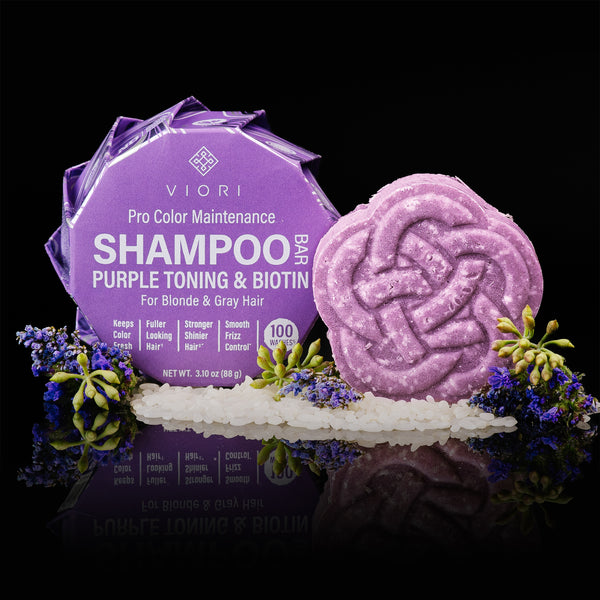
Real reviews for Purple Shampoo Bar with Biotin – Blonde & Gray | VIORI
If you want help dialing in a routine, start with your scalp type (oily, normal, or dry), then choose the Viori bar that matches that reality-and commit to the hand-lather method. It’s simple, it’s professional, and it’s one of the fastest ways to protect your investment in color.


