
After two decades styling hair and testing countless products, I've learned something that might surprise you: the "smartest" shampoo isn't the one with the most scientific-sounding ingredients list or the sleekest lab-created formula.
The most intelligent hair care actually comes from understanding chemistry so deeply that you can work with your hair's biology rather than against it. And sometimes, that means looking backward to ancient techniques that modern labs are only beginning to understand.
Today, I want to share what I've discovered about truly clever hair care-the kind that uses biological intelligence to solve problems that synthetic chemistry often makes worse. This is the technical deep-dive you won't find in typical beauty blogs, and it explains why some hair products work on a fundamentally different level.
The pH Paradox: Smart Chemistry Vs. Static Chemistry
Let's start with something every hair care article mentions: pH balance. You've heard it a thousand times-hair's natural pH is around 4.5-5.0, slightly acidic, and shampoos should match this to keep cuticles smooth and sealed.
That's absolutely true. But here's what most sources don't tell you: there's a massive difference between static pH and dynamic pH systems.
Most shampoos are formulated to a specific pH number-let's say 5.5. They measure that number in the lab, bottle it, and ship it. Done. The problem? That's a fixed measurement that doesn't adapt to what your specific hair needs at that specific moment.
The Fermentation Difference
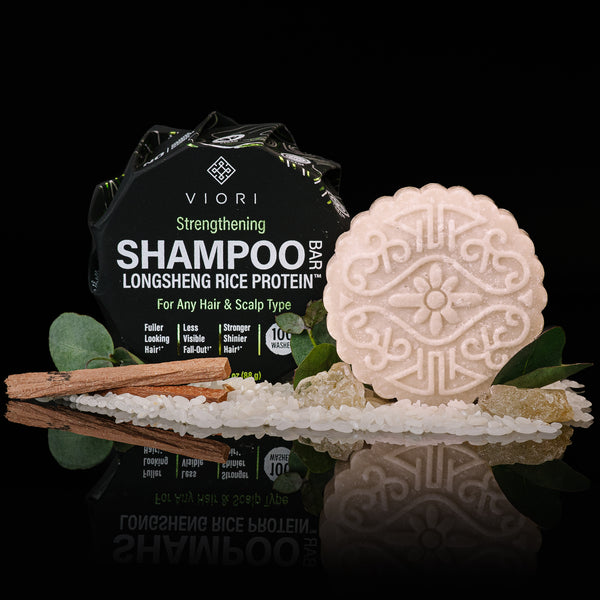
Here's where traditional fermentation techniques get genuinely clever. When rice undergoes fermentation-the ancient method used by the Red Yao women of Longsheng, China, and the foundation of Viori's formula-something remarkable happens at the molecular level.
The fermentation process (7-10 days for traditional rice water) creates:
- Lactic acid - A gentle, weak acid that provides sustained acidity without harsh spikes
- Amino acids from protein breakdown - These function as amphoteric compounds, meaning they can act as either acids OR bases depending on what's needed
- Inositol (Vitamin B8) - Released through fermentation with unique binding properties to hair keratin
This combination creates what chemists call a buffering system-a dynamic pH that can adjust on the fly.
NOT SURE WHICH PRODUCT IS RIGHT FOR YOU?
TAKE THE QUIZTakes 30 seconds · 134,000+ customers matched
Think of it this way: If your hair is too alkaline (opened cuticles from hard water, chemical treatments, or environmental damage), the fermented rice water system donates acidity to lower the pH. If your hair is too acidic (over-treated with acidic products), the amino acids can buffer upward, providing balance.
This is molecular intelligence. The formula reads what your hair needs and responds accordingly, something a static pH measurement simply cannot do.
It's the difference between a thermostat that adjusts to the room temperature versus a heater that's either fully on or fully off. Both might reach the same temperature eventually, but one does it with finesse while the other causes uncomfortable fluctuations.
The Protein Gradient: Why Fermentation Creates Superior Conditioning
Every professional stylist knows about the protein-moisture balance. It's the delicate dance we're constantly managing: too much protein makes hair brittle and straw-like, too little leaves it weak and prone to breakage.
Most shampoos address this with hydrolyzed proteins-proteins that have been chemically or enzymatically broken down into smaller pieces that can penetrate the hair shaft.
That works, but here's what makes fermentation-based approaches fundamentally different:
Natural Enzyme Action Creates a Spectrum
When rice ferments naturally, the enzymes don't just break proteins down-they create a complete spectrum of molecular weights:
- Large rice proteins (50-100 kDa) that coat and protect the hair surface
- Medium peptides (5-20 kDa) that penetrate into the cuticle layers
- Small amino acids (< 1 kDa) that can reach the hair's inner cortex
This means your hair receives three levels of treatment simultaneously:
- Surface protection from the large proteins forming a shield
- Mid-shaft reinforcement from medium peptides filling gaps in the cuticle layer
- Deep conditioning from tiny amino acids reaching the core structure
Compare this to synthetic hydrolyzed rice protein, which is typically processed to a uniform molecular weight-usually 1.5-3 kDa for cosmetic applications. This gives consistent penetration at one level, but it lacks the multi-dimensional protection and conditioning.
It's the difference between a shotgun blast and a precision smart bomb. The fermented version self-distributes across all of hair's structural layers because it naturally contains the full range. The synthetic version requires formulators to add multiple different protein types at different weights-and they're essentially guessing at the ideal ratios.
Nature already figured out the perfect ratio over thousands of years of natural fermentation.
The Sebum Mimicry Most Formulators Completely Miss
Here's a technical angle that beauty blogs almost never cover, but it explains something I see constantly in my salon: why some people struggle intensely when transitioning from conventional to natural products, while others glide through effortlessly.
The answer lies in sebum mimicry through fatty acid profiles.
Understanding the Conventional Shampoo Cycle
Most commercial shampoos follow this pattern:
- Harsh sulfates (SLS, SLES) completely strip away your scalp's natural sebum
- Silicones (dimethicone, cyclomethicone) replace that sebum with synthetic coating
- Synthetic conditioners (quaternium compounds) provide artificial slip and softness
Your scalp isn't passive in this process-it adapts to what you're doing. When you consistently strip away all the sebum, your scalp responds by either:
- Overproducing oil to compensate (leading to greasy hair that "needs" daily washing)
- Underproducing oil because the signaling gets disrupted (resulting in dry, flaky scalp despite heavy conditioning)
Both outcomes trap you in a cycle of dependency on the products causing the problem.
The Biological Communication Solution
The truly clever approach isn't just avoiding sulfates and silicones (though that's important). It's providing fatty acids that match your natural sebum composition so your scalp can recalibrate its own production.
This is where rice bran oil becomes fascinating. Its fatty acid profile closely mirrors human sebum-and that similarity isn't just academically interesting, it's functionally critical. When you apply fatty acids that closely match what your scalp naturally produces, you're essentially speaking your skin's language.
But there's an even more sophisticated mechanism at work: Rice bran contains gamma-oryzanol, a compound that appears to regulate sebum production through pathways scientists are still studying. Early research suggests it may affect 5-alpha reductase activity-the same enzymatic pathway involved in hormonal hair loss.
This might explain why Viori users frequently report:
- Reduced oiliness without experiencing dryness
- Improved scalp condition overall
- Decreased hair shedding over time
This is biological communication, not just surface-level cosmetic coating. The product is actually signaling to your sebaceous glands, helping them recalibrate to healthy production levels rather than just masking the problem.
Silicones can't do this because they're inert coatings-they don't communicate with your skin's biology, they just sit on top of it.
The Cuticle Closure Mechanism That Goes Deeper Than You Think
Most people understand the basics: acidic pH closes cuticles for shiny hair, alkaline pH opens them causing dullness. That's Hair Care 101.
But this oversimplification misses the truly sophisticated approach to cuticle management, and it's worth understanding because it explains why some products make hair feel better while others make hair actually become healthier over time.
Beyond Surface Conditioning
Look at Viori's conditioner bars, which contain Behentrimonium Methosulfate (BTMS)-a cationic (positively charged) conditioning agent. This is standard technology: hair carries a negative charge, especially when damaged, so positively charged ingredients are attracted to those negative sites. That's why BTMS is in virtually every conditioner on the market.
But here's what makes fermentation-based formulations work differently: they combine these cationic conditioners with inositol from the fermentation process.
Inositol has a unique property that distinguishes it from typical conditioning agents: it doesn't just bind to the hair's surface-it actually incorporates into the cell membrane complex (CMC) between cuticle cells.
The CMC is essentially the "mortar" between the "bricks" of cuticle cells. When this structure is damaged-from heat styling, chemical processing, environmental stress-it creates microscopic gaps. These gaps allow moisture to escape from inside the hair and allow the cuticle layers to lift and separate.
Standard synthetic conditioners coat the outside of cuticles, smoothing them temporarily.
Inositol reinforces the spaces between cuticle cells, providing structural repair that persists even after the surface coating wears away.
This is why users often report that fermentation-based products make hair feel simultaneously strong AND conditioned-the inositol is working at a structural level that surface conditioning cannot address.
The Panthenol Activation Secret
Vitamin B5 (panthenol) appears in countless hair products, and for good reason-it's genuinely beneficial. But not all panthenol delivers equal results, and here's why:
Panthenol penetrates and works best in the presence of three specific conditions:
- Slightly acidic pH (which protonates the molecule, improving penetration)
- Humectants (which carry panthenol deeper into the hair shaft)
- Proteins (panthenol preferentially binds to damaged sites marked by protein loss)
Here's the elegant part: fermented rice water provides all three conditions simultaneously and organically:
- Natural acidity from the lactic acid created during fermentation
- Glycerin-like humectant compounds from rice starch breakdown
- The complete protein gradient we discussed earlier
Most synthetic formulations add these components separately-citric acid for pH adjustment, added glycerin for humectancy, purchased hydrolyzed protein-all mixed together after formulation in quantities that may or may not optimize panthenol delivery.
In fermented rice water, these conditions emerge naturally from the biological process itself. The panthenol (which is also released as a metabolite during fermentation) exists in its ideal delivery matrix from the very beginning.
WHAT CUSTOMERS ARE SAYING
Real reviews for Hidden Waterfall Barra de Champú
This is emergence-where the whole becomes genuinely greater than the sum of its parts through natural process rather than calculated addition. You can't really engineer this in a lab because the synergies emerge from living biochemical processes, not from mixing pre-made ingredients in optimal ratios.
The Scalp Microbiome Factor Almost No One Discusses
This is where "clever" shampoo gets truly fascinating, and it's an angle almost entirely absent from beauty blogs: how formulation affects your scalp's bacterial ecosystem without actually adding probiotics.
The Preservative Problem Nobody Talks About
Traditional liquid shampoos require aggressive preservation systems because they're water-based products stored in warm, humid bathrooms-basically a perfect bacterial breeding ground.
Common preservatives include:
- Methylisothiazolinone (MIT)
- Phenoxyethanol
- Parabens (less common now due to consumer pressure, but still used)
Here's what recent research reveals: these preservatives don't just prevent bacterial growth in the bottle-they continue affecting your scalp's microbiome for 8-12 hours after washing.
A 2021 study in the International Journal of Cosmetic Science found that scalps washed with MIT-preserved shampoos showed a 40-60% reduction in beneficial Cutibacterium species for up to 10 hours post-wash. These beneficial bacteria are crucial because they prevent Malassezia overgrowth-a primary cause of dandruff.
In other words, your shampoo might be causing the scalp problems it claims to solve, simply through its preservation system disrupting your natural bacterial balance.
The Solid Bar Advantage for Microbiome Health
Properly formulated solid bars that dry between uses are essentially self-preserving due to low water activity. Bacteria need moisture to grow; without free water in the product, preservation needs are minimal.
Viori's bars use only sodium lactate (derived from natural corn and beet fermentation) as a mild preservative and humectant.
Here's why this matters: Sodium lactate is actually a postbiotic-a metabolic byproduct of beneficial Lactobacillus bacteria. When applied to your scalp, it:
- Lowers pH slightly, creating an environment that favors beneficial bacteria over pathogenic species
- Provides lactic acid, which beneficial skin bacteria also naturally produce
- Doesn't disrupt bacterial cell membranes like harsher preservatives do
This is molecular cleverness operating on multiple levels: using a compound that preserves the product effectively while simultaneously supporting-rather than destroying-your scalp's natural bacterial ecosystem.
The practical results I see in my salon? Clients using microbiome-friendly products often report:
- Gradual reduction in dandruff (as bacterial balance normalizes)
- Less scalp itching and irritation (reduced inflammatory response from dysbiosis)
- Ability to extend time between washes (as sebum production normalizes alongside microbiome stabilization)
This isn't marketing language-it's microbiology. Your scalp is an ecosystem, and product formulation directly affects whether that ecosystem thrives or struggles.
The Silicone Replacement That Actually Works
Everyone in the natural hair movement knows that silicones create instant shine and slip. Everyone also knows they can cause buildup, environmental concerns, and long-term hair health issues.
The natural hair world has tried countless "silicone alternatives," and honestly, most don't actually work as well:


