
People ask me “what’s the best rice for hair?” like there’s one perfect grain that works for everyone. After 20 years behind the chair, I’ve learned the truth is much more specific-and honestly, more helpful: the “best” rice depends on how it behaves on hair at a microscopic level.
Most of what you read online focuses on tradition, DIY recipes, or vitamin content. But hair doesn’t respond to rice the way your body responds to food. Hair is a fiber. What matters is how rice-derived ingredients affect the cuticle, the surface feel, and the pH balance of your hair and scalp over time.
So instead of ranking rice by popularity, let’s talk about the rarely discussed factors that actually change results: starch structure, fermentation chemistry, and how the final product is formulated.
What rice can do for hair (and what it can’t)
First, a quick reality check: hair is not living tissue. It can’t “drink up nutrients” the way skin can. When rice-based routines work, it’s usually because they change the way hair behaves mechanically-how it slides, tangles, frizzes, and breaks.
NOT SURE WHICH PRODUCT IS RIGHT FOR YOU?
TAKE THE QUIZTakes 30 seconds · 134,000+ customers matched
Done well, rice-based haircare can support:
- Smoother feel by reducing friction between strands
- More shine by helping the cuticle lie flatter
- Less breakage over time by reinforcing and coating fragile areas
- Scalp comfort when the formula respects the scalp’s pH and barrier
Done poorly (usually with overly strong DIY batches), rice routines can leave hair feeling coated, stiff, or weirdly dry-especially if your pH gets thrown off or residue builds up.
The overlooked deciding factor: starch architecture
If you only remember one “nerdy” point from this article, make it this: rice isn’t just rice-starch behaves differently depending on the grain.
Rice starch is mainly built from two molecules: amylose and amylopectin. Their ratio changes how “gel-like” or “film-forming” a rice mixture becomes. That film can be a good thing-think slip, shine, smoother detangling. But if the film gets too heavy for your hair type, it can tip into buildup and drag.
That’s why two people can try “rice water” and have opposite experiences. They’re not just using different routines-they’re getting different coating behavior on the cuticle.
Why a high-starch, short-grain rice is a big deal
One reason Viori stands out in this conversation is that their approach centers on Longsheng rice, described as a high-starch, short-grain rice unique to the Longsheng mountains. From a performance standpoint, that detail matters because high-starch rice can create a more noticeable smoothing and conditioning feel.
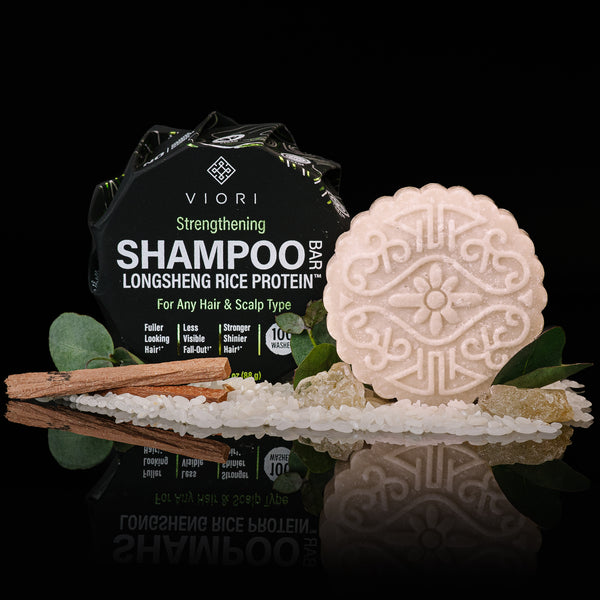
But here’s the nuance most websites skip: high-starch also increases the risk of residue if you’re mixing and applying rice water yourself without controlling concentration and rinsing technique. It’s not that high-starch rice is “bad.” It’s that it needs to be handled correctly.
Fermentation: where rice haircare becomes powerful (or unpredictable)
Fermentation isn’t a magical label-it’s a biochemical process. And the outcomes can vary wildly depending on temperature, timing, and how the final product is controlled. With fermented rice, you’re not just extracting what’s in the grain; you’re also creating new byproducts along the way.
Viori notes that they use a lower concentration of fermented Longsheng rice water because using rice water at too high a concentration can disrupt hair and scalp pH if used too often or too much. That’s an important point: the goal is consistent benefits without pushing hair into that rough, raised-cuticle territory.
Why pH is the “quiet hero” of great hair
When hair products run too alkaline, the cuticle can lift. Lifted cuticles usually show up as frizz, tangling, dullness, and a general “my hair won’t behave” feeling. Viori emphasizes their bars are pH balanced, which is exactly what I look for when I want hair to stay smoother and more manageable long-term.
The hard-water problem nobody blames on rice (but should)
Let me give you a scenario I see all the time: someone tries a rice rinse, loves the idea, then says their hair feels squeaky or stiff afterward. In many cases, the real culprit isn’t rice itself-it’s hard water.
Minerals in hard water can interact with residues and film-formers, leaving hair feeling:
- Tacky or draggy
- Dull, even if it feels “coated”
- More tangled as it dries
This is one reason a professionally formulated, rinse-clean system can feel so different from DIY experiments. Controlled formulas are designed to perform more consistently across different water types.
So what is the best rice for hair, technically?
If “best” means more shine, more slip, and better strength feel with less risk of residue and pH issues, then the answer isn’t a single grain name. The real “best rice” outcome comes from a combination of:
- A high-starch rice that delivers noticeable cosmetic benefits
- Controlled fermentation to create helpful compounds without going rogue
- pH-balanced delivery so the cuticle stays smoother over time
This is why Viori’s fermented Longsheng Rice Water™ inside a balanced shampoo-and-conditioner system is such a practical solution: you get the rice benefits without needing to gamble on kitchen variables.
How to make rice-based haircare work for your hair type
Instead of forcing one routine on every head of hair, I like to match the “rice effect” to what your hair tends to do naturally.
WHAT CUSTOMERS ARE SAYING
Real reviews for Hidden Waterfall Barra de Champú
If your hair is low porosity (buildup-prone)
Low-porosity hair often gets weighed down easily and can feel coated fast. Heavy DIY rice mixtures can be too much. A controlled, pH-balanced approach tends to give you the smoothing benefits without leaving you with that stubborn film.
If your hair is high porosity (dry, damaged, or color-treated)
High-porosity hair often loves the smoothing and reinforcing side of rice-based ingredients, but it still needs consistent conditioning to keep the cuticle calmer. This is where pairing shampoo with conditioner really matters for softness and detangling.
If your scalp gets oily but your ends feel dry
This combination is incredibly common. Many people do best when they focus cleansing where oil is (the scalp) and focus conditioning where dryness lives (mid-lengths and ends). Viori even shares guidance along these lines-using an oil-managing option for the scalp and a more moisturizing conditioner on the ends when needed.
A simple, salon-smart way to use rice-based care (without overdoing it)
If you want consistent results, here’s the approach I recommend most often:
- Choose a pH-balanced system rather than chasing super-strong DIY concentration.
- Pay attention to how hair feels once it’s dry, not just in the shower.
- Condition on purpose-conditioning helps reduce friction and protects the hair fiber after cleansing.
- Give it time. Some people notice a change quickly, but long-term improvements (like less breakage) usually show up over weeks, not hours.
Final thoughts
“Best rice for hair” isn’t really a beauty quiz question-it’s a formulation question. The grain matters, but what matters more is how it’s fermented, how strong it is, and whether the final product respects your hair and scalp’s pH.
If you want the rice benefits with fewer surprises, a controlled option like Viori’s fermented Longsheng Rice Water™ in their pH-balanced bars is a smart, consistent way to get there.


