
After two decades behind the chair, I've had my hands in pretty much every hair product imaginable. I've tested expensive salon formulas on fine hair, drugstore brands on thick coils, and everything in between. But nothing-and I mean nothing-prepared me for what I discovered when I started digging into the actual chemistry of shampoo bars.
Most people think about shampoo bars as the eco-friendly option. You know: less plastic, easier to travel with, looks cute on your shower shelf. And sure, those benefits are real. But they completely miss the fascinating story happening at the molecular level-one that honestly challenges everything the beauty industry has taken for granted since your grandmother was a girl.
Here's what shocked me: solid shampoo bars aren't just a sustainable swap for liquid shampoos. They're actually a more advanced delivery system for getting beneficial ingredients into your hair. I know that sounds counterintuitive. A compressed bar of soap-looking stuff, more sophisticated than that silky liquid in the fancy bottle? But stick with me here.
The Water Paradox: You're Paying to Ship Water Around
Let me ask you something that seems obvious once you think about it, but somehow the entire industry has ignored for decades: when you buy liquid shampoo, what are you really buying?
A bottle that's 70-80% water.
Water you already have. Coming out of your showerhead. For basically free.
Now, wasting money on shipping water around the country is annoying enough. But the problem goes way deeper than economics. Pre-diluting shampoo creates what chemists call the dilution paradox, and it's a fundamental chemistry issue.
When active ingredients-your proteins, vitamins, conditioning agents-are already swimming in water before they even touch your hair, they're at their maximum dispersion state. They're spread out, diluted, competing with all those water molecules for access to your hair shaft.
This limits something called the concentration gradient. Basically, that's the driving force that pushes beneficial ingredients into your hair rather than just coating the surface or washing away.
How Shampoo Bars Create "Smart" Ingredient Delivery
Solid shampoo bars work on a completely different principle. When you activate a bar with water-whether by rubbing it directly on your hair or working it into a lather in your hands-you create what I call a supersaturation event.
NOT SURE WHICH PRODUCT IS RIGHT FOR YOU?
TAKE THE QUIZTakes 30 seconds · 134,000+ customers matched
Here's what's actually happening:
Step 1: Localized Hydration
Water starts dissolving the compressed bar exactly where you're applying it. Unlike liquid shampoo where everything is pre-mixed, the bar releases ingredients in a highly concentrated micro-environment right at the point of contact.
Step 2: Concentration-Driven Penetration
Because the concentration at that bar-hair contact point is somewhere between 10 to 20 times higher than in liquid products, there's a much stronger force pushing active ingredients through your cuticle layers and into the hair shaft. It's like the difference between a gentle stream and a pressure washer-more force, more penetration.
Step 3: Progressive Release
As you continue working the product through your hair, ingredients activate gradually rather than all at once. The friction you create serves double duty-it gently lifts those cuticle scales while progressively releasing more active compounds.
This isn't primitive technology. It's actually more sophisticated than liquid shampoo-it just doesn't look sophisticated because we've been conditioned to equate "advanced" with "liquid in a pump bottle."
The Rice Water Revolution: When Ancient Tradition Meets Real Chemistry
You've probably heard about the Red Yao women and their floor-length hair. When Viori talks about the Longsheng rice water tradition, they're tapping into something with serious scientific credibility. That hair isn't just genetics-it's chemistry in action.
But here's what makes this particularly interesting in a solid bar format.
Why Fermented Rice Proteins Work Better When Concentrated
Rice proteins typically have molecular weights between 10,000 and 20,000 Daltons. Traditional cosmetic science says proteins this large can't penetrate the hair cuticle effectively-they're simply too big to squeeze through the tiny gaps in those overlapping cuticle scales.
So how does rice protein actually strengthen hair instead of just sitting on the surface?
The answer lies in hydrolyzed rice protein fragments-smaller pieces created during fermentation that range from 500 to 2,000 Daltons. These can penetrate, but only under the right conditions.
In liquid shampoos, rice proteins typically show up at 0.5-2% concentration. They provide some benefit, sure, but most of that protein washes down your drain before it can properly bind to your hair.
In a solid bar formulation, something remarkable happens:
- The localized concentration during application can reach 10-20%
- This "protein flooding" effect saturates binding sites rapidly
- The friction temporarily lifts cuticle scales, allowing those smaller protein fragments to slip inside
- The scales re-seal after rinsing, trapping the proteins in the cortex
You're essentially getting a protein treatment with every single wash. Not a light protein rinse-an actual treatment.
The Fermentation Factor: Why Enzymes Matter More Than You Think
When rice is fermented using traditional methods, enzymatic breakdown produces specific bioactive compounds that don't even exist in plain rice water. We're talking about:
Inositol (Vitamin B8): A cyclic molecule that's been proven to improve hair follicle health and support the hair growth cycle. This isn't marketing fluff-there are actual peer-reviewed studies on this.
Panthenol (Vitamin B5): A humectant that actually penetrates the hair shaft and increases moisture retention from the inside out, not just surface coating.
Amino acids: Literal building blocks that can integrate into damaged areas of your keratin structure, like biological spackle for your hair.
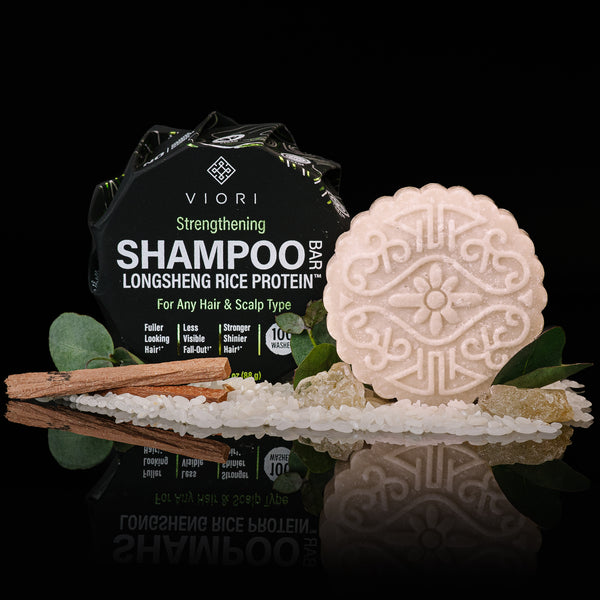
In liquid formulations, these water-soluble compounds are diluted and competing with excess water molecules for penetration sites on your hair. It's crowded in there, and a lot of the good stuff just washes away.
But in a solid bar matrix, something fascinating happens during application. You create what chemists call an anhydrous-to-aqueous transition zone. That's a fancy term for a low-water environment that suddenly gets hydrated.
In this microenvironment, those beneficial molecules aren't swimming in excess water. There's a thermodynamic "pull" that drives them into your hair shaft rather than letting them float away in the rinse water.
This is advanced delivery science disguised as a simple bar of "soap." Which, by the way, these aren't soap at all-but that's a whole other chemistry lesson.
The Conditioning Paradox: Why More Isn't Always More
Let's talk about conditioning agents for a minute, specifically Behentrimonium Methosulfate-which goes by BTMS because nobody wants to say that five times fast. It's a key ingredient in Viori's conditioner bars.
First, let's clear up some confusion: despite having "sulfate" in its name, BTMS is not a sulfate-based cleanser. It's a completely different class of compound-a conditioning agent derived from plants like colza, which is rapeseed.
But here's where solid-state chemistry creates an unexpected advantage that most people never learn about.
The Temperature-Dependent Release Mechanism
BTMS is typically used at 2-5% concentration in liquid conditioners. Formulators have to carefully balance preventing buildup-you know, that greasy, weighted-down feeling-against providing insufficient conditioning, which leaves your hair tangly and rough.
In solid conditioner bars, BTMS can be present at 25-35% of the formula. That's five to ten times more concentrated.
You'd think this would create terrible, greasy buildup that would make your hair look like you dunked it in olive oil. But it doesn't. Here's why, and this is where it gets cool:
BTMS has a melting point around 60°C, which is 140°F. In a solid bar, it exists in a semicrystalline state-partially ordered, partially flexible. When you activate the bar with warm water:
- The surface layer softens based on your water temperature and the friction from application
- BTMS molecules release in a controlled, measured way
- The semicrystalline structure creates "metered dosing" that's literally impossible in liquid products
- As the product cools on your hair, BTMS forms an organized molecular layer rather than random globs
This creates incredible slip and detangling without that heavy, greasy feel you'd get from putting 25% BTMS in a liquid conditioner. It's self-regulating chemistry.
Chain Length Matters: The Colza Advantage
The plant source matters more than most people realize. Viori uses colza-derived BTMS, which has a different fatty acid profile than coconut or palm-derived versions.
Colza-derived BTMS contains higher proportions of erucic acid-a longer-chain fatty acid. We're talking 22 carbons versus coconut's 12 carbons. That difference might sound minor, but it's huge.
From a tribological perspective-that's the science of friction and lubrication, which yes, absolutely applies to hair-longer chains create:
- Lower friction between hair strands, which means less tangling
- More durable lubrication films that resist rinse-off
- Better cuticle alignment due to a molecular "combing" effect
This is why so many people report that solid conditioner bars provide better detangling compared to liquid alternatives. It's not just about what's in the product-it's about the specific molecular architecture of those ingredients.
The Friction Question: Rethinking "Gentle" Hair Care
Traditional hair care wisdom is crystal clear: be gentle, minimize friction, don't disturb the cuticle. Handle your hair like it's spun glass.
Yet shampoo bars require rubbing them on your hair or creating vigorous lather in your hands. This seems contradictory-maybe even potentially damaging.
But emerging research is challenging these long-held assumptions about friction and hair health. Turns out, we might have been thinking about this all wrong.
Controlled Mechanical Stimulation Has Benefits
There's a crucial difference between controlled friction and chaotic friction. Let me break this down:
At the scalp level:
- Consistent, controlled friction stimulates mechanoreceptors-basically, touch sensors in your skin
- This triggers increased microcirculation, meaning more blood flow to your hair follicles
- Enhanced blood flow delivers more nutrients and oxygen to support hair growth
- Mechanical stimulation may activate cellular signaling pathways related to the hair growth cycle
At the hair shaft level:
- Moderate, consistent friction temporarily lifts cuticle scales in a predictable way
- This allows better ingredient penetration, like we discussed earlier
- Immediate re-sealing after rinsing "locks in" those deposited proteins and humectants
- Regular, controlled cuticle manipulation may actually improve alignment over time
Think of it this way: liquid shampoos require you to scrub with your fingers, creating unpredictable pressure and direction. You're pushing harder in some spots, barely touching others. A solid bar creates more consistent friction vectors-especially when using the lather-in-hands method.
It's not about avoiding friction entirely. It's about making that friction work for your hair rather than against it.
WHAT CUSTOMERS ARE SAYING
Real reviews for Hidden Waterfall Barra de Champú
The Stability Secret: Why Your Liquid Shampoo Changes Over Time
Viori emphasizes that their products are pH balanced between 3.5 and 6.5-the optimal range for hair health. But there's a hidden issue with liquid shampoos that most consumers never learn about, and it drove me crazy once I discovered it.
The pH Drift Problem
Maintaining stable pH in liquid products is remarkably difficult. Over time, several factors cause what chemists call "pH drift":
Hydrolysis reactions: Water slowly breaks down certain ingredients, releasing acidic or basic byproducts that shift pH.
Microbial activity: Even with preservatives, low-level bacterial metabolism can alter pH over time.
Container interactions: Plastic bottles can leach alkaline compounds into the product. Those bottles aren't as inert as you think.
Temperature cycling: Shipping and storage temperature changes affect the chemical equilibrium that maintains pH.
This is why a liquid shampoo might have a perfect pH of 5.5 when it's manufactured but drift to 6.5 or higher after six months sitting in your shower. That might not sound like a big deal, but it is.
For color-treated hair, chemically processed hair, or gray hair-which has a more porous structure-pH control is absolutely critical. A pH that's even one point too high can cause cuticle swelling, color fading, and increased damage.
Why Solid Bars Stay Stable
In a solid bar with low water activity-typically less than 10% free water-pH-shifting reactions occur at dramatically reduced rates:
- Hydrolysis reactions need water as a reactant, which is scarce in compressed bars
- Microbial growth requires free water-the low-moisture environment is inherently self-preserving
- No bottle means no container-product interactions
- Molecular mobility is restricted in the solid state, improving temperature stability
A well-formulated shampoo bar maintains its pH stability for years, not months. This is a significant but massively underappreciated advantage.
The Lather Revolution: Why Foam Structure Actually Matters
Let me share something that genuinely surprised me when I first researched it: the foam you create with a shampoo bar is fundamentally different from liquid shampoo foam-and it may actually clean more efficiently.
Surfactant Organization in Concentrated Systems
Surfactants-that's your cleansing agents, like Sodium Cocoyl Isethionate, which is the primary cleanser in Viori bars-form structures called micelles when dissolved in water. These are tiny spherical clusters that trap oils and dirt so they can be rinsed away.
Standard teaching says micelles form at a specific concentration called the Critical Micelle Concentration, or CMC. Most liquid shampoos contain surfactants well above CMC, ensuring plenty of micelles for cleansing.
But recent colloid chemistry research reveals something interesting about highly concentrated surfactant systems-like what you create when activating a shampoo bar.
Above certain concentrations-typically above 40%-surfactants don't just form simple micelles. They create sophisticated structures called liquid crystalline phases:
- Hexagonal phases: Cylindrical micelles arranged in organized patterns
- Lamellar phases: Bilayer sheets of surfactants
- Cubic phases: Complex three-dimensional networks
These structures have dramatically different properties from regular micelles:
- Enhanced cleaning capacity: Liquid crystalline phases can trap more oil and dirt per


