
After twenty years behind the chair, I've learned that the most interesting conversations in hair care happen at the molecular level. Yet when it comes to bar shampoo, most discussions never get past "it's eco-friendly" and "great for travel."
Don't get me wrong-those benefits are absolutely real. But they completely miss what makes bar shampoo genuinely fascinating: it represents a fundamentally different approach to hair cleansing that challenges everything we thought we knew about how surfactants should interact with hair.
Today, I want to take you deep into the chemistry. Because once you understand what's actually happening when you use a shampoo bar, you'll never look at that little solid brick the same way again.
The Water Question: It's Not What You Think
Here's something that surprised me when I first studied formulation chemistry: traditional liquid shampoo is 70-80% water. And that water isn't just filler-it's a critical functional ingredient.
Water serves as a chemical mediator. It pre-dilutes surfactants, buffers sudden pH changes, and controls how quickly active ingredients reach your hair shaft. It's the stage manager of the entire cleansing performance.
When you remove water and create a bar, you're not making "solid shampoo." You're creating something chemically distinct: a delivery system that deposits concentrated ingredients directly onto wet hair, where they activate on contact.
Think about what this means in practice.
The Concentration Cascade
When you rub a bar on your wet hair, you're experiencing what I call a "surfactant gradient." The point of contact receives ingredients at near-100% concentration, then rapidly dilutes as you work the product through your hair.
Liquid shampoos provide homogeneous concentration throughout-every part of your hair gets the same level of active ingredients. Bar shampoos create zones of varying intensity.
This isn't better or worse-it's different. And it explains why technique matters so much more with bars than with liquids.
The pH Shock Nobody Talks About
Here's a technical detail that keeps formulators up at night: when a concentrated bar touches wet hair, there's a momentary localized pH spike before dilution occurs.
NOT SURE WHICH PRODUCT IS RIGHT FOR YOU?
TAKE THE QUIZTakes 30 seconds · 134,000+ customers matched
Quality bars like those from Viori are carefully balanced to a 3.5-6.5 pH range when measured in diluted form. But that measurement doesn't capture what happens during those critical first seconds of contact, when the bar deposits concentrated ingredients before water dilutes them.
This is why bar formulation is so much more challenging than liquid formulation. You're not just balancing a stable pH in a bottle-you're engineering a product that will create an acceptable pH as it dilutes on someone's head.
Inside the Syndet Revolution
Most people don't realize that quality bar shampoos aren't technically "soap." They're syndets-synthetic detergents-and the chemistry is surprisingly sophisticated.
Why Sodium Cocoyl Isethionate Changed Everything
Let me get slightly technical for a moment, because this is where it gets interesting.
Sodium Cocoyl Isethionate (SCI) is the primary surfactant in premium bar shampoos. It's what chemists call an amphiphilic molecule-one end loves water, the other loves oil. This allows it to trap dirt and sebum in tiny spherical structures called micelles.
But here's the crucial detail: SCI creates smaller, more uniform micelles than traditional sulfates-approximately 3-5 nanometers in diameter. That's small enough to penetrate between cuticle layers without forcing them dramatically apart.
This is why bar shampoo feels different. You're literally experiencing cleansing at a different scale.
When clients tell me their hair feels "cleaner but not stripped" after switching to a bar, they're not imagining it. They're detecting a genuine difference in how the surfactant interacts with their hair structure.
The Conditioning Paradox That Shouldn't Work (But Does)
Here's something that puzzles even experienced formulators: Viori includes a conditioning agent called Behentrimonium Methosulfate in both their shampoo AND conditioner bars.
Despite the intimidating name (and the word "sulfate"), this isn't a harsh stripping agent. It's actually a cationic surfactant-positively charged-which means it behaves opposite to cleansing surfactants.
This creates a technical paradox:
- Shampoo surfactants are anionic (negatively charged)-they strip away oils and open cuticles
- Conditioning agents are cationic (positively charged)-they deposit on hair and close cuticles
- Including both in a single bar creates a simultaneous cleansing-conditioning event that can't happen in traditional systems where these ingredients are in separate bottles
When you use a bar containing both ingredients, you're experiencing "competitive adsorption"-the cleansing and conditioning surfactants are literally competing for binding sites on your hair shaft.
The ratio between them determines whether your hair feels squeaky clean or slightly conditioned. This is formulation artistry at its finest, and it explains why some bars leave hair feeling stripped while others leave it feeling soft despite being labeled as "shampoo."
The Rice Water Variable: Ancient Tradition Meets Modern Science
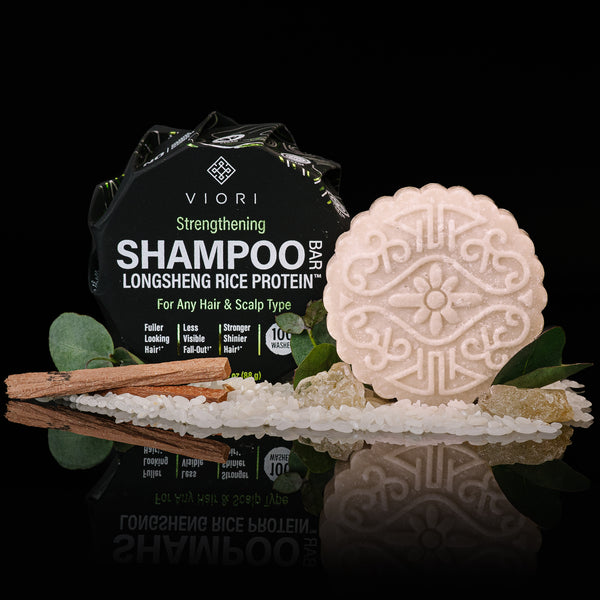
Viori's signature ingredient-fermented Longsheng rice water-deserves serious technical analysis beyond the cultural story (though that story is genuinely fascinating).
Let's examine what actually happens chemically during fermentation.
The Fermentation Transformation
When rice is fermented for 7-10 days (as Viori does), several chemical changes occur:
1. Protein hydrolysis: Large proteins break down into smaller peptides and amino acids. This is critical because full proteins are too large to penetrate hair cuticles-they're typically over 10,000 Daltons in molecular weight. Hydrolyzed rice proteins range from 100-1,000 Daltons, small enough to actually enter the cortex layer of damaged hair.
2. Inositol elevation: Fermentation increases vitamin B8 (inositol) content. This cyclic sugar alcohol acts as a cellular signaling molecule. While the mechanism isn't fully understood, studies suggest it may influence the cells that produce hair at the follicle level.
3. Natural pH buffering: Fermentation produces lactic acid and other organic acids, which naturally lower pH. This creates a self-buffering system that helps maintain the acidic environment hair thrives in.
What Rice Protein Actually Does (Honestly)
Let me be straight with you about something: many dermatologists are skeptical that topically applied nutrients can truly affect hair health, since hair is technically "dead" tissue.
They're not entirely wrong. But they're missing an important nuance.
We're not trying to "feed" your hair. Rice proteins work through surface chemistry. They coat the hair shaft, filling microscopic gaps in damaged cuticles. This is a physical effect, not a nutritional one-like spackling tiny cracks in a wall.
The results are real but temporary:
- Increased hair diameter (volumizing effect)
- Improved light reflection (shine)
- Temporary structural reinforcement of damaged areas
- Smoother cuticle surface (reduced tangling)
These effects wash away over time, which is why consistent use matters. Think of it like moisturizer for your hands-you're not permanently fixing dryness, but regular use maintains the improvement.
Why Bar Formulation Is Actually Harder Than Liquid
Creating a stable, effective bar requires solving problems that liquid formulators never face.
The Anhydrous Challenge
Without water as a solvent, everything changes:
Binding chemistry: The bar must physically hold together. Viori uses cetyl alcohol and stearic acid-fatty alcohols that act as both emollients and binding agents. These ingredients partially melt during application (from friction and warmth), releasing active ingredients in a controlled way.
It's essentially a controlled-release mechanism built into the physical structure.
Ingredient compatibility: In liquid shampoos, water keeps incompatible ingredients separated. In bars, everything is in direct, concentrated contact. Ingredients can potentially react, crystallize, or separate over time.
This is why bar formulation requires extensive stability testing. Formulators must ensure ingredients remain compatible in their concentrated state for years.
pH control without water: pH technically measures hydrogen ion concentration in aqueous solution. In an anhydrous bar, pH is theoretical until the bar contacts water. Formulators must predict how the bar will behave when diluted-it's complex chemistry involving calculations and extensive empirical testing.
The Melting Point Engineering
Here's a detail I find elegant: the conditioning bar must remain solid at room temperature but readily release ingredients at scalp temperature (about 35°C or 95°F).
This requires selecting fats and waxes with precisely engineered melting points.
Notice that Viori uses cocoa butter? It melts at 34-38°C-almost exactly scalp temperature. This isn't coincidence. When you apply the bar, body heat triggers a phase change that releases conditioning agents exactly where and when you need them.
That's sophisticated formulation.
Why Your Technique Matters More Than You Think
One of the most overlooked aspects of bar shampoo is how application technique fundamentally affects results.
With liquid shampoo, you pour and distribute-it's relatively passive. With bars, you must actively create lather, and this introduces new variables.
The Physics of Application
When you rub a bar on wet hair, you're creating:
Shear forces: Mechanical friction generates heat, which slightly softens the bar and increases ingredient release.
Localized concentration zones: The contact point receives maximum product, creating concentration gradients across your scalp.
Cuticle manipulation: The friction physically lifts cuticle scales. This can enhance cleansing but may increase damage if done too aggressively.
This is why Viori recommends lathering in your hands rather than directly on hair for color-treated hair-it reduces mechanical stress and creates more uniform distribution.
My Professional Technique Recommendation
In my practice, I've noticed that clients who struggle with bar shampoos are almost always using insufficient water and excessive friction.
The ideal technique:
- Thoroughly saturate hair (more water than you think you need)
- Wet the bar completely
- Create lather with minimal friction-let the surfactants do the work
- Distribute through hair with your hands, not the bar itself
- Focus the bar application on your scalp, not your lengths
The surfactants are powerful enough to clean effectively without aggressive rubbing. Trust the chemistry.
The Hard Water Problem Nobody Mentions
Here's an under-discussed technical challenge: bar shampoos are more sensitive to hard water than liquid shampoos.
WHAT CUSTOMERS ARE SAYING
Real reviews for Hidden Waterfall Barra de Champú
The Chemistry of Interference
Hard water contains dissolved calcium and magnesium ions. When surfactants encounter these ions, they form insoluble precipitates-soap scum.
Liquid shampoos typically contain chelating agents (like EDTA or citric acid) in sufficient concentration to sequester hard water minerals before they interfere. Bar shampoos have limited space for these ingredients in their concentrated form.
The result: Users in hard water areas often report:
- Difficulty lathering
- Film or residue on hair
- Hair feeling "waxy" or "coated"
Viori partially addresses this by including citric acid (especially in their Citrus Yao formulation), which chelates calcium. But users in very hard water areas (>180 ppm) may still struggle.
My Hard Water Solutions
If you live in a hard water area and want to use bar shampoo:
- Install a shower filter: Removes some minerals before they reach your hair
- Use an apple cider vinegar rinse: Dilute ACV 1:4 with water, pour through hair after washing to dissolve mineral deposits
- Choose citrus-based bars: The citric acid provides some hard water protection
- Expect a longer lathering time: You may need to work the bar longer to generate foam
Why Conditioning Bars Are Even More Complex
If formulating a cleansing bar is challenging, creating an effective conditioning bar is exponentially harder.
The Deposition Challenge
Conditioners work through "substantivity"-the ability to deposit ingredients that remain on hair after rinsing.
In liquid conditioners, this is achieved through cationic surfactants (attracted to negatively-charged hair), emollients suspended in a cream base, and often silicones for slip and shine.
In a solid bar without silicones (like Viori's), you must achieve the same deposition using:
Behentrimonium Methosulfate (BTMS): The primary conditioning workhorse, provides slip and detangling
Cocoa butter and shea butter: High-melting-point fats that soften with warmth and friction, depositing emollients as they melt
Cetyl alcohol: Acts as both binder and conditioning agent (it's a fatty alcohol with emollient properties, not a drying alcohol)
The challenge is getting these ingredients to deposit in the right amounts. Too little, and hair feels dry. Too much, and it feels greasy or heavy.
The Preservation Advantage You Didn't Know About
Here's an underappreciated benefit: bar shampoos are inherently self-preserving in a way liquid shampoos can never be.
The Microbiological Reality
Bacteria, mold, and yeast require water to grow-specifically, "available water" that's not bound up in chemical structures. Microbiologists measure this as water activity (aw), scaled from 0 to 1.
Most bacteria need aw > 0.90 to grow. Mold and yeast tolerate lower levels but typically need aw > 0.70.
Anhydrous products like bars have water activity near zero when dry. Even when wet during use, they dry out again, creating an environment hostile to microbial growth.
This is why Viori's bars can be stored 3-5 years without degradation. Liquid shampoos, despite preservatives, typically have a shelf life of 2-3 years maximum.
The caveat: This assumes proper storage. If a bar remains constantly wet (poor drainage), surface mold can eventually grow. Proper drying between uses is critical-which is why well-designed bar holders with good drainage matter.


