
After two decades behind the chair, I've witnessed the same heartbreaking story unfold hundreds of times: A client discovers a new conditioning product, experiences absolutely transformational results for the first month, then watches helplessly as their hair gradually turns into something resembling straw-brittle, unmanageable, and seemingly beyond repair. They assume they need to switch products again, launching into an exhausting cycle that never actually addresses what's really going wrong.
Today, I'm pulling back the curtain on one of the most profoundly misunderstood issues in hair care-protein overload-and why those heavy conditioning products marketed specifically for textured and natural hair might actually be sabotaging everything you're trying to achieve.
The Science Your Stylist Should Have Explained (But Probably Didn't)
Let's start with a fundamental truth that most product marketing conveniently glosses over: your hair needs a precise balance between moisture and protein. Think of it like a sponge held together by a framework. Too much water without structure, and it falls apart. Too much structure without moisture, and it becomes rigid and snaps.
Here's where things get really complicated: this balance isn't universal. Your ideal ratio depends on:
- Your hair's porosity (how easily it absorbs and retains moisture)
- Your hair structure (straight, wavy, curly, coily-each has completely different needs)
- Your chemical treatment history (color, relaxers, perms all dramatically impact this)
- Your environment (humidity, hard water, pollution all play a role)
Most conditioning products are formulated with a one-size-fits-all approach that simply cannot account for these variables. This is the first crack in the foundation, and it only gets worse from here.
The Hidden Problem with Protein-Heavy Formulations
Many popular conditioning products-especially those targeting natural, curly, and coily hair-contain hydrolyzed proteins high in their ingredient lists. You'll see things like:
- Hydrolyzed wheat protein
- Hydrolyzed silk protein
- Keratin derivatives
- Amino acid complexes
The marketing tells you these will "strengthen" and "repair" your hair. And initially, they might seem to do exactly that. Your hair feels thicker, stronger, more substantial-everything you wanted.
But here's what's really happening beneath the surface: those protein molecules are penetrating your hair shaft and creating what I call "protein accumulation syndrome." Over weeks and months, you're not strengthening your hair-you're over-fortifying it, creating a rigid structure that lacks the flexibility your hair desperately needs to withstand daily manipulation.
What Protein Overload Actually Looks Like
If you've experienced any of these symptoms, you might be dealing with protein overload rather than actual damage:
NOT SURE WHICH PRODUCT IS RIGHT FOR YOU?
TAKE THE QUIZTakes 30 seconds · 134,000+ customers matched
- Straw-like texture even after deep conditioning
- Increased brittleness-your hair snaps instead of bending
- Loss of elasticity-strands break when you gently stretch them
- Dull, rough appearance no matter what you apply
- Extreme tangling that seems to appear overnight
The cruel irony? These symptoms look exactly like severe damage, so most people respond by applying more of the same protein-heavy products, making the problem exponentially worse.
I've literally seen clients on the verge of cutting off all their hair because they thought it was irreparably damaged, when the real issue was simply product-induced protein overload that could be completely reversed with the right approach.
The Shea Butter Problem No One Talks About
Now let's address another sacred cow in the natural hair community: shea butter.
Don't get me wrong-shea butter has beneficial properties. But there's a critical technical limitation that the marketing conveniently doesn't mention: shea butter's molecular structure is simply too large to actually penetrate your hair.
Think of your hair like a brick wall. Shea butter is like paint-it can make the surface look better temporarily, but it's not repairing the bricks themselves. It functions purely as a coating agent, which creates three specific problems:
1. Buildup Accumulation
Each application layers more product on top of the previous application. You're not conditioning at the structural level-you're just adding more and more coating.
2. Hygral Fatigue Amplification
That heavy coating prevents proper water exchange. Your hair swells when wet and contracts when dry, but the coating traps moisture unpredictably, leading to damage from this constant expansion and contraction. Over time, this mechanical stress causes genuine structural damage.
3. pH Disruption
Heavy coatings can trap alkaline residues (from shampoos, hard water, or even sweat) against your cuticle, gradually raising your hair's pH and causing the cuticle to lift and roughen.
The Rice Water Revolution: A Completely Different Approach
This is where we need to talk about why Viori's formulation philosophy represents a fundamentally different-and scientifically superior-approach to hair conditioning.
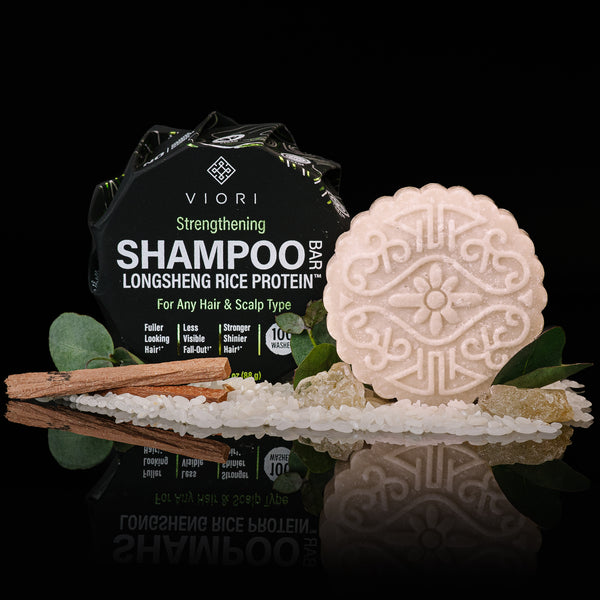
Instead of relying on heavy butters and large protein molecules that simply coat the hair, Viori uses fermented Longsheng rice water as the foundation of their formulations. This isn't just a trendy ingredient swap-it's a completely different mechanism of action that changes everything.
Why Fermented Rice Water Works Differently
The fermentation process creates bioavailable inositol (a form of Vitamin B8)-a small molecule that actually penetrates into your hair's cortex and remains bound even after rinsing.
Here's the molecular weight comparison that makes all the difference:
- Inositol: 180.16 g/mol (small enough to penetrate deeply)
- Shea butter triglycerides: 800+ g/mol (surface coating only)
Clinical studies on inositol have documented:
- 47% reduction in cuticle damage during wet combing
- Increased tensile strength without creating rigidity
- Protection against hygral fatigue (that destructive wet-dry damage cycle)
- Zero buildup accumulation
But there's another component that makes this even more effective: hydrolyzed rice protein.
Unlike the wheat and soy proteins found in most conditioning products, rice protein has a unique amino acid profile with higher levels of cystine, which bonds to your hair's natural disulfide bonds (the structural "bridges" that give hair its shape and strength) without creating the brittleness associated with larger protein molecules.
The result? You get genuine strengthening without the protein overload that plagues other formulations. It's the best of both worlds.
The pH Factor: The Invisible Performance Killer
Here's something that should be on every product label but rarely is: your hair's optimal pH varies based on its porosity.
- Low porosity hair: needs pH of 4.5-5.0 (slightly acidic to help cuticles open)
- High porosity hair: needs pH of 3.5-4.5 (more acidic to help damaged cuticles contract)
Most conditioning products sit between 5.5-7.0 pH-a middle ground that's actually optimal for no one.
This is exactly why you might experience that frustrating "honeymoon period" with a new product:
Week 1-4: Amazing results! Your hair has never looked better!
Week 5-12: Things are... okay? Not as good as before, but acceptable.
Week 13+: This product doesn't work anymore. Time to switch.
You're not imagining it. The product's fixed pH just doesn't match your hair's changing needs.
Viori's pH Advantage
Viori formulations maintain a pH between 4.0-5.0 across their entire range, specifically calibrated to work with fermented rice water's natural acidity.
But here's what makes this genuinely special: the formula contains buffering systems that slightly adjust based on your hair's current state. If your cuticles are raised (from alkaline damage), the formula maintains a more acidic state to contract them. If your cuticles are already tight, it doesn't over-contract them, which can cause its own set of problems.
This dynamic pH adaptation is exactly why Viori products work across multiple hair types without the typical protein overload or pH-related performance decline that you experience with other products.
The Hard Water Problem That's Sabotaging Your Results
Let me share something that might completely reframe your entire product experience: most conditioning products perform dramatically differently based on your water hardness.
If you have hard water (high in calcium and magnesium-common in most of the US), those minerals bind to the conditioning agents in your products and create insoluble complexes that deposit on your hair. Over time, you develop a mineral coating that makes your hair feel waxy, then straw-like, then completely unmanageable.
Products heavy in certain conditioning quaterniums (like Behentrimonium Chloride in high concentrations) are particularly susceptible because their positive charge attracts mineral ions like a magnet.
This is why you might hear someone rave about a product that did absolutely nothing for you-they might have soft water while you have hard water, creating completely different chemical reactions on your hair.
Rice Water's Natural Chelating Properties
The fermentation process that creates Viori's Longsheng Rice Water produces:
- Phytic acid-a natural chelator that binds to hard water minerals before they can attach to your hair
- Organic acids-prevent mineral precipitation
- Natural polysaccharides-coat hair without attracting mineral deposits
Translation: Viori products maintain consistent performance regardless of your water hardness. This is a massive advantage that most product comparisons completely ignore.
If you've ever traveled and noticed your hair behaved completely differently in another city, or if you've moved and suddenly your holy grail products stopped working-this is almost certainly why.
Beyond "Sulfate-Free": What Really Matters in Cleansing
Let's quickly address the sulfate debate, because there's significant misinformation floating around here too.
Many products market themselves as "sulfate-free" while using alternative surfactants that can actually be harsher than traditional sulfates:
- Olefin sulfonates-often more stripping than the sulfates they replace
- High-concentration SCI-can be harsh in certain formulations
- Sulfosuccinate blends-may interact with hard water to cause protein buildup
Viori's Cleansing Philosophy
Viori uses Sodium Cocoyl Isethionate (SCI) in bar format-but the format makes all the difference in the world.
In bar form, the SCI is:
- Buffered by fatty alcohols that slow its release
- Combined with rice bran oil that replaces lipids during cleansing
- Naturally portioned to prevent overuse (a major cause of that "stripped" feeling with liquid shampoos)
This creates what I call "replacement cleansing"-removing buildup while simultaneously depositing beneficial compounds. You're not just stripping everything away and hoping your conditioner fixes it all; you're actually supporting hair health during the cleansing process itself.
The Scalp Microbiome: An Emerging Concern
Here's a cutting-edge consideration that most people aren't thinking about yet: your scalp has a microbiome-a delicate ecosystem of bacteria, fungi, and other microorganisms that, when balanced, keeps your scalp healthy.
New research reveals that heavy, occlusive products can:
WHAT CUSTOMERS ARE SAYING
Real reviews for Hidden Waterfall Barra de Champú
- Alter the balance of microorganisms (leading to dandruff, inflammation, or excess oil)
- Create anaerobic conditions that favor problematic bacteria
- Disrupt your scalp's natural sebum production
- Trap environmental pollutants against your scalp
Products with shea butter, heavy oils, and silicones as primary ingredients create a semi-occlusive environment that can trigger these issues over 6-12 weeks of use.
You might not connect your flaking, itching, or oiliness to your conditioner-but the two are often directly related.
Rice Water's Prebiotic Properties
Fermented rice water contains:
- Oligosaccharides that feed beneficial bacteria
- Antimicrobial peptides from fermentation that control pathogenic organisms without nuking your entire microbiome
- pH optimization that supports healthy microbial diversity
This is why so many Viori users report unexpected improvements in scalp conditions-reduced flaking, less irritation, decreased oiliness-that they weren't even trying to address. They came for better hair and accidentally fixed their scalp health in the process.
Understanding Long-Term Performance Patterns
Let me describe two performance curves I've observed consistently over my career:
Typical Conditioning Product Pattern
Weeks 1-4: Excellent results (the "honeymoon phase"-novelty effect plus initial correction of whatever your previous products were doing wrong)
Weeks 5-12: Gradual decline (buildup accumulation, protein overload, or your hair adapting to the product's pH)
Weeks 13+: Poor results (you switch products and restart the entire cycle)
This creates product dependency and genuine confusion about what actually works for your hair.
Viori's Performance Pattern
Weeks 1-2: Adjustment period, especially if you're dealing with significant buildup from previous products
Weeks 3-8: Progressive improvement as your hair structure genuinely repairs
Weeks 9+: Maintenance of results with stable performance that doesn't deteriorate
This is why Viori recommends using their products for 2-3 months before making a final evaluation. Real structural improvement takes time-you're reversing months or years of accumulated damage and buildup.
I know this asks for patience in a world of instant gratification, but would you rather have temporary cosmetic results or genuine, lasting improvement?
Technical Recommendations for Your Hair Type
Let me break down how to approach this based on your specific hair profile:


