
A 2‑in‑1 bar is the kind of idea that makes perfect sense at first glance: one bar, one step, less stuff in the shower, and a simpler routine. When it works, it feels almost magical-clean roots, soft ends, no fuss.
But if you’ve ever tried a 2‑in‑1 and ended up with hair that felt coated, limp, squeaky, frizzy, or strangely “clean but not nice,” you’re not imagining things. From a formulation standpoint, a true 2‑in‑1 bar is one of the hardest formats to engineer because it forces two opposing systems-cleansing and conditioning-to cooperate inside the same solid product.
Why 2‑in‑1 is a chemistry balancing act
Here’s the part most people never hear: shampoo and conditioner are often built on opposite charge technologies. That matters because hair is not a neutral surface-it’s reactive, especially when it’s wet, porous, or damaged.
NOT SURE WHICH PRODUCT IS RIGHT FOR YOU?
TAKE THE QUIZTakes 30 seconds · 134,000+ customers matched
Cleansing usually relies on “lift and rinse” chemistry
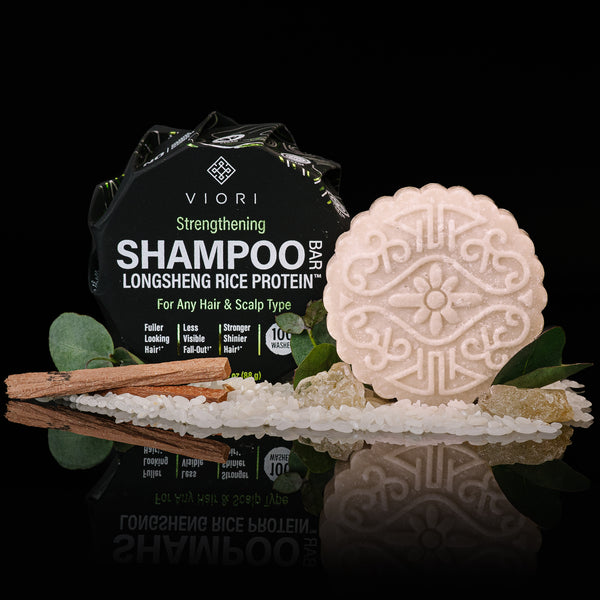
Effective cleansing is typically driven by surfactants that excel at surrounding oils and debris so they can be rinsed away. Viori shampoo bars use Sodium Cocoyl Isethionate (SCI), a mild cleanser known for creating a rich lather without relying on harsh cleansing sulfates.
Conditioning usually relies on “deposit and protect” chemistry
Conditioners work differently. Hair-especially through the mid-lengths and ends-often carries more negative charge and has more surface roughness, so conditioning ingredients are designed to cling to it, improve slip, and smooth the cuticle. Viori conditioner bars use Behentrimonium Methosulfate (BTMS), a conditioning agent valued for softness and manageability (and despite the name, it isn’t a harsh cleansing sulfate).
So what happens when you combine them?
When cleansing (often negative) and conditioning (often positive) systems meet, they can bind together and interfere with each other. That can show up as:
- Residue or “waxy” feel even right after rinsing
- Flat roots that collapse faster than usual
- Draggy tangles that make hair feel rough despite “conditioning” claims
- Dullness from uneven film sitting on the surface
This is why 2‑in‑1 bars can be incredible for one person and a complete miss for another. It’s not just preference-there’s real chemistry behind that split.
The solid-bar factor nobody considers: you control the dilution
Liquid shampoos and conditioners come pre-diluted and designed to behave predictably. Bars are different. With a bar, you create the concentration in real time, every time you wash, depending on how much water you use, how long you lather, and where the product hits the hair.
That means the same bar can feel totally different based on:
- How thoroughly you wet your hair first
- How much product you load into one area
- Your water quality (especially if you have hard water)
- How long you massage and emulsify before rinsing
In practical terms: a 2‑in‑1 bar has less room for “autopilot.” Technique matters more than most people realize.
Friction: the mechanical downside of rubbing a bar on hair
Ingredients get all the attention, but mechanics play a huge role with bars. When you rub a bar directly onto your head, you’re not only applying product-you’re also increasing friction against the cuticle.
The cuticle is like shingles on a roof. Too much friction-especially when hair is wet-can lift those shingles, which may lead to:
- More tangles and roughness
- More frizz (because the surface won’t lie flat)
- Less shine (light scatters instead of reflecting)
- More vulnerability on color-treated hair
This is one reason Viori recommends a color-friendlier approach: build lather in your hands and apply with your fingers rather than scrubbing the bar directly onto the hair.
pH: the quiet deal-breaker for “clean and soft”
When people say a product made their hair feel “straw-like” or “puffy,” the culprit is often pH. Hair products generally need to stay in a mildly acidic range-Viori notes hair products should typically be between pH 3.5 and 6.5-because overly alkaline formulas can raise the cuticle over time and increase dryness, frizz, and breakage risk.
Viori bars are pH balanced, which is a big reason many users find them comfortable for regular use. For 2‑in‑1 concepts, pH is especially important because you’re trying to cleanse without roughing the cuticle, while also conditioning without leaving excess film behind.
The deposition paradox: why 2‑in‑1 can love porous hair but overwhelm fine hair
Conditioning doesn’t land evenly on every strand. It tends to “grab” where hair is most porous and most negatively charged-often the mid-lengths and ends. That creates a pattern I’ve seen repeatedly:
- High-porosity hair may love a 2‑in‑1 approach because it readily accepts conditioning and benefits from extra smoothing support.
- Low-porosity or very fine hair can feel weighed down more easily because conditioning tends to sit on the surface, building film faster than the hair can absorb it.
This lines up with Viori’s guidance on porosity: low-porosity hair often does better with lighter cleansing approaches, while high-porosity hair typically thrives with more moisture and strengthening support.
How to use a 2‑in‑1 bar approach without the usual pitfalls
If you love the simplicity of “one bar,” you can dramatically improve results by treating technique as part of the system. Here’s the salon-minded method I recommend.
WHAT CUSTOMERS ARE SAYING
Real reviews for Hidden Waterfall Barra de Champú
- Wet thoroughly first so the bar doesn’t hit dry patches and overload one area.
- Lather in your palms and apply the foam with your hands to reduce friction and improve distribution.
- Work scalp and ends differently: focus cleansing where oil lives (scalp), and keep the most conditioning attention on mid-lengths and ends.
- Give it a minute before rinsing-conditioning needs contact time to smooth and soften.
And if you’re deciding whether to stick with it, be fair to your hair. Viori recommends giving products 2-3 months before calling it quits, since results can vary based on your starting condition, scalp type, and goals.
A smarter “2‑in‑1 lifestyle” using Viori’s bar system
Sometimes the simplest routine isn’t literally one product-it’s a routine that feels effortless because it matches your scalp and hair behavior. Viori’s bar lineup makes it easy to keep things streamlined while still being precise.
- Citrus Yao is typically favored for normal to oily scalps, and its formula includes scent components with citric acid, which helps break down oil.
- Terrace Garden, Hidden Waterfall, and Native Essence are commonly chosen for normal to dry scalps, with Native Essence being the unscented option for sensitive users.
This matters because the scalp is skin and the ends are older hair fiber-most people don’t actually need the exact same behavior from root to tip.
Final thoughts: why 2‑in‑1 bars are so polarizing (and why that’s normal)
2‑in‑1 bars sit at the intersection of chemistry (cleansing vs. conditioning systems), physics (friction and cuticle mechanics), and user variables (dilution, water quality, porosity, and technique). When all of those line up, the experience can be clean, soft, and low-maintenance.
When they don’t, it’s not that your hair is “difficult.” It’s that a single bar is being asked to do two jobs that naturally want opposite conditions to perform their best-and your hair type may be exposing that compromise.


