
If you've been researching ginger shampoo bars for hair loss, you've probably noticed something peculiar: the reviews are all over the map. Some people swear their hair transformed completely, while others claim they saw absolutely nothing happen. As someone who's spent two decades behind the salon chair and studying hair care formulation science, I can tell you this isn't random-it reflects a deeper scientific reality that most people (and many manufacturers) completely miss.
Let me pull back the curtain on what's really happening with ginger shampoo bars, why results vary so dramatically, and what you actually need to know before investing your money and hope into any hair loss product.
Why Ginger Bar Reviews Contradict Each Other So Wildly
Here's the uncomfortable truth: when you see a review for a "ginger shampoo bar," you might not be reading about the same product chemistry as the next reviewer-even if the ingredient label looks identical.
The Chemistry That Changes Everything
Ginger contains three primary bioactive compounds: gingerols, shogaols, and paradols. These aren't interchangeable-they have distinctly different effects on your scalp and hair follicles.
Here's what almost nobody tells you: when ginger is processed into a solid bar, gingerols convert into shogaols. This happens during the dehydration and heat processes required to make a bar solid. Why does this matter?
- Gingerols primarily stimulate surface circulation-that warming, tingling feeling you notice immediately
- Shogaols penetrate deeper into your hair follicles and deliver more potent anti-inflammatory benefits
- The conversion rate varies wildly based on manufacturing processes that companies rarely disclose
Two "ginger shampoo bars" sitting side-by-side on a shelf may contain completely different active compound profiles. One might be rich in surface-stimulating gingerols, while another has converted most of its ginger into follicle-penetrating shogaols. The ingredient label won't tell you which one you're getting.
This explains those contradictory reviews perfectly. People are literally using different chemical formulations while believing they're testing the same thing.
NOT SURE WHICH PRODUCT IS RIGHT FOR YOU?
TAKE THE QUIZTakes 30 seconds · 134,000+ customers matched
The Hidden Variable: Your Bar is Working Differently Than You Think
Let me share something I've observed with hundreds of clients over the years: the physical format of a shampoo bar fundamentally changes how ingredients interact with your scalp-and almost no one accounts for this.
The Friction Factor
When you use a bar shampoo instead of a liquid, you're creating:
- Direct scalp friction that increases microcirculation independent of any chemical ingredients
- Pressure and motion that stimulate nerve receptors in your scalp
- Extended contact time because bars require more working and manipulation
- Concentrated application spots rather than even distribution
I've had countless clients tell me about the "warming sensation" they feel with ginger bars. But here's the question I always ask: Are you feeling the ginger compounds, the increased blood flow from rubbing the bar on your scalp, or a combination of both?
The honest answer? Most people can't tell-and that's not their fault. The bar format compounds these variables in ways that liquid formulations simply cannot replicate.
This is one reason why I appreciate Viori's approach. Their shampoo bars are designed with the understanding that the application method matters just as much as the ingredients. The bar format isn't just about convenience or eco-friendliness-it's a delivery system that changes how compounds interact with your scalp.
Your Water is Sabotaging (Or Saving) Your Results
Here's a technical factor that virtually never appears in ginger bar reviews, but it's absolutely critical: your local water chemistry determines whether ginger compounds actually work on your scalp.
The pH Problem Nobody Talks About
Ginger's active compounds are most stable and effective between pH 4-6. Most bar shampoos start around pH 5-6, which sounds perfect. But here's what happens when you actually use them:
- Your tap water probably sits between pH 7.5-8.5 (especially if you have hard water)
- When you wet your ginger bar and create lather, you're mixing that pH 5-6 bar with pH 7.5-8.5 water
- This shifts the effective pH significantly during application
- That pH shift can either activate or completely deactivate ginger's hair-growth-promoting compounds
This means the exact same ginger bar will produce genuinely different results in New York versus Phoenix-purely based on water chemistry. And yet, you'll read reviews as if everyone is working with identical conditions.
Why Bars Get Hit Harder Than Liquids
Liquid shampoos contain buffering systems that resist pH changes. They're formulated to maintain their pH even when diluted with your alkaline tap water.
Bar formulations, especially natural ones without synthetic stabilizers, have minimal pH buffering capacity. Every time you use your bar, you're essentially creating a fresh pH environment influenced by:
- Your water's mineral content
- Your scalp's natural pH (which varies with your sebum production)
- Residual styling products in your hair
- Even your water temperature
This is where formulation sophistication becomes crucial. Viori specifically pH-balances their bars to support healthy scalp function. This isn't just marketing language-it's acknowledgment that pH stability directly affects ingredient performance and scalp microbiome health.
The Fermentation Question: Why Processing Method Matters More Than Ingredients
Let me connect something that transformed my understanding of hair care formulation: fermented ingredients demonstrate dramatically enhanced bioavailability compared to raw botanical extracts.
What Most Ginger Bars Are Missing
Traditional Asian hair care practices often involved fermented ginger preparations that:
- Converted gingerols into more stable, longer-lasting shogaols and paradols
- Created smaller molecular compounds that penetrate the scalp more effectively
- Produced additional bioactive compounds not present in raw ginger
- Increased concentrations of B vitamins and amino acids
Most commercial ginger shampoo bars use raw ginger extract or ginger essential oil-not fermented preparations. This represents a massive gap in effectiveness that reviews never identify because consumers don't know this distinction exists.
Have you seen reviews that say "it worked great for a month, then just stopped working"? This often indicates compound degradation-the active gingerols have oxidized or evaporated, leaving you with a progressively less effective product.
The Viori Parallel: Why Fermentation Works
This is precisely why I find Viori's approach with fermented Longsheng rice water so compelling from a formulation science perspective. The fermentation process:
- Increases inositol (vitamin B8) levels by 3-4 times
- Elevates panthenol (vitamin B5) concentrations substantially
- Creates hydrolyzed rice proteins with optimal molecular weight for follicle penetration
- Stabilizes pH to protect these compounds during storage and use
The Longsheng Yao women have used this fermented rice water hair care tradition for centuries, with documented results (many don't experience gray hair until their 80s). That's not marketing mythology-it's a living case study in how fermentation transforms ingredient efficacy.
When you're evaluating any botanical hair care product, the processing method matters just as much as the ingredient itself. A poorly processed "superfood" ingredient will underperform a well-processed common ingredient every single time.
Why Your Scalp Type Determines Everything
Here's a professional insight that completely changes how you should read ginger bar reviews: ginger compounds are lipophilic, meaning they dissolve in and interact with oils. This means ginger works fundamentally differently depending on whether you have an oily or dry scalp.
For Oily Scalps
If your scalp produces significant sebum:
- Gingerols dissolve readily into your natural scalp oils
- This actually enhances penetration to the follicle (good!)
- BUT it also means faster washout and shorter contact time
- You may need more frequent applications to maintain results
- You'll probably see that "worked for a while then stopped" pattern more often
For Dry Scalps
If you have a dry scalp:
- Less sebum means ginger compounds sit on the scalp surface longer
- This creates increased potential for irritation (ginger is inherently stimulating)
- Paradoxically, you may get better results despite less comfort
- Discomfort often leads to discontinuation before results appear
- You might abandon a product that would have worked if you'd pushed through
This is where scalp-type-specific formulation becomes essential. Generic "one size fits all" ginger bars ignore this fundamental compatibility issue.
Viori addresses this directly with different bars for different scalp needs-Citrus Yao for oily scalps, Terrace Garden and Native Essence for dry to normal scalps. This isn't just product line expansion; it's recognition that scalp chemistry varies and formulations need to account for that reality.
The Dangerous Myth: "More Ginger Equals Better Results"
When I analyze reviews, I see a consistent pattern: people assume a stronger ginger scent means the product is more effective. Let me be clear: this is profoundly wrong and can actually damage your hair.
The Therapeutic Window Reality
For hair loss applications, ginger doesn't follow a "more is better" pattern. Instead, it has a therapeutic window:
- Too little: No follicular stimulation, just pleasant scent
- Optimal range: Increased circulation, reduced inflammation, potential growth support
- Too much: Inflammatory response, irritation, potential follicular damage
I've seen clients damage their scalps by using overly concentrated ginger products, thinking more intensity equals faster results. Hair loss often accelerates when they do this.
Most ginger shampoo bars fall into either the "too little" or "too much" categories because manufacturers:
- Use ginger primarily for marketing appeal and scent, not therapeutic effect
- Don't understand optimal concentration ranges for scalp application
- Can't account for compound stability during bar manufacturing
- Add ginger essential oil (mostly aromatic) rather than ginger extract (potentially bioactive)
This explains why identical products receive both five-star and one-star reviews-individual scalp sensitivity creates vastly different experiences within these concentration ranges. What's therapeutic for one person triggers inflammation in another.
WHAT CUSTOMERS ARE SAYING
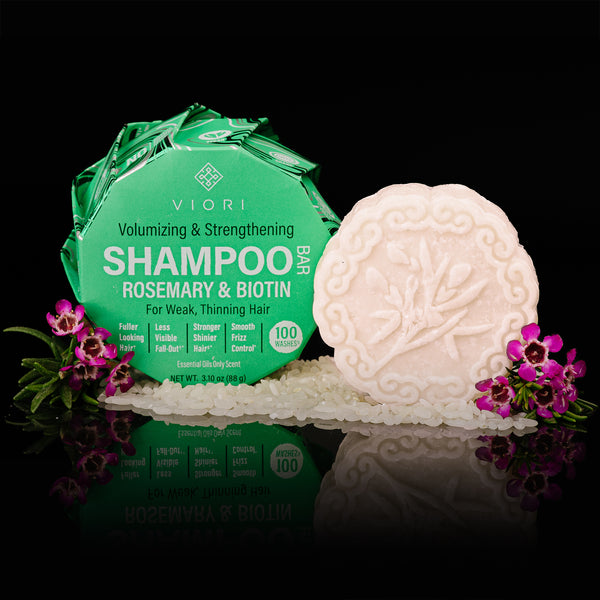
Real reviews for Rosemary Biotin Shampoo Bar – Thinning Hair | VIORI
The Synergy Factor: Why Ginger Alone Won't Solve Hair Loss
After 20 years of professional hair care, I can tell you with certainty: single-ingredient approaches to hair loss rarely succeed. The most glowing ginger bar reviews typically involve products with multiple complementary ingredients-but reviewers attribute all results to the ginger.
What Actually Works: Comprehensive Formulation
Effective hair loss support requires a multi-pronged approach:
- Circulatory stimulants (like ginger) to increase blood flow to follicles
- Protein sources for structural hair repair and strengthening
- B vitamins for follicular metabolism (especially inositol and panthenol)
- Anti-inflammatory compounds to create a healthy scalp environment
- Moisture regulation to prevent breakage and support scalp barrier function
When someone reviews a "ginger bar" positively, they may actually be responding to supporting ingredients while crediting the ginger-or dismissing an effective product because they don't feel the ginger "warming" sensation they expected.
Viori's bars exemplify this synergistic approach:
- Fermented Longsheng rice water provides growth-promoting proteins and amino acids
- Fermentation-enhanced B vitamins (especially B5 and B8) support follicular metabolism
- Rice bran oil delivers antioxidants that protect follicles from oxidative stress
- Bamboo and aloe reduce scalp inflammation
- Cocoa and shea butter provide moisture balance
This is formulation sophistication-addressing hair health from multiple angles rather than betting everything on a single trending ingredient.
The Timeline Problem: Why Most Reviews Are Meaningless
Here's a harsh professional truth that will change how you read reviews forever: hair growth cycles make any review under 90 days essentially worthless for evaluating hair loss products-yet most online reviews fall into this category.
The Hair Growth Reality
Your hair follicles cycle through distinct phases:
- Anagen (growth) phase: 2-7 years
- Catagen (transition) phase: 2-3 weeks
- Telogen (resting) phase: 3-4 months
If you're experiencing hair loss, you have follicles scattered across all these stages, with many stuck in telogen. No topical product can force a telogen follicle into anagen-you must wait for the natural cycle to complete.
What Reviews Actually Measure at Different Timeframes
- Week 1-4 reviews: Measuring only immediate sensory effects (tingling, scent, how hair feels) and placebo response
- Week 4-8 reviews: May capture reduced shedding, which is often just normal cycle completion misattributed to the product
- Week 8-12 reviews: Beginning to capture actual effects on new growth
- 3+ month reviews: Actually meaningful for assessing hair loss impact
When you see a rave review from someone who's used a ginger bar for two weeks, they're telling you about how it smells and feels-nothing more. They literally haven't used it long enough for hair growth effects to be measurable.
Viori acknowledges this reality in their guidance, noting that results vary and recommending 2-3 months of use before evaluation. This demonstrates formulation honesty rather than promising overnight miracles that biological reality cannot deliver.
Your Bathroom is Changing Your Product Chemistry
Here's something I've observed professionally that reviews completely ignore: bar shampoos aren't chemically static


