
"Why doesn't my hair look like that?"
I hear this question at least three times a week. A client slides her phone across my station, showing me an Instagram post or a screenshot from a commercial-hair flowing in perfect, glossy waves that seem to defy gravity itself. Her expression is a mixture of hope and frustration.
After two decades as a beauty professional, I've learned that this simple question reveals something profound about shampoo advertising. These commercials aren't really selling cleansing products. They're selling an emotional transformation that no bottle-or bar-can deliver alone.
The global hair care industry generates over $87 billion annually, and a significant portion of that comes from advertising that creates a very specific kind of dissatisfaction. Not anger. Not disgust. Something more subtle and more powerful: the feeling that you're just one product away from the hair-and by extension, the life-you're supposed to have.
Let me share what most people never see: the enormous gap between what these commercials promise and what hair science actually allows.
The Technical Deception: What Those Flowing Locks Really Are
The Hair Model Reality Nobody Discusses
Here's something the average consumer doesn't know: the models in shampoo commercials typically have what we in the industry call "virgin hair." This means hair that has never been chemically processed, is rarely heat-styled, and has been maintained with professional treatments worth thousands of dollars annually.
Even more telling, these models are specifically chosen for having low-porosity, fine-to-medium density hair that photographs with exceptional shine. In my salon, when I work with this hair type-which represents perhaps 10-15% of the general population-even basic products create dramatic visual results.
The hair you're seeing isn't representative. It's exceptional. It's like using Olympic athletes to advertise running shoes and wondering why you can't run that fast.
NOT SURE WHICH PRODUCT IS RIGHT FOR YOU?
TAKE THE QUIZTakes 30 seconds · 134,000+ customers matched
The "Wet Hair" Illusion
One of the most pervasive technical deceptions involves those gorgeous "washing" sequences. That luminous, perfectly-flowing wet hair cascading down the model's back? It's rarely actually wet with water and shampoo.
Industry insiders know these sequences often use:
- Glycerin-based gels that create the appearance of wetness while maintaining complete control over hair movement
- Silicone serums applied heavily to create that "just rinsed" gleam
- Strategic lighting positioned to catch every possible reflection point
- Calibrated wind machines to move hair in ways that water-weighted hair never naturally would
Here's what actually happens when you wash your hair with real shampoo and water: the surfactants temporarily strip some of your hair's natural sebum, the cuticle swells slightly, and the hair becomes heavier and less manageable. Real wet hair clumps together, tangles easily, and looks darker-none of which appears in these commercials.
The wet hair in commercials moves like silk. Real wet hair moves like... wet hair.
The "Before and After" Manipulation
Perhaps the most technically dishonest element is the before-and-after comparison. Having worked on editorial photoshoots early in my career, I can tell you the "before" image is often intentionally degraded.
Here's how it's done:
Creating the "Before":
- Models are instructed not to wash hair for several days before shooting
- Hair is backcombed or teased to create frizz and disorder
- Matte powder products are applied to eliminate any natural shine
- Lighting is deliberately flat and unflattering
- Models are asked to adopt tired, lifeless facial expressions
- Sometimes they'll even use a completely different person with different hair texture
Creating the "After":
- Professional styling with high-end tools
- Optimal lighting from multiple angles
- Digital retouching to remove every flyaway
- Post-production color correction to enhance shine
- A confident expression and engaging pose
- Often shot on a completely different day or even a different shoot entirely
It's not the shampoo that created the transformation. It's professional intervention at every single step.
The Psychological Architecture: Manufacturing the Need
The Aspirational Gap Theory
Shampoo commercials operate on what I call the "Aspirational Gap Theory." They must make your current hair seem inadequate while presenting an ideal that appears achievable (yet actually remains unattainable). This gap is carefully calculated.
Too small, and there's no motivation to purchase. Too large, and the claim becomes unbelievable.
The genius lies in the emotional narrative. These commercials don't explicitly say "your hair is terrible." Instead, they show you women experiencing joy, confidence, professional success, and romantic attention-then subtly link these life outcomes to their hair condition.
The message becomes: "Your life could feel like this, if only your hair looked different."
It's insidious because it's never stated directly. The association happens in your subconscious, which is precisely where the most effective advertising operates.
The Slow-Motion Phenomenon
Have you noticed that virtually every shampoo commercial features slow-motion hair movement? This isn't merely aesthetic-it's neurologically calculated.
From a psychological perspective, slow motion creates several effects:
- Increased Processing Time: Your brain has more opportunity to absorb the visual information, making the imagery more memorable
- Perception of Luxury: Slow motion is cognitively associated with high-value items worth examining in detail
- Emotional Amplification: Slower movement allows for greater emotional projection onto the subject
- Defamiliarization: Hair moving at unnatural speeds becomes hypnotic, almost otherworldly
But here's what your brain doesn't consciously process: hair cannot move that way in real life. The weight, texture, and natural friction of actual hair-especially healthy hair-prevent that liquid, continuous flow.
By showing you something physically impossible and associating it with their product, these commercials create a perpetual cycle of striving toward the unattainable.
The Visual Vocabulary: Decoding the Hidden Language
Color Psychology in Hair Advertising
As a colorist, I'm particularly attuned to how shampoo commercials use color semiotics. The overwhelming prevalence of certain shades isn't accidental.
Rich Brunettes and Deep Browns: These shades photograph with maximum shine and dimension. Light reflects off dark hair more dramatically than off lighter shades, creating that "liquid silk" appearance. Commercials favor these tones not because the product works better on dark hair, but because dark hair creates more visually impressive results on camera.
Dimensional Blonde Shades: When blondes appear, they're almost always featuring complex, multi-tonal color-never flat, single-process blonde. Why? Because dimension creates visual interest and movement that the camera can track. It also requires significant professional intervention to achieve, yet the commercial implies the shampoo alone maintains this complexity.
I've had countless blonde clients ask why their hair doesn't look like the commercial. The answer: the commercial blonde has $300+ worth of balayage or highlight work that took 3-4 hours to complete.
The Touch Gesture
Watch any shampoo commercial and count how many times the model touches her own hair. This gesture appears with remarkable consistency across brands and decades, and it's psychologically deliberate.
The self-touch communicates:
- Tactile pleasure: "This hair feels so good I can't stop touching it"
- Confidence: Touching one's own hair is a display of self-assurance
- Invitation: The gesture subconsciously invites the viewer to imagine touching hair that feels that good
- Product validation: The physical interaction "proves" the product delivered tangible, feelable results
Here's the irony: professional hairstylists generally advise clients not to constantly touch their hair. The oils from your hands transfer to the hair, making it look greasy faster and causing styles to fall. The very behavior these commercials glorify contradicts professional hair care advice.
The Transformation Narrative Arc
Most shampoo commercials follow a remarkably consistent storytelling structure:
- The Ordinary World: Woman with "problem" hair in an everyday setting
- The Call to Adventure: Discovery or decision to try the new product
- Transformation Sequence: The washing/application (often the most sensory and intimate footage)
- The New Reality: Woman with transformed hair experiencing elevated life circumstances
- The Resolution: Confident woman, often receiving social validation
This structure isn't accidental-it mirrors Joseph Campbell's "hero's journey" framework, the same narrative pattern found in mythology and blockbuster films. By positioning a shampoo purchase as the catalyst for a heroic transformation, these commercials tap into deep narrative patterns that humans find psychologically compelling.
Your brain processes the commercial the same way it processes a story about overcoming obstacles and achieving transformation. Except the "obstacle" is your current hair, and the "achievement" is purchasing their product.
The Unspoken Reality: What Commercials Don't Tell You
The Professional Styling Truth
Here's what I tell every client who brings in a commercial-inspired photo: what you're seeing required a team of specialists working for hours, sometimes days.
A typical high-budget shampoo commercial involves:
- Professional colorist: Creating optimal base color and dimension ($200-500)
- Hairstylist: Cutting, shaping, and prepping the hair before filming ($100-300)
- On-set stylist: Maintaining perfect hair between takes (multiple takes are always required)
- Lighting director: Positioning lights to maximize shine and minimize imperfections
- Makeup artist: Ensuring face and hair color palette harmonize
- Digital retoucher: Removing flyaways, enhancing shine, smoothing texture, perfecting movement in post-production
The shampoo itself is often the least important factor in how that hair looks.
I've worked on editorial shoots where we used whatever shampoo happened to be available backstage-sometimes basic, inexpensive formulas-and the results photographed beautifully. Why? Because of everything else we did.
The Cumulative Care Illusion
Shampoo commercials create what I call the "Cumulative Care Illusion"-the suggestion that using their product alone will create the results shown.
In my professional experience, hair that looks like commercial hair is the result of cumulative care:
- Genetic foundation: Natural hair texture, density, and growth patterns you're born with
- Professional color services: Properly formulated and applied color that enhances rather than damages
- Regular cuts: Maintaining shape and removing damage every 6-8 weeks
- Deep conditioning treatments: Professional treatments with concentrated, high-quality ingredients
- Heat protection: Quality products used before any thermal styling
- Proper styling technique: Professional methods that maximize your hair's natural attributes
- Lifestyle factors: Nutrition, hydration, stress management, and sleep quality all affect hair health
- And yes, appropriate shampoo: But as one component among many, not the sole factor
The commercial implies the shampoo alone creates the transformation. In reality, it's one small piece of a much larger puzzle.
WHAT CUSTOMERS ARE SAYING
Real reviews for Hidden Waterfall Barra de Champú
A Different Approach: Transparency in an Industry of Illusion
The Viori Difference
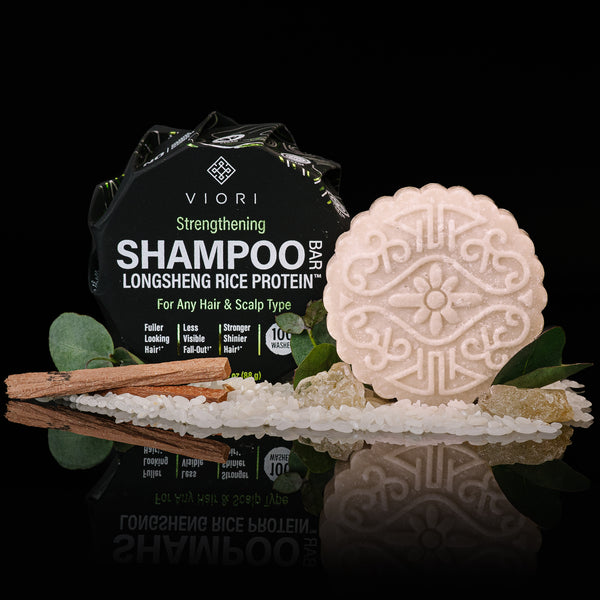
At Viori, we've chosen a different path-one that respects both hair science and consumer intelligence. Rather than creating impossible aspirations, our approach acknowledges the reality of how hair actually responds to ingredients.
The Red Yao women of Longsheng didn't develop their hair care rituals in a television studio with ring lights and wind machines. Their hair health-maintained into their 80s with minimal graying-comes from consistent use of properly fermented rice water rich in specific nutrients.
These include vitamins B5 and B8 (panthenol and inositol), along with rice protein. These aren't just marketing claims; they're compounds with documented effects on hair structure that you can research in cosmetic chemistry journals.
What makes this formulation honest is the acknowledgment that rice water at extremely high concentrations can actually disrupt your hair's pH balance. Rather than using maximum concentrations for exaggerated claims, Viori uses measured amounts that can be safely used daily, combined with complementary ingredients that support long-term hair health rather than creating temporary cosmetic effects.
pH Balance: The Unsexy Truth
Here's something you'll never see in a mainstream shampoo commercial: a detailed discussion of pH balance. Why? Because it's not visually dramatic. You can't film pH balance in slow-motion with wind machines.
But as a professional, I can tell you that pH balance is one of the most critical factors in hair health.
Hair's natural pH is between 4.5 and 5.5-slightly acidic. Many commercial shampoos have a pH of 8.0 or higher (alkaline) because higher pH creates more lather, and consumers have been conditioned to associate lather with cleaning power.
However, alkaline pH causes the hair cuticle to swell and open, leading to:
- Increased porosity and moisture loss
- Accelerated color fading
- Frizz and lack of manageability
- Cumulative damage over time
- Dull appearance despite "shine-enhancing" claims
Viori's bars are pH balanced between 3.5-6.5, which is optimal for hair health. This won't create dramatic before-and-after photos after one use, but it will support your hair's structural integrity over months and years of consistent use.
That's the difference between cosmetic effect and actual care.
Scent Chemistry: The Hidden Influencer
One rarely discussed element of shampoo commercials is scent. Obviously, you can't smell a television commercial, yet scent plays a massive role in how satisfied customers feel with hair products.
Research shows that scent can actually override visual assessment-people who smell something pleasant rate their hair as feeling better, even when objective measures show no difference. This is called the "olfactory-tactile cross-modal effect," and it's well-documented in consumer psychology.
Viori acknowledges this psychological reality while maintaining ingredient integrity. The fragrances used in varieties like Citrus Yao, Hidden Waterfall, and Terrace Garden are composed of essential oils and natural-equivalent compounds. They offer sensory pleasure without compromising the product's natural foundation.
For those sensitive to any


