
Twenty years ago, when I first picked up my shears professionally, suggesting someone wash their hair with a solid bar would've gotten me laughed out of the salon. It was something your grandmother did because she had to, not because she wanted to. Today? I'm watching the entire beauty industry turn itself inside out over this very concept. But here's what gets me-most conversations about unwrapped, solid-format products barely scratch the surface of what's actually happening when you make this switch.
I want to share something I've been calling the "unwrapped paradox," because going package-free changes so much more than your bathroom's plastic footprint. It transforms how you think about product value, how you approach your daily rituals, and even the actual chemistry occurring on your scalp right now.
The Trust Factor: Why Ditching Packaging Changes Everything
Here's something that might not have crossed your mind: when you buy an unwrapped product, you're entering a completely different trust relationship with whoever made it.
Think about traditional liquid shampoo for a second. That bottle isn't just holding the product-it's a sealed promise. Of sterility. Of freshness. Of protection from contamination. The packaging itself communicates safety before you even glance at the ingredient list. That pump or cap? Nobody's touched it but you.
Strip away that barrier, and suddenly you're trusting the manufacturing process, the storage conditions, every single person who handled that bar between creation and your shower caddy. This isn't a trivial psychological shift.
From a technical standpoint, this creates fascinating formulation challenges. Traditional liquid shampoos are roughly 70-80% water, which makes them incredibly vulnerable to microbial growth. This is exactly why they're loaded with preservatives-parabens, phenoxyethanol, or whatever newer alternatives brands are using now. The moment water enters the picture and that seal breaks, you've basically created a potential petri dish.
But solid bars? They're essentially self-preserving through their low moisture content. At Viori, our bar format contains minimal water, which means the formula doesn't need those aggressive preservation systems. This is why properly stored bars can have a shelf life of 3-5 years-something almost unheard of in liquid formulations without significant preservative loads.
So when you choose an unwrapped bar, you're not just choosing less packaging. You're choosing a fundamentally different preservation philosophy altogether.
The Friction Factor: How Physical Contact Changes Everything
Let's talk about something beauty marketing conveniently ignores: the actual physical interaction between your hair and a solid bar creates a completely different delivery system than liquid products.
When you apply a bar directly to your hair or create lather in your hands, you're introducing mechanical action that simply doesn't exist with liquids. This isn't just a different application method-it fundamentally affects how ingredients interact with your hair structure.
NOT SURE WHICH PRODUCT IS RIGHT FOR YOU?
TAKE THE QUIZTakes 30 seconds · 134,000+ customers matched
Quick hair biology refresher: Each strand is covered in overlapping scales called cuticles, like shingles on a roof. Traditional liquid shampoos flow smoothly over these scales with minimal disruption. But when you use a bar with direct application, that friction temporarily raises those cuticle scales, allowing ingredients to penetrate more deeply.
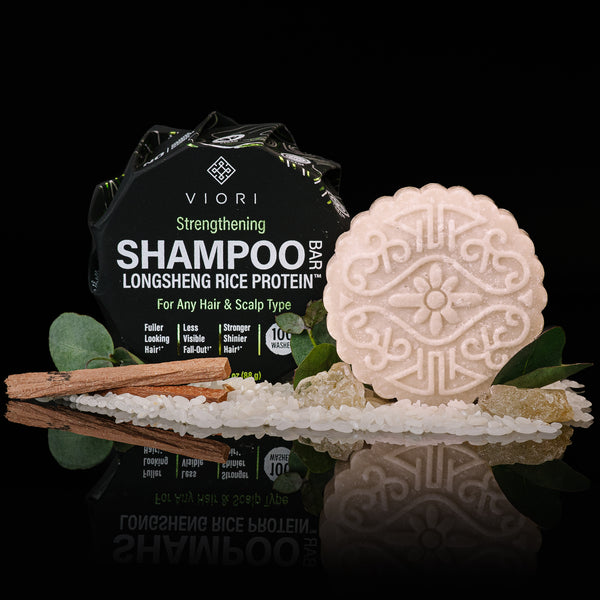
This is particularly relevant for protein-based ingredients. For instance, the hydrolyzed rice protein in Viori's formulations can actually access the hair shaft more effectively through this mechanical lifting action. It's like the difference between pouring water over closed venetian blinds versus gently tilting them open-suddenly, there's deeper access.
However-and this is crucial-this same friction can be problematic for certain hair conditions. If you have color-treated hair, especially hair colored with semi-permanent or demi-permanent dyes that sit on the cuticle surface, you might experience faster color fading. Not necessarily because of harsh cleansing agents, but because of this mechanical action itself.
This is why technique matters so much with bar products. For color-treated hair, I always recommend creating lather in your palms first rather than applying the bar directly to your head. This simple adjustment reduces friction while maintaining cleansing efficacy.
The Concentration Question: Understanding What You're Actually Getting
One of the most misunderstood aspects of bar products is their concentration compared to liquid alternatives. Let's dive into the chemistry for a moment.
Remember how I mentioned that liquid shampoos are 70-80% water? That means only 20-30% of what you're buying is actually active ingredients-surfactants (cleansing agents), conditioning agents, fragrance, preservatives, and beneficial actives.
When you remove water and create a solid bar, you're essentially creating a concentrated version where active ingredients comprise a much higher percentage by weight.
But here's what matters more than concentration alone: bioavailability-how effectively those ingredients can be delivered to and absorbed by your hair and scalp.
Unwrapped bars create an interesting technical advantage here. Without the dilution factor of water-based formulations, ingredients like rice bran oil, cocoa butter, and shea butter in Viori's bars can remain in their more natural, less processed states. These butters and oils provide occlusivity (sealing in moisture) and emollience (softening) that would require complex emulsification systems-additional chemical processing-in liquid formulations.
The trade-off? These concentrated formats require you to understand proper application techniques. Too much product creates buildup that weighs hair down; too little provides inadequate cleansing. This learning curve is a significant factor in why some users report that bars "don't work" for them-it's often a technique issue rather than a formulation problem.
Think of it like learning to drive a manual transmission after years of automatic. Same destination, completely different skill set required.
The Water Hardness Wild Card: Why Your Location Affects Results
Here's something I've encountered repeatedly in salon work that almost never appears in discussions about bar products: your water quality dramatically affects performance.
Hard water contains high levels of dissolved minerals-primarily calcium and magnesium. When cleansing products interact with these minerals, they can form insoluble deposits (that's the soap scum on your shower door). Liquid shampoos typically contain chelating agents like EDTA or citric acid that bind these minerals and prevent this reaction.
Bar products, with their concentrated formulations, can be more susceptible to hard water interference. When you wet a bar and create lather, you're diluting it with whatever water is available-and if that water is hard, you're potentially creating conditions for mineral buildup on hair.
This explains something I find fascinating: geographical variation in reviews. Someone with soft water in Seattle may have a completely different experience than someone with extremely hard water in Phoenix, using the identical product with identical technique.
The technical solution involves several strategies. Formulation pH is critical-Viori maintains a pH between 3.5-6.5 to support the scalp's natural acidic environment. Post-wash rinses with diluted apple cider vinegar can help. And chelating ingredients built into the formula, like sodium lactate in Viori's shampoo bars, serve multiple functions including moisture retention and acting as a mild chelating agent.
If you're struggling with bar products, check your local water report. You might be fighting chemistry, not the product.
The Ritual Transformation: How Bars Change Your Relationship With Hair Care
Moving beyond pure chemistry, let's examine something I find vastly more interesting: the psychological dimensions of unwrapped product use.
Using a bar requires what cognitive psychologists call "increased cognitive load." You must:
- Store the product properly to prevent dissolution
- Control the amount used through physical manipulation rather than dispensing from a pump
- Judge coverage and effectiveness without visual cues (bars don't create opaque, pearlescent lather from synthetic agents)
- Manage between-use drying to prevent waste
- Adjust technique based on your specific hair condition and water quality
This increased engagement fundamentally changes your relationship with the product. It's no longer a mindless routine but an active practice.
In my twenty years working with clients, I've observed this works in two distinct directions:
For engaged users, this creates a sense of craftsmanship and connection. They feel they're actively doing something beneficial for their hair health, which can actually enhance perceived effectiveness through what psychologists call the "effort justification effect"-we value things more highly when we invest effort in them.
For convenience-oriented users, this cognitive load represents unwanted friction in their routine, leading to dissatisfaction regardless of actual product performance.
This is why the "unwrapped life" isn't really about packaging at all-it's about whether you're willing to trade convenience for engagement. It's a fundamentally different value proposition that appeals to different personality types and life circumstances.
There's no wrong answer here. A busy parent getting three kids ready for school has different needs than someone who views their evening routine as meditative self-care time.
The Longevity Question: Do Bars Really Last Longer?
Let's address the claim that bar products last longer than liquid equivalents with some actual technical precision.
A typical Viori shampoo bar weighs approximately 90 grams and lasts 60+ washes. A standard liquid shampoo bottle contains 10-12 fluid ounces (300-355 ml). For proper comparison, we need to consider several factors:
Concentration differences: That 90g bar is essentially water-free, while the liquid bottle is 70-80% water. Remove water from both, and you're comparing roughly 90g of concentrated actives in the bar versus approximately 60-70g in a liquid bottle.
Usage control: Liquid products are notoriously overused. Studies suggest consumers use 2-3 times more liquid shampoo per wash than necessary. It's easy to over-pump or over-pour. Bars, by their physical nature, regulate usage more effectively-it's genuinely harder to use "too much" solid product.
Waste factors: Liquid bottles rarely get completely emptied. Product clings to the sides, pumps retain solution. Bars can be used down to tiny fragments, especially if you combine small pieces or use a soap saver bag.
When you factor in these variables, a single bar genuinely might replace 2-3 liquid bottles-but not simply because bars contain more product. Rather, they enforce more efficient usage and generate less waste throughout their lifetime.
This has profound implications for actual cost and environmental impact that go well beyond simple packaging reduction.
The Scalp Microbiome: A Cutting-Edge Consideration
Here's a technical angle you've probably never considered: how might unwrapped products affect scalp microbiome health differently than liquid alternatives?
Your scalp hosts a complex ecosystem of microorganisms-bacteria, fungi, and other microbes that play crucial roles in scalp health, odor control, and even hair growth signaling. Traditional liquid shampoos, with their preservatives and sometimes aggressive surfactant systems, can significantly disrupt this delicate ecosystem.
Bar products, particularly those formulated with natural ingredients and without synthetic preservatives, may interact with scalp microbiota differently. pH-balanced formulations that maintain the scalp's natural acidic environment support beneficial microbe populations.
Furthermore, ingredients like fermented rice water-which Viori uses-contain postbiotics: beneficial compounds produced during fermentation that support healthy microbial balance. The fermentation process increases concentrations of B vitamins (particularly inositol and panthenol) while creating short-chain fatty acids that beneficial scalp microbes can utilize.
This means the "unwrapped life" might not just be about what you're removing-plastic, preservatives, synthetic ingredients-but what you're supporting: a more balanced scalp ecosystem that contributes to long-term hair health in ways immediate cosmetic results don't capture.
We're only beginning to understand scalp microbiome science, but early research suggests that gentle, pH-appropriate cleansing that doesn't strip away all natural oils or destroy beneficial microbes may contribute to healthier long-term hair growth and scalp condition.
The Honest Truth About Limitations
Let's be technically honest about something sustainability marketing often glosses over: solid bar formats impose real formulation constraints.
Ingredient solubility: Some highly effective ingredients simply won't remain stable in anhydrous (water-free) solid formats. Certain peptides, some vitamins, and specific plant extracts require aqueous environments for stability and bioavailability.
Sensory experience: Consumers have been conditioned through decades of marketing to associate thick, luxurious lather with cleansing efficacy and creamy, slippery textures with conditioning effectiveness. Bars can create lather, but the sensory experience differs markedly. Solid conditioning bars create more of a paste texture that feels nothing like the creamy glide of liquid conditioners, even when delivering similar or superior benefits.
WHAT CUSTOMERS ARE SAYING
Real reviews for Hidden Waterfall Barra de Champú
Customization limitations: Liquid products can be easily customized at home with additives-oils, proteins, extracts. Bars are essentially fixed formulations.
These aren't failures of bar technology-they're inherent characteristics of the format. Understanding them helps us recognize that unwrapped products aren't universally superior; they're differently optimized with distinct advantages and trade-offs.
The Storage Challenge: Humidity, Heat, and Product Integrity
Here's a practical challenge that deserves more attention: unwrapped bars face environmental stresses that packaged liquid products never encounter.
Humidity: Solid bars are hygroscopic-they absorb moisture from the air. In humid environments, this causes surface softening leading to faster dissolution, potential microbial colonization on the surface, texture changes, and "sweating" (water beading on the surface).
Temperature: Heat affects solid bars differently than liquids. Bars containing butters like cocoa butter and shea butter can partially melt at temperatures above 75-80°F, then re-solidify, which may alter texture and usability.
Storage solutions: The recommendation for elevated holders with drainage isn't merely aesthetic-it's functional engineering. The key is creating airflow around all surfaces of the bar to facilitate drying while preventing water pooling.
The technical truth? Unwrapped products demand environmental management at the user level. Your bathroom's humidity, temperature, and air circulation patterns affect product performance and longevity. This is a hidden responsibility of the "unwrapped life"-you're essentially taking on quality control duties traditionally managed by packaging.
For optimal longevity, store bars away from direct water spray, allow them to dry completely between uses, and if possible, rotate between two bars to extend the drying time for each.
The Economic Paradox: When Sustainable Becomes Premium
Let's examine a fascinating economic quirk: removing packaging should theoretically reduce costs-less material, simplified shipping (bars are lighter and denser than liquid-filled bottles), reduced manufacturing complexity. Yet unwrapped bar products frequently command premium prices compared to mass-market liquid alternatives.
Why?
Formulation expertise: Creating effective bars requires specialized knowledge. The chemistry differs significantly from liquid formulations, and formulators with this expertise are relatively rare.
Market positioning: Unwrapped products are positioned in the "conscious consumer" segment, where buyers expect to pay more for values alignment-sustainability, ethics, natural ingredients.
Production scale: Most bar products are manufactured in smaller batches than mass-market liquids, reducing economies of scale.
Ingredient quality: Many brands leveraging unwrapped formats also prioritize premium, natural, or ethically sourced ingredients. Viori, for example, sources Longsheng rice directly from Red Yao villages through fair trade partnerships, which increases input costs but ensures quality and supports indigenous communities.
However, when you calculate cost per wash rather than cost per unit, bars often prove more economical. That premium upfront price distributes across significantly more uses, frequently resulting in lower total cost over time.
What the Unwrapped Life Really Means
After two decades in this industry, I've learned that the unwrapped product movement represents something far more complex than plastic-free packaging. It's a fundamental restructuring of:


