
I'll never forget the moment that completely changed how I recommend hair care products to my clients.
A woman I'd been styling for years sat down in my chair, visibly upset. She'd dropped hundreds of dollars on highly-rated products-the ones with five-star reviews and celebrity backing. Her bathroom counter looked like a beauty supply warehouse. Yet somehow, her hair had become drier, more brittle, and more lifeless than before she'd started her "upgrade" journey.
"I'm doing everything the reviews said," she told me, fighting back tears. "So why does my hair look worse?"
That conversation launched me into a deep dive that fundamentally transformed my entire professional approach. After twenty years in this industry, I realized we'd all been asking the wrong questions about hair care.
The Living Ecosystem on Your Scalp That Nobody Talks About
Here's something that will blow your mind: your scalp is home to roughly one million microorganisms per square centimeter.
Yes, you read that right. A million. Per square centimeter.
Your scalp isn't just skin with hair growing out of it-it's a thriving, complex ecosystem of bacteria, fungi, and other microscopic life that directly controls everything from how much oil you produce to your actual hair growth patterns. This invisible community is as unique to you as your fingerprint, and it's just as important to your hair health as any product you'll ever buy.
Yet almost nobody in the beauty industry talks about it.
When I started explaining this concept to clients, I watched the same lightbulb moment happen over and over. Suddenly, all their frustrating hair problems made perfect sense:
- The greasiness that shows up just hours after washing
- The mysterious scalp irritation that comes and goes
- The products that work miracles for their best friend but turn their hair into straw
- The expensive salon treatments that deliver absolutely zero results
These aren't signs of bad products or difficult hair. They're symptoms of microbiome disruption.
Your scalp's microbial balance controls:
NOT SURE WHICH PRODUCT IS RIGHT FOR YOU?
TAKE THE QUIZTakes 30 seconds · 134,000+ customers matched
- How much oil your scalp produces and when it produces it
- Inflammation and sensitivity responses
- The health and function of your hair follicles
- Your scalp's natural pH level
- The protective barriers that keep your scalp and hair healthy
Every single time you wash your hair, you're directly interacting with this invisible ecosystem. The real question is: are your products working with it or against it?
The Ancient Hair Ritual That Modern Science Finally Validated
Let me tell you about something remarkable I discovered while researching traditional hair care practices.
The Red Yao women of Huangluo village in China maintain jet-black, floor-length hair well into their eighties. Back in 2004, the Guinness World Records recognized them as the "world's longest hair village."
For nearly 2,000 years, these women have followed the same hair care ritual: washing with fermented rice water.
Here's what convinced me this wasn't just folklore or good genetics: the men of the Red Yao tribe don't use rice water in their hair care routine, and they don't have the same remarkably gray-free hair. If this was purely genetic, both men and women would share this trait. But they don't.
This pointed to something genuinely powerful in their rice water tradition.
Why Fermentation Transforms Ordinary Ingredients
For years, I dismissed ingredients like rice water as clever marketing tactics. Then I learned about the actual molecular effects of fermentation, and my professional skepticism completely evaporated.
Fermentation doesn't just preserve ingredients-it fundamentally transforms them at a molecular level:
When rice water ferments, the process breaks down complex molecular structures, creating:
- Smaller nutrient molecules that can actually penetrate your hair cuticle instead of just sitting on the surface
- Increased bioavailability of proteins and vitamins-meaning your hair can actually absorb and use them, not just touch them
- Natural probiotics that actively support your scalp's microbiome (remember those millions of microorganisms I mentioned?)
- Dramatically elevated B vitamins, particularly inositol (B8) and panthenol (B5)
Those last two vitamins matter enormously. Clinical research on inositol and panthenol demonstrates measurable improvements in hair strength, regeneration, and reduced graying. Not subjective "looks a bit shinier" results-actual, quantifiable changes in hair structure that show up under scientific testing.
This is exactly why at Viori, we don't just use regular rice water-we use fermented Longsheng rice water following the traditional Red Yao method. This isn't about romantic marketing imagery or exotic storytelling. It's about recognizing that this specific, high-starch, short-grain rice variety grown in these ancient mountain terraces has biochemical properties that regular rice water simply cannot replicate.
The fermentation process increases those critical B vitamins to levels that create real, visible transformation over time.
The pH Problem That's Sabotaging Your Hair
Let's dive into something technical that affects the results you get from every single wash: pH levels.
Your hair's optimal pH sits between 3.5 and 5.5-that's acidic. Your scalp's sweet spot hovers around 4.5 to 5.5. Most commercial shampoos? They drift toward alkalinity, often hitting pH 8.0 or even higher.
Here's exactly what happens when pH is too high:
- Your hair cuticles get forced open excessively
- Your scalp's protective acid mantle gets completely stripped away
- Your microbiome gets thrown into chaos
- Your scalp panics and triggers compensatory oil production
That last point is absolutely crucial. When a client tells me their roots look greasy the day after washing, nine times out of ten, the problem isn't their hair type or their genetics-it's pH disruption. Their scalp is working overtime trying to restore the protective barrier that harsh shampoo just obliterated.
It's like your scalp is frantically bailing water out of a boat with a hole in it. You can bail faster by washing more frequently, but you're never actually fixing the hole-the pH imbalance.
Quality formulations maintain pH levels that cleanse effectively without triggering this desperate reactive cycle.
This is why truly effective products can actually extend the time between washes. Not because they're leaving residue or coating your hair, but because they're not disrupting your scalp's natural equilibrium in the first place.
I've watched clients go from washing daily to washing twice weekly without even trying, simply because their scalp stopped overcompensating for damage that was no longer happening.
Why Your Friend's Holy Grail Product Destroyed Your Hair
Here's a scenario I encounter constantly in my chair: someone enthusiastically raves about their miracle product. You buy it, excited for the same dramatic transformation. Instead, your hair feels absolutely awful.
You wonder if maybe you got a bad batch. Maybe your hair is just impossibly difficult. Perhaps all those glowing reviews were fake.
Usually, the answer is much simpler: porosity.
Hair porosity-how your hair absorbs and retains moisture-varies dramatically from person to person. It's like the difference between a paper towel and a plastic bag. Both are useful materials, but they interact with water in completely opposite ways.
The Three Porosity Types
Low Porosity Hair has tightly closed cuticles that actively repel moisture. Imagine trying to water a plant with thick, waxy leaves-everything just beads up and rolls right off. Heavy oils and rich butters create buildup rather than providing nourishment. These hair types desperately need lightweight products that can actually penetrate.
High Porosity Hair has gaps and holes in the cuticle layer, usually from damage or chemical processing. It's like a sponge-it absorbs absolutely everything but retains practically nothing. You can deep condition for hours and still wake up the next morning with dry, frizzy hair. These types need proteins to physically fill the gaps and heavier ingredients to seal everything in.
Normal Porosity Hair falls somewhere in the middle, with cuticles that open and close appropriately in response to moisture. These are the lucky folks who have the easiest time finding products that work well.
This single factor explains so many product frustrations. It's not about quality versus cheap-it's about biological compatibility with your specific hair structure.
Rice protein offers something genuinely unique here. Its molecular size allows it to fill gaps in high-porosity hair while still being light enough not to overwhelm low-porosity strands. Combined with natural emollients like cocoa and shea butter-both of which we incorporate into Viori formulations-you get adaptive conditioning that responds to your hair's actual needs rather than forcing a one-size-fits-all approach that works for nobody.
The Sulfate Conversation Nobody's Having Correctly
Let's get technical for a moment about cleansing agents, because the "sulfate-free" marketing trend has created way more confusion than clarity.
Not all sulfates are created equal. And not all "sulfate-free" products are actually gentle.
The sulfates to genuinely avoid: Sodium lauryl sulfate (SLS) and sodium laureth sulfate (SLES) are indeed harsh and stripping. These are the problematic ingredients that earned sulfates their terrible reputation in the first place.
But here's where it gets really confusing: Chemical compounds like behentrimonium methosulfate contain the word "sulfate" in their name but function completely differently due to their molecular structure. This particular ingredient is actually a gentle conditioning agent, not a harsh cleanser at all.
At Viori, we use behentrimonium methosulfate derived from the colza plant in our conditioner bars. Despite having "sulfate" right there in its chemical name, it's so gentle it's routinely used in baby products.
For cleansing, we use sodium cocoyl isethionate (SCI)-often called "baby foam" in the professional industry because it's derived from coconut and mild enough for the most sensitive skin while still effectively removing product buildup and environmental pollutants.
This chemistry nuance gets completely lost in oversimplified marketing messages. "Sulfate-free" has become a meaningless catchall term that doesn't actually tell you whether a product is gentle, effective, or compatible with your hair.
The Revolutionary Aspect of Bar Products Nobody Mentions
When I first encountered bar shampoo several years ago, my initial reaction was pure skepticism. I'd spent two decades working exclusively with liquid formulations. Bars felt like a step backward, like going back to using soap on your hair.
Then I learned about formulation chemistry, and my perspective completely shifted.
Here's what most consumers don't realize: water makes up 70 to 90 percent of liquid shampoos and conditioners.
Think about that for a moment. You're paying for-and hauling home from the store-mostly water.
This creates several significant problems:
Preservation requirements: Water-based products absolutely require synthetic preservatives to prevent bacterial and mold growth. Those preservatives can irritate sensitive scalps and disrupt your microbiome balance.
Ingredient dilution: All those active ingredients you're paying premium prices for are massively diluted. You're getting a tiny fraction of their potential benefit with each wash.
Packaging and shipping waste: You're transporting heavy water in plastic bottles, creating completely unnecessary environmental impact.
WHAT CUSTOMERS ARE SAYING
Real reviews for Hidden Waterfall Barra de Champú
The Bar Advantage
Concentrated formulations without added water means:
- No synthetic preservatives needed. Viori bars use sodium lactate derived from fermented corn and beets as a natural preservative, though bars are essentially self-preserving when kept dry between uses.
- Higher concentration of active ingredients per wash. You're getting undiluted nutrients with every single application.
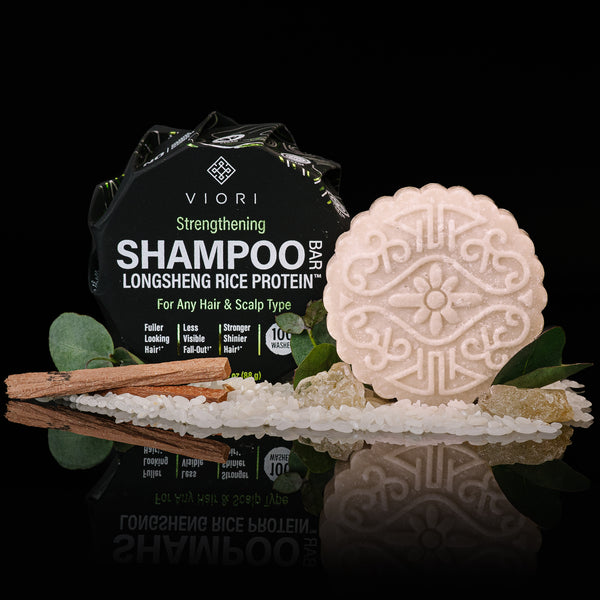
- Exceptional longevity. One 90-gram Viori bar replaces approximately three 10-ounce liquid bottles. The shelf life extends beyond three years without any chemical stabilizers.
From a professional perspective, this concentration factor matters enormously. It's the difference between taking a vitamin with a glass of water versus drinking a glass that's 90 percent water with a few vitamin molecules floating somewhere in it.
The Mistake Almost Everyone Makes When Choosing Products
Here's something I see constantly in my salon: people choose hair care products based on their hair texture-fine, thick, curly, straight.
This approach is completely backwards.
Your hair texture matters tremendously for styling products-mousses, gels, creams. But for shampoo and conditioner, you should be focusing primarily on scalp type: oily, normal, or dry.
Think about it logically: shampoo touches your scalp. Your scalp produces oil, or it doesn't produce enough oil. The condition of your scalp ultimately determines what your hair actually needs.
How to Identify Your Scalp Type
Oily scalp: Feels noticeably greasy within one to two days after washing
Normal scalp: Starts feeling oily around day three after washing
Dry scalp: Doesn't feel oily until day four or later after washing
Once you accurately identify your scalp type, you can match products correctly:
Oily scalps benefit dramatically from citrus-based formulations. Citric acid naturally breaks down excess sebum without the harsh stripping action that paradoxically triggers even more overproduction.
Dry scalps need moisture-rich formulations without additional oil-stripping agents that will make the underlying problem progressively worse.
Combination types-oily scalp with dry ends, which is extremely common-require targeted, strategic application: cleansing formula concentrated at roots, moisturizing conditioner applied to lengths only.
This is exactly why Viori offers different scent profiles that correspond to specific scalp types, not just arbitrary fragrance preferences:
- Citrus Yao contains citric acid specifically for oil control (designed for oily scalps)
- Terrace Garden and Native Essence focus on moisture retention (formulated for dry scalps)
- Hidden Waterfall sits in the middle with subtle citrus notes (balanced for normal scalps)
These aren't random scent choices for marketing variety-they're deliberate formulation differences that address distinct scalp needs.
The Transition Period Nobody Warns You About
Here's what I tell every single client who's switching to higher-quality products: expect a two to three week adjustment period.
Your scalp has adapted to whatever you've been using for months or possibly years. It takes real time to recalibrate.
What to Actually Expect
If you're switching from silicone-heavy products: Your hair might initially feel less "slippery" or artificially smooth. This isn't


