
After twenty years working behind the chair and formulating custom hair treatments, I've watched the shampoo bar movement explode-and I've seen just as many frustrated clients walk back through my salon doors wondering why their "miracle product" left their hair feeling like straw. The problem? Everyone talks about sustainability and zero waste, but almost nobody discusses the complex chemistry that determines whether these solid products will actually work for your unique hair.
Today, I'm sharing the technical knowledge that rarely makes it past marketing departments-the real science behind why shampoo bars work beautifully for some people and create absolute disasters for others.
The Friction Factor Nobody Mentions (And Why It Changes Everything)
Here's what caught me off guard when I first started recommending bars to clients: rubbing a solid product directly onto your hair fundamentally changes the cleansing process compared to liquid shampoo. This isn't just the same formula in a different package-the physics are completely different.
When you glide a bar across wet strands, you're creating localized zones of extremely high surfactant concentration combined with mechanical friction. Think about what's happening at the microscopic level:
- Cuticle lifting happens exponentially, not gradually. The combination of concentrated surfactants plus physical friction causes your hair cuticle to lift more aggressively than with pre-diluted liquid products. Picture roof shingles being forcibly pried up rather than gently coaxed open.
- Distribution becomes wildly uneven. Some strands receive ten times more product than others, leading to over-processed areas right next to under-cleansed sections. This explains why your hair might feel simultaneously clean and coated after the same wash.
- Hard water creates instant problems. When hard water minerals meet concentrated surfactants at the point of contact, they form insoluble complexes before the product even distributes. You're essentially trying to clean with soap that's already turned to scum.
This explains the standard advice to "lather in your hands first"-it actually defeats the purpose of the bar format, yet it's often necessary to avoid damage. Not exactly what the Instagram posts show, is it?
Why Rice Water Works Miracles for Some Clients and Ruins Hair for Others
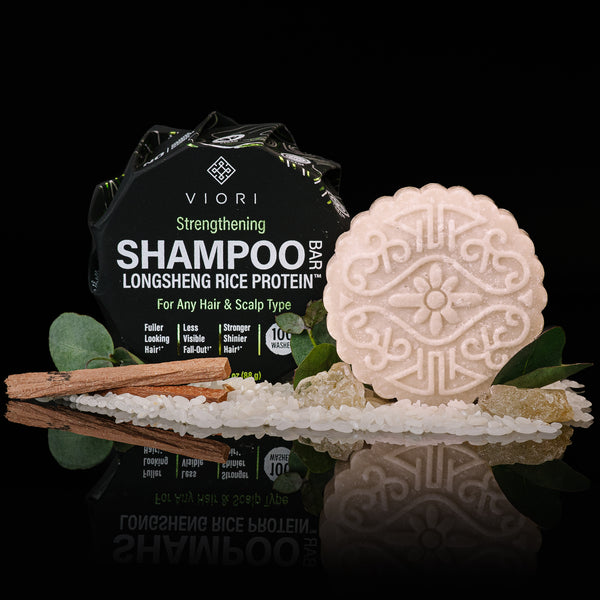
Products like Viori emphasize rice protein and fermented rice water, tapping into centuries-old Yao tradition. But here's the critical truth I've learned through countless consultations: protein overload is more common than protein deficiency, yet it's almost never diagnosed correctly.
The Molecular Weight Problem
Hydrolyzed rice protein consists of peptide chains with molecular weights typically between 150-2000 Daltons. When these proteins meet different hair types, completely different things happen:
Low porosity hair (tightly closed cuticles) can't absorb these proteins effectively. They accumulate on the surface, creating that "coated" feeling and attracting unwanted humidity. Your hair feels heavy, limp, or strangely sticky-and you have no idea why.
NOT SURE WHICH PRODUCT IS RIGHT FOR YOU?
TAKE THE QUIZTakes 30 seconds · 134,000+ customers matched
High porosity hair (damaged, lifted cuticles) absorbs protein too effectively. Initially, you get temporary strengthening that feels absolutely amazing. Then the hair becomes brittle-like an over-starched shirt that cracks when you bend it. I've seen this pattern dozens of times.
Medium porosity hair is the Goldilocks zone where rice proteins work exactly as advertised. This is probably whose hair you're seeing in all those glowing testimonials.
What Fermentation Actually Does
Fermented rice water increases beneficial compounds like inositol and panthenol, but it also creates smaller protein fragments that penetrate hair differently than whole proteins. Viori's Longsheng rice fermentation process creates very specific molecular sizes-which is why results can be so dramatically different from person to person.
Here's the frustrating part that keeps me up at night: both protein deficiency AND protein overload can present with similar symptoms-dry, straw-like texture, increased breakage, loss of elasticity. The treatment for each condition is opposite, which explains the passionate "miracle product" and "ruined my hair" reviews for the identical rice-based bar.
The pH Paradox That Misleads Almost Everyone
Let me address something that's technically true but functionally misleading in ways that drive me crazy: pH-balanced claims on shampoo bars.
The Chemistry Nobody Explains Clearly
Hair's ideal pH is 4.5-5.5, which is slightly acidic. Most shampoo bars claiming to be "pH balanced" actually test between 5.5-7.0. That qualifies as balanced for skin, but it's actually alkaline for hair structure. This distinction matters enormously.
With bars, this matters even more because of concentration at the application point. Even a pH 6.0 bar becomes more alkaline where you're rubbing it directly onto hair before dilution occurs. You're hitting your cuticles with a much higher pH than the package testing suggests.
Sodium cocoyl isethionate-the "gentle" surfactant used in Viori and many quality bar shampoos-has an inherent pH of 6.0-7.0 in solid form. Getting it below 5.5 requires acids that can make the bar crumble or irritate your scalp. It's a genuine formulation challenge, not laziness.
Your Water Chemistry Changes Everything
Here's something I wish more people understood: your local water pH interacts with your bar's pH, creating wildly different results based purely on geography:
- Alkaline water (pH 8+): Even a perfectly formulated bar gets pushed more alkaline, increasing cuticle lifting and potential damage
- Acidic water (pH 6-): The bar may work beautifully because the water compensates for the bar's natural alkalinity
- Hard water (high mineral content): Creates buildup regardless of pH, but pH determines severity
This explains why someone in Portland with soft, slightly acidic water might have completely different results than someone in Phoenix with hard, alkaline water-using the identical product with identical technique. I've seen this firsthand with clients who move between cities.
Hair Porosity Matters More Than Your Scalp Type (Yes, Really)
Most shampoo bar guidance focuses on scalp type-oily versus dry. After twenty years of professional experience, I can tell you this approach is backwards. Hair porosity is the primary predictor of bar shampoo success, yet it's rarely the focus of product recommendations.
The Three Porosity Scenarios
Low Porosity (Tightly Bound Cuticles)
Advantages: Less damage from friction; cuticles naturally resist over-lifting during the rubbing process.
Challenges: Products sit on the surface, creating buildup faster and requiring more thorough rinsing than other hair types.
Critical factor: You must use warm to hot water to open cuticles enough for proper cleansing-cold water simply won't work.
Interesting note: Acidic bars like Viori's Citrus Yao may actually work poorly for you because they keep already-tight cuticles even more sealed shut.
Medium Porosity (Healthy, Normal Cuticles)
This is the "Goldilocks zone" where bars work exactly as advertised. You can alternate between bar types without major issues, and your adjustment period is typically shortest-around 2-4 weeks. Most marketing photos and glowing testimonials likely come from this group.
High Porosity (Lifted, Damaged Cuticles)
Advantages: Protein-rich formulas like Viori's temporarily patch existing damage, giving immediate improvement.
Challenges: Over-absorption leads to protein overload within weeks; friction worsens existing cuticle damage over time.
Common pattern I see constantly: "Amazing at first, terrible later"-damaged areas soak up conditioning agents initially, then become oversaturated by week six or seven.
Critical factor: Cool or cold water is essential for your hair type; hot water opens already-lifted cuticles even further, accelerating damage.
The Professional Assessment Trick
Here's how I quickly assess clients in the salon: Take a strand of clean, dry hair and run it between your fingers from end to root.
- Smooth feel = low porosity (resists absorption)
- Slightly rough = medium porosity (normal absorption)
- Very rough, catches on fingers = high porosity (over-absorbs)
Match your bar selection to this porosity assessment, not just whether your scalp feels oily or dry. This single change will dramatically improve your results.
The Hard Water Crisis: Why Half My Clients Fail With Bars
In two decades of professional hair work, I can trace at least 60% of "this product ruined my hair" complaints to water chemistry, not product chemistry. With bars specifically, this percentage jumps even higher.
What Actually Happens at the Molecular Level
Phase 1: Initial Contact (First 10 seconds)
Sodium cocoyl isethionate meets calcium ions in your water and forms calcium cocoyl isethionate-an insoluble precipitate. This happens before the surfactant can properly cleanse your hair. You suddenly need 2-3 times more product to achieve the same cleaning effect, but you don't realize why.
Phase 2: Rinsing (10-60 seconds)
Conditioning ingredients meet magnesium ions, forming complexes that don't rinse clear. They deposit as a waxy coating on your hair shaft. This gets progressively worse with each wash because buildup is cumulative.
Phase 3: Drying (60+ minutes later)
Mineral deposits crystallize on the hair shaft, creating rough texture that catches light poorly (hello, dullness), increases friction between strands (tangles for days), and makes hair feel "dirty" even when freshly washed.
The Rice Water Complication
Here's where things get even more complex with rice-based bars: rice water naturally contains inositol (a slightly sticky carbohydrate), amino acids (protein fragments), and minerals. Yes, more minerals on top of what's already in your water.
In soft water, these create a beneficial coating that strengthens and adds shine. In hard water, they add to the mineral buildup problem, creating a hybrid organic-inorganic deposit that's extremely difficult to remove without professional intervention.
WHAT CUSTOMERS ARE SAYING
Real reviews for Hidden Waterfall Barra de Champú
The Solution Nobody Wants to Hear
If you have hard water-and test strips cost about $10 to find out definitively-you have three realistic options:
- Install a shower filter - Removes chlorine but NOT hardness minerals (this is marketing deception I see constantly and it infuriates me)
- Install a water softener - Actually removes calcium and magnesium at the source, but requires significant investment
- Use chelating rinses - Weekly apple cider vinegar or citric acid rinse to dissolve accumulated mineral buildup
Option three is what most people can actually implement, but it requires admitting the product isn't enough on its own-something marketing will never tell you.
Water Temperature: The Variable That Changes Everything
This is perhaps the most underappreciated technical factor in bar shampoo success, yet it's completely free to adjust.
Hot Water (110°F and Above)
- Opens cuticles dramatically, allowing deep cleansing
- Softens conditioning bars, dispensing more product than you realize
- Increases penetration of all ingredients, good and bad
- Strips more natural oil (water alone strips oil at high temperatures)
- Best for: Heavy buildup, very oily scalps, thick or coarse hair texture
Cold Water (70°F and Below)
- Keeps cuticles sealed and smooth, preventing damage
- Hardens conditioning bars, dispensing less product per application
- Prevents over-absorption of proteins and conditioning agents
- Seals in moisture and conditioning from previous steps
- Best for: Color-treated, damaged, fine, or thin hair
The Professional Protocol I Actually Teach
What I recommend to clients (which nobody online seems to mention):
- Cleanse with warm to hot water for efficient cleaning and cuticle opening
- Condition with warm water to allow ingredient penetration where you want it
- Final rinse with cool to cold water to seal cuticles closed and add reflective shine
This three-temperature approach works with any product, but it's especially important with bars because you can't control concentration as precisely as you can with liquids you dilute in your palms first.
What's Actually Happening During the "Adjustment Period"
The infamous transition phase when switching to bar shampoo deserves scientific scrutiny, not just vague platitudes about "detoxing" from conventional products.
Week 1-2: The Stripping Phase
Your scalp is conditioned to produce oil based on your previous product's stripping patterns. Bar shampoos strip oil differently-generally less aggressive on surface oils, but the friction can stimulate sebaceous glands in unexpected ways.
Hair may feel dry (cuticles adjusting to different pH) OR greasy (oil production hasn't downregulated yet). This is NOT detox-nothing is being detoxed. Your scalp is simply recalibrating its oil production to match new cleansing patterns.
Week 3-4: The Buildup Begins
Conditioning agents start accumulating on the hair shaft. Mineral deposits begin forming if you have hard water. Protein builds up on the cuticle surface layer by layer.
Interestingly, hair often feels BEST during this specific window-you have enough conditioning without being overloaded yet. This is when people typically post glowing reviews.
Week 5-8: The Breaking Point
Buildup reaches problematic levels for some users, while others achieve equilibrium and continue feeling fantastic indefinitely.
The difference? Water chemistry, application technique, hair porosity, and whether you're rotating between different products rather than using the same bar every single wash.
The Rotation Strategy That Changes Everything
Here's professional insight that dramatically improves long-term results: Don't use the same bar for every single wash.
- Alternate between protein-rich bars (like Viori's Hidden Waterfall) and protein-free options (like Native Essence)
- Periodically use a clarifying treatment-even just a baking soda paste once monthly
- Give bars 24-48 hours to fully dry between uses (reduces bacterial growth and extends bar life significantly)
The Scalp Microbiome Factor Nobody Discusses
Many bar shampoo users report they can "go longer between washes" after an adjustment period. The usual explanation is that you've stopped stripping oils aggressively, so your scalp stops overproducing to compensate. This is partially true but dramatically oversimplified.


