
I'll be honest with you-in my twenty years as a hair care professional, I've watched the liquid castile soap trend with growing concern. Month after month, clients come to me with the same story: they switched to castile soap for a more "natural" approach, and now their hair is dry, breaking, and somehow duller than before.
"But it's natural," they tell me. "It should be better for my hair, right?"
Here's the uncomfortable truth: castile soap might be natural, but so is lemon juice, and you wouldn't wash your hair with straight lemon juice every day. The question isn't whether something is natural-it's whether it works with your hair's biology or against it.
Today, I'm pulling back the curtain on the hidden chemistry crisis happening on thousands of heads across the country. Because understanding why castile soap fails as shampoo teaches us something crucial about what our hair actually needs.
The pH Problem Everyone Ignores
Let me start with a number that changes everything: castile soap has a pH between 8.9 and 10.
Your hair? It thrives at a pH of 4.5 to 5.5.
This isn't a small difference-it's a chemical catastrophe happening every time you wash.
Think of your hair cuticle like roof shingles. When your hair is at its natural, slightly acidic pH, these cuticle scales lie flat and smooth, creating that glossy, healthy appearance we all want. But when you expose your hair to alkaline pH (like castile soap), those cuticles lift and separate like shingles in a windstorm.
What happens when your cuticles lift:
NOT SURE WHICH PRODUCT IS RIGHT FOR YOU?
TAKE THE QUIZTakes 30 seconds · 134,000+ customers matched
- Your hair becomes overly porous, absorbing and losing moisture erratically
- The inner structure of your hair (where your strength proteins live) becomes exposed and vulnerable
- UV radiation and environmental damage penetrate more easily
- Your hair looks dull because the rough surface scatters light instead of reflecting it
- Strands tangle and catch on each other because of the roughened texture
I've seen this pattern hundreds of times: someone switches to castile soap, and within a few months, their hair texture has noticeably changed-not in a good way.
The Soap vs. Shampoo Distinction You Need to Understand
Here's something most natural beauty blogs won't tell you: castile soap and shampoo are chemically different products, and that difference matters immensely.
True soaps like castile are made through saponification-mixing oils (traditionally 100% olive oil) with lye. This creates molecules that are incredibly efficient at grabbing onto oils and washing them away. Too efficient, actually, for modern hair care needs.
Quality shampoos (yes, even natural ones) use surfactants specifically designed to cleanse at a pH your hair can tolerate. They remove dirt and excess oil while preserving the beneficial sebum your scalp produces for protection.
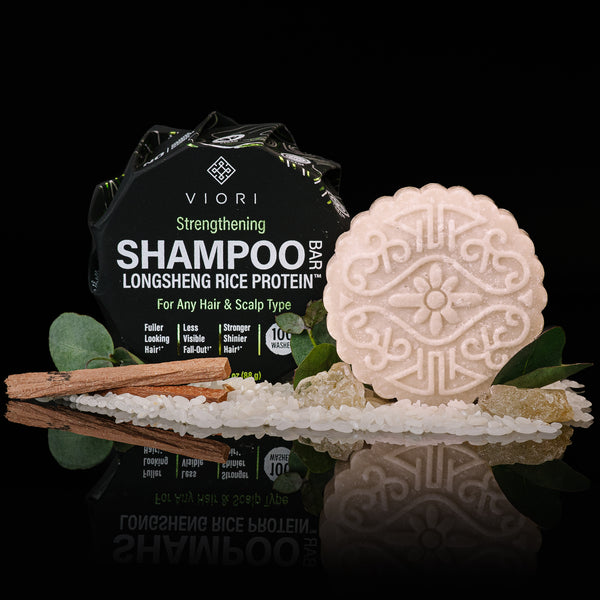
This is where I need to mention Viori's approach, because it perfectly illustrates this distinction. Their bars use Sodium Cocoyl Isethionate-a coconut-derived surfactant that cleanses gently without the alkaline pH spike of true soap. It's still natural, but it's formulated to match what hair actually needs.
The difference isn't about "chemicals versus natural." It's about chemistry that works with your hair versus chemistry that fights against it.
The Hard Water Disaster
If you live in an area with hard water (and about 85% of American homes do), castile soap becomes even more problematic.
When soap molecules meet the calcium and magnesium in hard water, they form something you're definitely familiar with: soap scum. That filmy residue you scrub off your shower? That's exactly what's coating your hair.
On your hair, this creates:
- A waxy, dull coating that's nearly impossible to rinse completely
- Progressive buildup that gets worse with each wash
- A surface that actually attracts dirt and oil faster
- Stiff, breakage-prone texture
I had a client once who couldn't figure out why her hair felt increasingly "coated" and heavy. She was using castile soap in an area with notoriously hard water. When we looked at her hair under magnification, the soap scum buildup was visible-like a layer of wax on each strand.
Modern shampoo formulations (including Viori's rice water bars) use surfactants that don't react with hard water minerals. This isn't about adding "chemicals"-it's about choosing chemistry that matches our modern water infrastructure.
What Ancient Wisdom Actually Teaches Us
This is where the conversation gets really interesting, because there is an ancient hair care tradition that works beautifully-but it's not soap-based cleansing.
The Red Yao women of China have used fermented rice water for centuries, and their hair remains remarkably healthy well into old age. But here's the key difference: fermented rice water has a pH of approximately 5.5-naturally matching your hair's optimal pH.
The fermentation process creates compounds that genuinely benefit hair:
- Inositol that penetrates damaged areas and strengthens from within
- Amino acids that are building blocks for keratin repair
- Vitamins B and E with antioxidant and protective properties
- Natural pH balance that works with your hair instead of against it
Both castile soap and fermented rice water are "natural," but only one respects your hair's biology. That's the lesson we should be learning from traditional practices-not that old automatically means better, but that we should look for approaches that align with how our hair actually functions.
Viori's formulations draw on this rice water tradition precisely because the chemistry makes sense. It's ancient wisdom that happens to align perfectly with modern understanding of hair structure.
The Protein Destruction You Can't See (Until It's Too Late)
Here's something I rarely see discussed in natural hair care communities, but it's critical: alkaline pH doesn't just open your cuticles-it can actually break down the protein bonds in your hair.
Your hair is about 95% keratin protein held together by different types of bonds. When you repeatedly expose hair to pH 9-10 (the castile soap range), you're breaking salt bonds with every wash. While these bonds can reform, the constant breaking and reforming under stress causes:
- Progressive protein loss: Small amounts of dissolved keratin washing away each time
- Weakened internal structure: Even if the outer cuticle reseals, the inside of your hair is compromised
- Gradual thinning: Individual strands literally become thinner over time
This explains the pattern I see professionally:
First few weeks: "My hair feels so clean! Really squeaky!"
(Translation: Completely stripped. That "squeaky" feeling is actually friction from roughened cuticles.)
2-3 months in: "I'm using a lot of conditioner to compensate."
(Translation: Trying to repair ongoing damage.)
4-6 months later: "My hair texture has changed. It seems thinner and breaks more easily."
(Translation: Cumulative protein loss becoming visible.)
The Sebum Stripping Cycle
Your scalp produces sebum for important reasons-moisture retention, environmental protection, antimicrobial properties, and natural conditioning. It's not dirt. It's not something you need to strip away completely.
But castile soap's high pH and aggressive oil-removal properties eliminate all sebum. Your scalp responds predictably:
- Overproduces oil trying to restore protection
- You wash more frequently because your hair feels oily
- This strips even more sebum
- Your scalp produces even more oil
- The cycle intensifies
People often interpret this as "detox" or "adjustment period," but it's actually chronic scalp stress. Your skin is desperately trying to protect itself, and you keep removing that protection.
Here's my rule of thumb: If you need aggressive follow-up treatments to make your hair manageable after washing, your cleanser isn't appropriate. Quality cleansing should leave your hair in a condition that requires minimal correction.
The Curly Hair Catastrophe
For those with textured, curly, or coily hair (Type 3-4), castile soap presents unique dangers.
These hair types naturally:
- Have lower moisture content (sebum doesn't travel down curls as easily)
- Show damage more obviously (curl pattern loosening or destruction)
- Require careful pH management to maintain curl structure
When castile soap's alkaline pH opens already-vulnerable curly hair cuticles, it creates:
- Hygral fatigue: Repeated swelling and contracting from uncontrolled moisture absorption
- Mechanical damage: Swollen, rough cuticles that catch and break during detangling
- Curl pattern loss: Damaged cuticles can't maintain the structure needed for defined curls
I've had clients with beautiful curls report that their curl pattern "loosened" or "relaxed" after months of castile soap use. That's not natural curl evolution-it's structural damage preventing proper curl formation.
The Historical Context We're Ignoring
People who advocate for castile soap often point to historical use, but they're missing crucial context.
Traditional soap users:
- Washed weekly or monthly (not daily)
- Used mandatory acidic rinses (vinegar wasn't optional-it was essential)
- Accepted 3-6 month "transition periods" of poor results
- Had completely different expectations for hair appearance
- Weren't exposed to modern environmental stressors like pollution, indoor heating, and increased UV from ozone depletion
Modern reality:
- Many people need or prefer more frequent washing
- We expect immediate functionality
- Professional and social standards for hair appearance
- Cumulative environmental stresses requiring protective care
Suggesting we return to historical soap use without acknowledging how different our needs and contexts have become is setting people up for failure.
The "Transition Period" Myth
Let's talk about this concept of "transition" that castile soap advocates warn about.
There are legitimate transition scenarios-switching from silicone-heavy products requires removing that coating, or adjusting washing frequency affects sebum production. Those are real.
But these are NOT legitimate explanations:
- "Your hair needs time to adjust to the pH" (No-your hair is being damaged; it just takes time to become obvious)
- "It's removing years of buildup" (If it takes 6 months, that's not transition-that's incompatibility)
- "Your scalp is detoxing" (Not a real biological process in this context)
Quality hair care shouldn't require months of terrible results. That's not transition-that's rationalization of unsuitable products.
The Water Chemistry Wild Card
In my professional experience, local water chemistry dramatically affects outcomes, and castile soap fails most spectacularly with:
WHAT CUSTOMERS ARE SAYING
Real reviews for Hidden Waterfall Barra de Champú
Hard water:
- Immediate soap scum formation
- Impossible to rinse clearly
- Progressive buildup making hair unmanageable
Chlorinated municipal water:
- Chlorine raises pH even further
- Oxidative stress on already-vulnerable hair
- Accelerated color fading for treated hair
Variable well water:
- Unpredictable results even in the same household
- Potential iron or sulfur creating additional reactions
This explains why castile soap might work for someone with soft water who washes infrequently, while failing catastrophically for someone else. But should basic hair cleansing really require perfect conditions to work safely?
What "Chemical-Free" Actually Means (Nothing)
Here's an uncomfortable truth from a chemistry standpoint: everything is chemicals.
Water is a chemical. Olive oil is a mixture of chemicals. Your hair is made of chemicals.
The question isn't "chemical versus natural"-it's "which chemistry works with your hair's biology?"
Castile soap is natural. So is arsenic. "Natural" doesn't automatically mean beneficial or appropriate.
Viori's Longsheng rice formulations are natural. The fermentation process is traditional. But the modern formulation also incorporates scientific understanding of optimal pH levels, surfactant selection for gentle cleansing, and ingredient combinations that deliver benefits in stable, usable forms.
This represents informed natural formulation-honoring traditional wisdom while respecting chemistry.
Moving Forward: Better Questions to Ask
The liquid castile soap movement reflects genuine, valid desires:
- Reducing potentially harmful synthetics
- Simplifying routines
- Connecting with traditional practices
- Making more conscious choices
The problem isn't the intention-it's executing based on incomplete understanding.
Instead of asking "Is it natural?" ask:
- What is the pH? (Should be 4.5-6.5 for hair products)
- Does it work with my hair type and water chemistry?
- Are results immediate, or does it require months of "adjustment"? (Red flag if the latter)
- Do I need extensive follow-up treatments to make my hair manageable? (Another red flag)
- Is there scientific rationale for why this benefits hair structure?
The Viori Difference: When Ancient Wisdom Meets Modern Chemistry
What distinguishes rice water bar formulations from castile soap isn't marketing-it's fundamental chemistry compatibility.
Viori's approach combines:
- Fermented rice water at hair-compatible pH
- Surfactants selected for gentle cleansing without alkalinity
- Formulation designed for modern water chemistry
- Natural ingredients chosen for compatibility with hair structure
- No "transition period" required because the chemistry is appropriate from day one
The Red Y


