
I'll never forget the morning Sarah walked into my salon. She settled into my chair with hair so damaged and brittle, I honestly thought she'd attempted some kind of DIY bleaching catastrophe at home. When I gently asked what happened, she beamed with pride and pulled out a rustic bar wrapped in twine. "I've been using this all-natural, pure soap from the farmer's market for six months! Isn't it amazing?"
My heart sank. This wasn't amazing. This was a textbook case of well-intentioned destruction.
After two decades behind the chair, I've watched this exact scenario unfold more times than I can count. Enthusiastic clients, seduced by the romance of "natural" and "simple," unknowingly inflicting hundreds of dollars worth of preventable damage on their hair. And the worst part? They think they're doing something healthy.
Let's have an honest conversation about naive soap, pH chemistry, and why that charming handmade bar might be your hair's worst enemy.
What Actually Is Naive Soap?
"Naive soap" or "pure soap" sounds wonderfully wholesome, doesn't it? It's made through an ancient process called saponification-basically, fats or oils meet lye (an alkali), and through chemical magic, you get soap. Simple. Traditional. The kind of thing your great-grandmother might have made on the farm.
The appeal is intoxicating. Natural ingredients you can pronounce. Traditional methods passed down through generations. Nothing "chemical-sounding" cluttering up the label. It feels pure, honest, and safe in a world full of mysterious ingredients.
But here's the uncomfortable truth: chemistry doesn't give a damn about our romantic notions of what's "natural."
The pH Catastrophe No One Talks About
I'm about to share the single most important thing the "back to nature" beauty movement consistently ignores, and I need you to really hear this:
True naive soap has a pH between 8 and 11. Your hair and scalp function optimally at a pH of 4.5 to 5.5.
NOT SURE WHICH PRODUCT IS RIGHT FOR YOU?
TAKE THE QUIZTakes 30 seconds · 134,000+ customers matched
This isn't some minor technical detail. This is a fundamental chemical mismatch that creates cascading damage every single time you wash. And unlike a bad haircut that grows out, this kind of damage compounds over time.
What's Really Happening to Your Hair
Picture your hair cuticle as tiny overlapping roof shingles. When your hair exists in its happy, slightly acidic environment, those microscopic scales lie smooth and flat against the hair shaft. Everything's sealed up, protected, functioning as nature designed.
Now imagine dumping a highly alkaline substance on that delicate structure. Those protective scales don't just ruffle slightly-they lift up and separate. And once they're up, everything goes wrong.
Here's what I observe under magnification and what you experience in real, frustrating life:
The Cuticle Crisis
Once those protective cuticle scales raise up and stay up, you're looking at:
- Hair strands that catch and snag on each other, creating tangles that lead to breakage
- Moisture escaping from the hair shaft like water through a broken dam
- The vulnerable inner cortex exposed to everything damaging in your environment-UV radiation, pollution, chlorine, you name it
- That "squeaky clean" feeling you might actually like (spoiler: that's literally the texture of damaged, roughened hair)
Yeah, that satisfying squeak some people love? That's not "really clean." That's the sound of your hair screaming.
The Soap Scum Nightmare
If you have hard water-and statistically, most of us do-naive soap creates an entirely separate problem. The soap reacts with calcium and magnesium minerals in your water to form insoluble salts. You know that stubborn white film on your shower tiles that requires serious elbow grease to remove?
That same stuff is coating your hair.
On your hair, this waxy buildup:
- Refuses to rinse away no matter how long you stand under the spray
- Accumulates with every wash, getting progressively worse
- Weighs down your hair and suffocates any natural volume or movement
- Requires acidic rinses like vinegar to remove, adding extra steps and opening the door to over-correction
The Sebum Stripping Death Spiral
True soap's aggressive cleansing action is indiscriminate. It strips away dirt, sure, but it also obliterates your scalp's protective sebum layer-those natural oils that keep both your scalp and hair healthy and balanced.
Your scalp's response? Pure panic.
It kicks into overdrive, producing excess oil to compensate for what's been stripped away. Now you've got that maddening combination of an oily, greasy scalp with dry, straw-like ends. So what do most people do? They wash more frequently to combat the oiliness, which only accelerates the entire damage cycle.
It's a vicious loop, and I watch clients get stuck in it constantly.
The "Natural Fallacy" We Really Need to Address
Look, I completely get the appeal of "returning to what our ancestors used." The logic seems bulletproof on the surface: humans used simple soap for centuries without issue, so modern formulations must be unnecessary corporate nonsense designed to extract money from our wallets, right?
Let me add some context that conveniently gets left out of that argument:
Historical hair care looked absolutely nothing like what we do today:
- People washed their hair weekly, monthly, or even less frequently-not daily or every other day
- They typically used extensive oil treatments before washing to create a protective barrier
- They followed up with lengthy acidic rinses using various vinegars, lemon water, or other pH-balancing solutions
- Water mineral content varied dramatically by region (many areas had naturally soft water)
- Cultural expectations for hair appearance were completely, fundamentally different
But here's the thing that matters most: they didn't have better options. We do.
Using naive soap today isn't some noble return to ancestral wisdom-it's ignoring scientific advancement that could actually protect your hair.
When Damage Masquerades as Results
This is the truly insidious part that almost nobody discusses: naive soap can initially seem absolutely amazing.
During those first blissful weeks, you might notice:
- Incredible volume (because the hair shaft is actually swelling from pH damage)
- That ultra-clean, squeaky feeling (because the cuticle is being progressively roughened)
- Hair that feels genuinely "thicker" (because each individual strand is literally expanded and damaged)
You're thrilled! You take photos. You post glowing reviews on social media. You evangelize to your friends and family about this miracle product you've discovered.
Then, somewhere around the 4 to 8 week mark, everything falls spectacularly apart:
- That amazing volume transforms into unmanageable, frizzy chaos
- The clean feeling reveals itself as chronic dryness and brittleness
- The thickness is obviously damage now-rough, straw-like, completely unnatural texture
But here's the psychological trap: by this point, you've invested money, time, and genuine belief into this product and philosophy. You've publicly recommended it. You've embraced the identity of someone who's "gone natural."
So instead of blaming the fundamental chemistry mismatch, you blame your hair. "My hair just needs more time to adjust," you tell yourself, continuing the damage for months more.
The Professional Damage Control I Perform Every Single Week
Let me walk you through what I encounter regularly in my salon chair-clients who've used "pure soap" for extended periods, presenting with textbook damage patterns:
Extreme Hygral Fatigue
The hair swells and contracts excessively during each wash cycle, progressively weakening the internal protein structure. The hair literally becomes exhausted from the repeated pH stress. It's like bending a paperclip back and forth-eventually, it just breaks.
Progressive Cuticle Damage
This creates a permanently rough, porous texture. Unlike temporary damage that responds well to treatments, this doesn't fully reverse with any product I can apply-you're often looking at the long, frustrating process of growing it out and cutting it off.
Accelerated Color Fade
Those raised, damaged cuticles allow color molecules to escape at an alarming rate. My color-treated clients using naive soap need root touch-ups and toning twice as frequently, which gets expensive fast.
Chemical Treatment Complications
Perms, relaxers, keratin treatments, and other chemical services fail or behave in completely unpredictable ways on soap-damaged hair. I've actually had to refuse services because the hair was too structurally compromised to safely proceed.
The corrective process I have to implement typically includes:
- Chelating treatments to remove stubborn mineral buildup ($40-80 per session)
- Protein reconstruction treatments to reinforce the weakened structure ($60-120)
- Intensive moisturizing and repair treatments ($50-100)
- An extended transition period during pH rebalancing, which takes a minimum of 6-12 weeks
And even after all that professional intervention, time, and financial investment? Some of the damage is simply irreversible.
The Smarter Evolution: pH-Balanced Bar Formulations
If you're drawn to bar products for environmental reasons-reducing plastic waste, lower carbon footprint from shipping weight, highly concentrated formulas that last longer-I'm completely with you. Those are legitimate, important considerations that I personally support.
But you absolutely don't have to sacrifice your hair's health for sustainability.
Modern pH-balanced bar formulations deliver all the environmental benefits you're looking for without the devastating chemical compromise. The key is understanding what distinguishes a good bar from a damaging one.
Not All Bars Are Created Equal
Quality hair care bars use what's called synthetic detergents (syndets) instead of traditional saponified oils. Before you recoil at the word "synthetic," take a breath and understand what this actually means in practical terms:
- They're formulated with carefully selected surfactants that maintain a hair-appropriate pH (typically 5-6.5)
- They don't react with hard water minerals to create that waxy buildup
- They can be precisely engineered for targeted cleansing without over-stripping natural oils
- They allow the incorporation of conditioning agents that actually function properly at the correct pH
When you see ingredients like Sodium Cocoyl Isethionate (which is derived from coconut oil) in a formulation, you're looking at a mild, effective surfactant that cleanses thoroughly at a hair-safe pH. This isn't "adding harsh chemicals"-it's using chemistry intelligently to protect your hair while still cleaning it effectively.
The Viori Approach: Where Ancient Wisdom Meets Modern Science
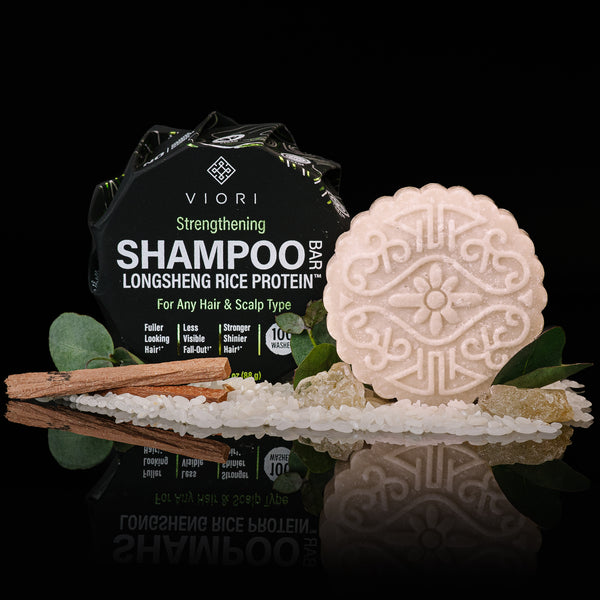
This is precisely where Viori has genuinely revolutionized the bar format. Rather than simply reverting to primitive soap chemistry and slapping "natural" on the label, they've applied modern scientific understanding to traditional ingredients with proven effectiveness.
WHAT CUSTOMERS ARE SAYING
Real reviews for Hidden Waterfall Barra de Champú
The incorporation of fermented Longsheng rice water into their formulations is a perfect example of sophisticated botanical chemistry in action. The Red Yao women of China's Longsheng region are justifiably famous for maintaining floor-length, remarkably healthy hair well into their 80s and even 90s. Their centuries-old secret? Fermented rice water.
But here's what makes it actually work in a modern context: it's not naive soap.
The fermentation process naturally:
- Creates a more acidic, hair-appropriate pH environment
- Increases the concentration of beneficial compounds like inositol, vitamins, and minerals
- Produces proteins that are small enough to actually penetrate the hair shaft rather than just sitting on the surface
- Has literal centuries of empirical evidence backing its effectiveness
This isn't about romanticizing the past or fetishizing "ancient wisdom"-it's about genuinely understanding why traditional practices worked from a chemistry standpoint and then replicating those beneficial mechanisms in a properly formulated product.
Viori's formulations thoughtfully combine this rice water tradition with modern pH-balanced surfactants, creating bars that are simultaneously:
- Environmentally responsible (zero waste packaging, completely plastic-free)
- Chemically appropriate for hair (properly pH-balanced to your hair's actual needs)
- Traditionally inspired (honoring the rice water heritage of the Red Yao)
- Scientifically sound (applying modern formulation chemistry principles)
You get the sustainable bar format you genuinely want without destroying your hair in the process. It's not a compromise-it's an evolution.
What to Look for When Shopping for Hair Care Bars
If you're in the market for pH-balanced bar formulations, here's your professional checklist for evaluating products:
1. Clear pH Specifications
The product should explicitly state a pH between 4.5 and 6.5 for hair products. This information should be readily available on the packaging or website. If you can't easily find this crucial specification, that's a significant red flag.
2. Appropriate Surfactant Systems
Look for quality ingredients like:
- Sodium Cocoyl Isethionate (SCI)
- Behentrimonium Methosulfate
- Sodium Lauryl Sulfoacetate
- Sodium Lauroyl Methyl Isethionate
Actively avoid bars that list saponified oils (like "saponified coconut oil" or "saponified olive oil") as the primary cleansing agent.
3. Integrated Conditioning Components
Quality bars should include conditioning agents that actually function at proper pH levels:
- Natural butters (shea, cocoa, mango)
- Beneficial proteins (rice, silk, wheat, keratin)
- Nourishing oils
- Panthenol (Pro-Vitamin B5)
- Ceramides or similar lipid components
4. No Corrective Measures Required
If a product requires vinegar rinses, lemon rinses, or other pH-correcting steps as part of the regular routine, it's fundamentally not properly formulated. Your shampoo bar should work correctly on its own without requiring you to become an amateur chemist.
The Professional Bottom Line
After 20 years of correcting naive soap damage in my chair, I cannot be more direct: save the traditional soap for washing your hands.
Your hair is a complex protein structure with very specific pH requirements, moisture needs, and chemical vulnerabilities. Treating it with high-pH naive soap is like fueling a precision German engine with crude oil-yes, it's technically simpler and more "natural," but the resulting damage is inevitable, progressive, and ultimately catastrophic.


