
Beyond the Beauty Trends: What's Really Happening on Your Skin
After twenty years behind the chair and countless consultations, I've noticed something curious: rice extract has become skincare's darling ingredient, yet most conversations barely scratch the surface. Everyone's talking about vitamins and amino acids, but almost no one is discussing what I find most compelling-the unique way rice extract actually interacts with your skin's natural barrier system.
Today, I'm pulling back the curtain on the real science behind rice extract toners, including some truths the beauty industry would rather you didn't know.
The Film You Can't See (But Your Skin Definitely Feels)
Here's what most people don't realize: rice extract in toner form doesn't work primarily by attracting moisture to your skin. Instead, it creates something far more interesting-a semi-permeable film made of polysaccharides that sits on your skin's surface, regulating how much water your skin loses throughout the day.
Think of it like this: your skin is constantly losing water through evaporation (professionals call this trans-epidermal water loss, or TEWL). Most skincare ingredients approach this problem in one of two ways-they either try to pull water into your skin, or they create an occlusive barrier that seals everything in completely.
Rice extract does something different. It creates what I call the "Goldilocks zone of occlusion"-just enough protection to reduce water loss by 15-25%, but not so much that it prevents your skin from breathing and completing its natural repair processes.
Why Fermentation Changes Everything
When rice is fermented-like in the traditional methods used for centuries by communities such as the Red Yao women of Longsheng-something remarkable happens at the molecular level. The rice starches break down into shorter chains of sugars (polysaccharides and oligosaccharides) that are:
- Small enough to sink into the uppermost layers of your skin (unlike heavy, unfermented starches that just sit on the surface)
- Large enough to form a breathable protective film (unlike simple humectants like glycerin that provide no barrier protection)
- Hygroscopic without leaving that dreaded sticky feeling when formulated correctly
This is where sourcing becomes critical. Viori's use of Longsheng rice water isn't just marketing poetry-it represents access to traditional fermentation knowledge developed over centuries, creating a specific molecular profile that commercial, rushed fermentation processes simply can't replicate.
NOT SURE WHICH PRODUCT IS RIGHT FOR YOU?
TAKE THE QUIZTakes 30 seconds · 134,000+ customers matched
The Inositol Story Nobody's Telling You
You've probably seen inositol listed as a benefit of rice extract, sometimes called "vitamin B8." But here's what the ingredient lists don't tell you: inositol isn't just another beneficial vitamin sitting passively in the formula. It's actually a signaling molecule that actively communicates with your skin cells.
Specifically, inositol influences:
- How your cell membranes manage their phospholipid content
- How calcium moves in and out of skin cells (critical for healthy cell turnover)
- The pathways your skin uses to produce ceramides-those crucial lipids that form your moisture barrier
Here's where it gets really interesting: when rice is properly fermented, the bioavailable inositol content can increase by 300-400%. But-and this is crucial-the type of inositol molecules present changes based on fermentation method.
Traditional fermentation methods, like those developed in Longsheng, tend to produce a more balanced spectrum of inositol forms compared to industrial processes that prioritize speed over quality. This is why seeing "rice ferment filtrate" on an ingredient list doesn't actually tell you much about what you're getting. The fermentation process matters enormously.
The pH Balancing Act (And The Arsenic Question)
Let's address something most brands would rather ignore: rice accumulates arsenic from soil more efficiently than almost any other crop.
Now, before you panic, understand that arsenic content in rice products is generally considered safe for consumption. However, when we're talking about something you might apply to your face daily for years, we need to think about long-term exposure differently.
From a formulation chemistry perspective, here's what's fascinating (and a bit concerning): arsenic solubility and its ability to absorb through skin are highly pH-dependent. At pH levels above 6.5, inorganic arsenic becomes more soluble and potentially more bioavailable through skin. Below pH 5.0, you increase the risk of skin irritation.
This creates a formulation tightrope that requires both knowledge and care to navigate.
Quality manufacturers address this through:
- Sourcing from regions with naturally low-arsenic soil (like the ancient terraced mountains of Longsheng, where rice has been cultivated using traditional methods for over 2,000 years)
- Multiple rinsing and fermentation processes that can reduce arsenic content by 40-60%
- Precise pH monitoring to maintain that sweet spot between efficacy and safety
The fact that Viori specifically monitors pH levels closely and uses multiple rinsing and fermentation processes to minimize arsenic traces tells me they understand this chemistry-something many trendy rice water brands don't even acknowledge exists.
The Protein Paradox: Size Matters More Than You Think
Everyone loves to talk about rice protein in skincare, but here's an inconvenient truth I share with all my clients: most rice proteins are too large to actually penetrate your skin barrier when applied topically.
Hydrolyzed rice protein-which means protein that's been broken down into smaller pieces-is different. But the degree of hydrolysis creates dramatically different results:
- Large hydrolyzed rice protein molecules (>10,000 Daltons): These form films on your skin's surface, provide shine, but offer primarily surface-level benefits
- Medium-sized molecules (1,000-10,000 Daltons): These can actually penetrate into your skin's upper layers and provide conditioning benefits
- Small molecules (<1,000 Daltons): These penetrate deeper but may cause sensitivity in some people
The sweet spot for toner formulations typically falls in that medium-weight range. The beautiful thing about traditional fermentation? It naturally produces a mixture of all three sizes, giving you multi-level benefits rather than a single-target approach.
Most brands don't specify the molecular weight of their hydrolyzed rice protein. Traditional preparations, however, create this beneficial mixture naturally through the fermentation timeline.
How You Apply It Matters (Probably More Than the Product Itself)
Here's something I've observed over two decades working with clients: your application method dramatically affects how well rice extract toner works-and this relates directly to those polysaccharide films I mentioned earlier.
The "Seven-Skin Method" Isn't Just K-Beauty Hype
The Korean beauty technique of applying toner in multiple thin layers (sometimes called the "seven-skin method") isn't just clever marketing. It actually optimizes rice extract's unique properties:
First layer: Initial polysaccharides begin adhering to your skin cells
Second-third layers: The protective film builds progressively without becoming occlusive
Subsequent layers: Additional beneficial ingredients get trapped beneath the polysaccharide film, increasing their contact time with your skin
This creates a gradient of hydration from your skin's surface down into the deeper layers-far more effective than one heavy application.
But here's the catch: this only works with properly formulated rice extract toners that don't contain heavy film-formers like certain silicones or synthetic polymers. If your toner contains dimethicone or similar ingredients, layering actually reduces efficacy because you're creating an impermeable barrier after the first application.
Viori's formulations are specifically free of silicones and synthetic polymers, making them well-suited to layering techniques-whether you're using them as intended for hair care or applying them to the scalp (which is, essentially, a scalp "toner" treatment).
Fresh Rice Water vs. Fermented Extract: They're Not the Same Thing
One of the biggest misconceptions I see in the DIY beauty community is that making your own rice water at home is equivalent to a properly formulated rice extract toner. The chemistry tells a very different story:
Hour 0-12: Fresh Rice Water
- High starch content that mostly sits on skin's surface
- Minimal inositol
- pH around 6.0-6.5 (slightly higher than ideal)
- Oxidizes rapidly when exposed to air
- Bacterial contamination risk is HIGH
Day 1-7: Fermented Rice Water
- Starches break down into beneficial shorter polysaccharides
- Inositol content increases 3-4 times
- pH drops to a more skin-friendly 5.0-5.5
- B-vitamin content increases
- Still highly prone to contamination without preservatives
Professionally Formulated Rice Extract Toner
- Controlled polysaccharide chain length for optimal benefit
- Optimized inositol profile
- pH-balanced and stable over time
- Protected against microbial growth
- Complementary ingredients that enhance rice extract's benefits
The traditional Red Yao method that Viori references represents a middle ground-it's a fermentation process refined over centuries that maximizes beneficial compounds while minimizing risks. However, even these traditional methods benefit from modern preservation techniques for long-term storage.
Your Water Quality Is Sabotaging Your Results
Here's something that almost never gets discussed in skincare circles: the mineral content of your water dramatically affects how rice extract toners perform.
Rice polysaccharides can bind to calcium and magnesium ions present in hard water, which:
- Changes how the protective film forms on your skin
- Reduces the effective concentration of beneficial rice compounds
- Creates that sticky or heavy feeling some people complain about
- Can affect the pH stability of the product over time
This explains why some people have amazing results with rice extract toners while others complain about residue or lack of results-it's often related to their local water quality, not the product itself.
The solution? Apply rice extract toner to skin that's been misted with filtered or distilled water, not straight from the tap.
For products designed for use in the shower (like Viori's shampoo and conditioner bars), this same principle applies-the mineral content of your shower water will affect how the rice extract interacts with your hair and scalp. If you have very hard water, you might not be experiencing the full benefits of your products.
WHAT CUSTOMERS ARE SAYING
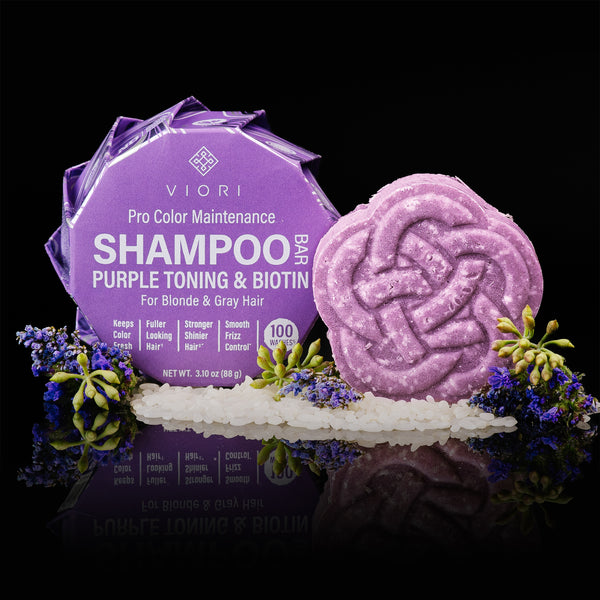
Real reviews for Purple Shampoo Bar with Biotin – Blonde & Gray | VIORI
The Concentration Sweet Spot (Why More Isn't Better)
Viori makes a fascinating statement in their product information: "We use a lower concentration of Longsheng rice water in our products because rice water at a high concentration can disrupt your hair and scalp's pH level if used too often or too much."
This reflects a sophisticated understanding of formulation chemistry that many brands miss in their rush to put "high concentration" on their labels.
The Hygroscopic Reversal Effect
At concentrations above approximately 15-20% (depending on the specific rice extract and fermentation method), rice polysaccharides can actually begin to draw moisture OUT of your skin when environmental humidity is low-the same way honey or glycerin can be dehydrating in very dry climates.
Why? Because highly hygroscopic (water-loving) ingredients always seek equilibrium. If there's more water in your skin than in the air around you, and you've slathered on a high concentration of a powerful humectant, that ingredient will pull water from your skin to balance itself with the environment.
The optimal concentration for rice extract actually looks like this:
- 5-10% for daily use products (focus on consistency over intensity)
- 10-15% for intensive treatments (used 2-3 times weekly)
- Above 15% should be reserved for specialized applications in controlled, humid environments
This is part of why traditional use by the Red Yao women works so beautifully-they're not using pure, concentrated rice water multiple times per day. They're using it as a periodic treatment, allowing the benefits to accumulate without the potential pH disruption or hygroscopic reversal effects.
The Microbiome Connection (The Cutting Edge of Rice Extract Research)
Here's where we venture into genuinely cutting-edge territory: rice extract's effect on your skin and scalp microbiome.
Your skin and scalp aren't sterile surfaces-they're thriving ecosystems of bacteria, fungi, and other microorganisms that, when balanced, keep your skin healthy. When out of balance, you get everything from acne to dandruff to eczema.
Fermented rice contains:
- Oligosaccharides that may act as "food" (prebiotics) for beneficial bacteria
- Organic acids that modulate pH in ways that favor good microbes over problematic ones
- Antimicrobial peptides produced during fermentation that may selectively inhibit harmful bacteria
Emerging research suggests that rice ferment filtrate may help support healthy microbial diversity-specifically promoting beneficial bacteria while potentially limiting problematic strains.
This could explain some of the scalp health benefits reported by users of rice-based hair care products like Viori's bars. It's not just about the direct effects of vitamins and proteins on your hair shaft-it's about creating a scalp environment where beneficial microbes can flourish, which in turn supports healthier hair growth.
What Actually Matters: Your Professional Buying Guide
After dissecting all this chemistry, here's what actually matters when you're evaluating rice extract toners or treatments:
For Maximum Efficacy, Look For:
- Transparent sourcing - Rice from low-arsenic, traditionally cultivated regions is preferable (Longsheng rice, for example, comes from ancient terraced mountains with traditional cultivation methods)
- Detailed fermentation information - Traditional, longer fermentation produces superior inositol profiles and beneficial compounds
- The concentration sweet spot - 5-15% rice extract, properly pH balanced (usually between 4.7-5.5)
- Clean formulation - Avoid heavy silicones, synthetic polymers, or too many competing film-forming ingredients that interfere with rice extract's unique properties
- pH transparency - Brands should be willing to share pH information (if they're not monitoring it, that's a red flag)


