
After two decades working with hair of every texture, porosity, and condition imaginable, I've learned that what we don't talk about in eco-friendly hair care is often more important than what we do.
The term "eco-friendly shampoo" has become so common that it's practically meaningless. Walk down any beauty aisle and you'll see dozens of products claiming to be natural, sustainable, or green. But as someone who's spent 20 years studying formulations, ingredients, and their real-world effects, I can tell you that the environmental story of hair care is far more complex-and fascinating-than most brands want you to know.
Let me share the technical insights that rarely make it onto product labels, but dramatically impact both your hair health and our planet's wellbeing.
Why "Eco-Friendly" Isn't Enough Anymore
Most conversations about sustainable shampoo stop at the obvious checkboxes: biodegradable ingredients, recyclable packaging, cruelty-free testing. These matter, absolutely. But they're just the beginning.
The real environmental impact of your shampoo starts long before it reaches your shower-in the fields where ingredients are grown, the facilities where they're processed, and the trucks that transport them. It continues after you rinse, as those ingredients travel through water systems and eventually back into the environment.
This complete lifecycle perspective reveals some surprising truths that challenge conventional eco-friendly wisdom.
The Fermentation Secret Nobody Talks About
Here's something I've observed throughout my career that deserves far more attention: how ingredients are processed matters just as much as what those ingredients are.
Take rice water, a traditional beauty ingredient that's experienced a modern resurgence. You can use plain rice water, or you can use fermented rice water. The environmental difference is dramatic.
Fermentation is an environmental game-changer because:
It concentrates beneficial compounds naturally. Fermented rice water contains higher levels of inositol (Vitamin B8) and panthenol (Vitamin B5) than unfermented versions. This means you need less raw material to achieve the same hair-strengthening results.
NOT SURE WHICH PRODUCT IS RIGHT FOR YOU?
TAKE THE QUIZTakes 30 seconds · 134,000+ customers matched
It naturally balances pH without chemicals. The fermentation process brings ingredients to an optimal pH range (3.5-6.5) on its own. Conventional shampoos often require additional chemicals to reach this range, adding environmental burden.
It creates natural preservatives. Fermented ingredients resist microbial growth naturally, reducing the need for synthetic preservation systems that can persist in water systems.
At Viori, we've embraced this traditional wisdom not just for its hair benefits, but for its environmental elegance-nature doing the work that would otherwise require industrial processing.
The Water Paradox: Why You're Shipping Bottles of... Water
This is one of those technical realities that completely changed how I think about product sustainability.
Most liquid shampoos contain 70-80% water.
Let that sink in. When you buy a 10-ounce bottle of shampoo, you're paying to transport 7-8 ounces of plain water from a manufacturing facility to your home.
The compounding environmental costs are staggering:
- Transportation emissions increase exponentially when you're shipping water weight around the globe
- Packaging must be heavier and more robust to prevent leaking liquid products
- Water-based formulas require preservative systems to prevent bacterial growth
Now consider the alternative: solid shampoo bars.
A 3.2-ounce shampoo bar typically provides the equivalent of three 10-ounce liquid bottles-that's roughly 30 ounces of product value from a 3.2-ounce package. The environmental mathematics are compelling:
- 90% reduction in packaging waste
- Approximately 15 times less weight to transport per equivalent use
- Minimal preservation needs since bars are naturally self-preserving when properly dried between uses
I've done the calculations dozens of times while formulating products throughout my career, and the numbers always lead to the same conclusion: eliminating water from the equation is one of the single most impactful environmental choices a hair care product can make.
The Ingredient Sourcing Story That Should Matter More
Let's talk about something that keeps me up at night: sustainable poverty.
Many brands proudly display fair trade certifications, which is admirable. But there's an even more powerful model that rarely gets discussed: direct trade relationships with indigenous communities at premium prices.
I've seen what happens when communities can profit directly from sustainable cultivation. In regions like Longsheng, China, the Red Yao people have maintained rice terraces for nearly 2,000 years using methods that actually enhance biodiversity. When hair care brands source directly from such communities-especially at premium rates above market value-they create a virtuous cycle:
Communities have economic incentive to preserve their environment rather than selling land to industrial agriculture. Traditional, low-impact farming methods remain viable because they're actually profitable.
Ancient knowledge gets passed down instead of abandoned. These time-tested techniques often represent hundreds or thousands of years of environmental adaptation.
Ecosystems remain intact. The biodiversity supported by traditional cultivation methods disappears when industrial monoculture takes over.
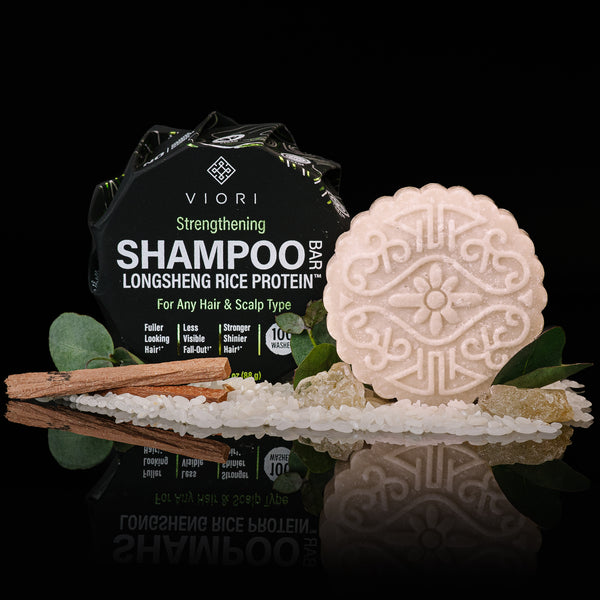
At Viori, we source our Longsheng rice directly from Red Yao villages at twice the market rate. This isn't charity-it's recognition that their sustainable practices and traditional knowledge have genuine value that should be compensated accordingly.
The pH Balance Factor: Environmental Chemistry Most Brands Ignore
Here's where my technical training becomes crucial for understanding environmental impact.
Human hair and scalp naturally exist at approximately 4.5-5.5 pH. Many conventional shampoos clock in at 8.0 or higher. This pH mismatch creates an environmental cascade effect that most consumers never connect to their shampoo choice.
When alkaline shampoos strip your scalp's natural oils, your sebaceous glands panic and overproduce sebum. This triggers a vicious environmental cycle:
- You need to wash your hair more frequently to combat oiliness
- More frequent washing means dramatically increased water consumption
- You go through products faster, meaning more manufacturing and packaging
- All environmental impacts multiply with each additional wash
I've worked with clients who reduced their washing frequency by 30-50% simply by switching to pH-balanced products. The water savings alone are substantial-and that's before considering reduced energy use, product consumption, and manufacturing demand.
But here's the technical detail that really matters: pH affects how quickly ingredients break down after they wash down your drain.
Products formulated at natural pH levels degrade more readily in water treatment systems because they don't require the buffering agents that stabilize high-pH formulations. These buffering agents-often phosphates or synthetic compounds-can persist in water systems and contribute to problems like algal blooms that devastate aquatic ecosystems.
Beyond the "Sulfate-Free" Label: The Chemistry They Don't Explain
The beauty industry has taught consumers that "sulfate-free" equals eco-friendly. As a formulation specialist, I can tell you this binary thinking misses crucial nuances.
Not all sulfates are created equal.
The problematic ones-sodium lauryl sulfate (SLS) and sodium laureth sulfate (SLES)-are harsh detergents that strip hair aggressively and can persist in water systems. However, there's an entire category of compounds containing the SO₄²⁻ molecule that behave completely differently.
Behentrimonium methosulfate, for example, contains a sulfate group but functions as a gentle conditioning agent. The molecular structure makes all the difference:
- Traditional sulfates are anionic surfactants that strip away oils aggressively, requiring higher concentrations and creating more environmental burden
- Quaternary ammonium compounds with sulfate groups are cationic surfactants that actually help close the hair cuticle and retain moisture
The environmental distinction is significant. Traditional sulfates damage hair in ways that necessitate additional conditioning products-more packaging, more ingredients, more environmental impact.
Gentler cleansing systems derived from coconut (like sodium cocoyl isethionate) combined with appropriate conditioning agents create formulations that are both more effective and genuinely more sustainable. But this technical nuance gets lost in simplified marketing slogans.
The Protein Concentration Paradox
After 20 years of working with hair, I've seen countless trends come and go. The current rice water craze is a perfect example of how incomplete information can actually increase environmental impact.
Pure rice water at high concentrations, used too frequently, can backfire:
- Protein overload makes hair brittle and prone to breakage
- Damaged hair requires more frequent cutting, wasting the very growth you're trying to achieve
- Users abandon products that cause adverse effects, cycling through multiple products and increasing waste
The environmental solution lies in using lower, scientifically optimized concentrations of rice water combined with complementary ingredients. This approach:
- Reduces raw material requirements (less rice needed per dose)
- Improves efficacy through proper protein-moisture balance
- Increases product satisfaction, so users actually finish products instead of abandoning them half-used
It's counterintuitive, but using less of a natural ingredient in a carefully formulated product can actually be more sustainable than using more of that ingredient in its pure form.
The Scent Question: When Natural Isn't Necessarily Better
This is controversial in natural beauty circles, but after two decades of formulation work, I believe it needs to be said: essential oils aren't always the most environmentally responsible fragrance choice.
Consider the extraction ratios:
- Rose oil requires approximately 10,000 pounds of rose petals for 1 pound of oil
- Jasmine requires roughly 8 million hand-picked flowers for 1 kilogram of absolute
- Sandalwood comes from slow-growing trees that take 30+ years to mature
The environmental costs accumulate quickly:
- Vast land use for sufficient crop yields
- Water-intensive distillation processes
- Significant energy requirements for extraction
- Habitat disruption from monoculture cultivation
Here's the technical reality that makes some people uncomfortable: Nature-identical fragrance compounds-synthetic molecules that are molecularly identical to their natural counterparts-can actually be more environmentally sustainable.
When these compounds are free from harmful substances (carcinogens, mutagens, reproductive toxins, organ toxins, and acute toxins), they offer the sensory benefits of natural scents without requiring:
- Agricultural land use
- Agricultural runoff or pesticide application
- Harvesting from endangered or slow-growing plants
- Energy-intensive extraction processes
At Viori, we use nature-identical fragrances that meet strict safety criteria while minimizing environmental impact-a decision based on scientific assessment rather than marketing appeal.
The Packaging Details That Actually Matter
Everyone knows plastic is bad, but the alternatives have their own environmental considerations that rarely get examined with technical rigor.
WHAT CUSTOMERS ARE SAYING
Real reviews for Hidden Waterfall Barra de Champú
Take bamboo soap dishes, popular among eco-conscious consumers. Bamboo grows quickly and doesn't require pesticides, so it's marketed as automatically sustainable. But there's a moisture problem that leads many manufacturers to:
- Apply chemical treatments (defeating the eco-friendly purpose)
- Design products that need frequent replacement (increasing consumption)
- Create items that fail prematurely from mold
A better approach uses untreated bamboo with proper care instructions:
- Cure holders with food-grade oils before first use
- Place away from direct water spray
- Position low in the shower where steam exposure is minimal
- Regular drying and wiping
This creates products that last years rather than months-but it requires consumer education that few brands invest in.
Similarly, with paper packaging: Recycled paper is obviously better than plastic, but printable, water-resistant recycled paper often contains coatings that complicate recycling.
The most environmentally sound approach uses:
- Minimal printing to reduce ink and coating requirements
- Soy or vegetable-based inks that are biodegradable
- Uncoated paper that's fully recyclable and biodegradable, even if less polished
At Viori, we've chosen function over flash-simple recycled paper packaging that can actually complete the recycling loop.
The Longevity Factor: An Overlooked Environmental Multiplier
Here's an environmental calculation that almost never appears on eco-friendly labels: product longevity.
A shampoo bar lasting 60+ washes means:
- Fewer purchasing transactions (reduced transportation for shopping trips)
- Fewer shipping events for online orders
- Dramatically reduced packaging over time (60 washes from one bar versus multiple bottles)
- Lower storage requirements (both retail and home storage consume energy)
The environmental benefits multiply with each use. A consumer using three bars over nine months has a radically smaller environmental footprint than someone trying eight different products in the same period.
But here's the catch: This only works if consumers actually use the product long enough to experience its benefits.
The Transition Period: An Environmental Cost Nobody Calculates
When clients switch hair care products and don't allow adequate adjustment time (typically 2-3 months), they often:
- Abandon the product partially used
- Purchase another product to try
- Keep multiple products simultaneously, reducing the usage rate of each
- Eventually dispose of several partially-used products
I've seen this pattern hundreds of times. The environmental solution isn't just creating eco-friendly products-it's educating consumers about:
- Natural transition periods as hair adjusts to new formulations
- Proper usage techniques (most people use far too much product)
- Realistic timelines for results (changes develop gradually)
One consumer who fully uses three bars over nine months beats eight consumers trying "eco-friendly" products they abandon after three weeks.
The Hard Water Variable They Don't Tell You About
Here's a technical factor that dramatically affects environmental impact but rarely appears in eco-friendly discussions: regional water hardness.
Hard water contains high levels of dissolved minerals-primarily calcium and magnesium. When these interact with soap-based cleansers, they create insoluble precipitates. That's the "soap scum" coating your shower.


