
I'll never forget the day a client brought in her chipped shampoo bar, looking almost embarrassed. "Is this normal?" she asked, showing me the small pieces that had flaked off the edges. In my twenty years as a beauty professional, I've had this conversation more times than I can count-and it always leads to a fascinating discussion about chemistry, physics, and the delicate art of creating solid haircare products.
If you've noticed small chips breaking off your shampoo bar or spotted cracks forming along those beautiful embossed patterns, you're definitely not alone. Today, I'm pulling back the curtain to show you exactly why shampoo bars chip, crack, and sometimes crumble-plus what you can actually do about it.
The Hidden Architecture: What Makes a Shampoo Bar Stay Together?
Here's something most people don't realize: creating a shampoo bar is like constructing a tiny building. Every ingredient serves a specific structural purpose, and if one element is off, the whole thing can fall apart-literally.
Traditional soap bars are relatively simple. They're made through a straightforward chemical reaction between fats and lye. But modern shampoo bars? They're incredibly complex matrices where multiple ingredients need to work in perfect harmony.
The Binding Challenge
At Viori, we use vegetable-derived cetyl alcohol and stearic acid as the "scaffolding" that holds everything together. Think of these as the steel beams of our tiny building. Cocoa butter and shea butter add flexibility-without them, the bar would be too rigid and brittle. Then there's rice protein, bamboo extract, and all the other nourishing components suspended throughout this entire structure.
The formulation challenge is enormous. A truly great shampoo bar needs to be:
- Firm enough to maintain its shape sitting on your bathroom shelf
- Pliable enough to create luxurious lather without requiring aggressive rubbing
- Stable enough to resist dissolving in humid bathroom environments
- Permeable enough to release conditioning ingredients when you actually use it
It's a delicate balancing act that takes years to perfect. Too much binder creates a hard, waxy bar that refuses to lather properly. Too little, and you get a crumbly product that chips and breaks before you've used half of it.
The Physics Behind the Chip: Why Bars Actually Fracture
Temperature Shock: Your Shower is Basically a Stress Test
Want to know something wild? Your shampoo bar experiences extreme temperature swings every single time you shower.
Picture this: Your bar is sitting at room temperature-maybe 65 to 70 degrees. Then you turn on your hot shower and suddenly expose it to water that's potentially 100 to 110 degrees. That's a 40 to 50 degree temperature jump happening in seconds. Then the whole process reverses when the bar cools down after your shower.
NOT SURE WHICH PRODUCT IS RIGHT FOR YOU?
TAKE THE QUIZTakes 30 seconds · 134,000+ customers matched
Different ingredients respond differently to these temperature changes. Cocoa butter and shea butter expand when heated, while the surfactant base (Sodium Cocoyl Isethionate, or SCI) remains more stable. This creates internal stress within the bar-imagine trying to fit puzzle pieces together that keep changing size.
Over dozens of showers, these stresses accumulate at vulnerable points. Corners, edges, and areas around embossed patterns take the brunt of it. Eventually, you'll notice a small chip, a surface crack, or sometimes a deeper fracture running through the bar.
The Hydration Gradient: When Water Doesn't Play Fair
Here's where it gets really interesting. When water hits your shampoo bar, it doesn't penetrate uniformly. Instead, it creates what scientists call a "hydration gradient"-the outer layer absorbs moisture and softens while the inner core remains dry and rigid.
Imagine a sponge cake with a hard center. The soft outer layer wants to expand, but the rigid core resists. At the boundary between these zones, something has to give-and that's exactly where chips and flakes break away.
At Viori, we address this through careful ingredient selection. Vegetable glycerin and sodium lactate act as humectants that help moisture absorb more evenly throughout the bar, reducing that dramatic difference between wet exterior and dry interior.
The Crystallization Factor: When Ingredients Reorganize Themselves
Rice Protein's Hidden Behavior
This is where chemistry gets genuinely fascinating. Hydrolyzed rice protein-a key ingredient in our Longsheng Rice Water formulation-doesn't just sit there passively in the bar. Over time, these protein molecules can actually reorganize themselves, aligning into semi-crystalline zones that are more rigid than the surrounding material.
Think of it like ice crystals forming in ice cream that's been in your freezer too long. These crystalline regions have completely different mechanical properties than the rest of the bar, creating weak points where cracks prefer to start when the bar experiences stress during use.
Vitamin Distribution Matters More Than You'd Think
Fat-soluble vitamins like Vitamin E and B-complex vitamins from fermented rice don't dissolve completely in the surfactant base. Instead, they exist as microscopic droplets distributed throughout the matrix.
If these particles aren't evenly distributed during manufacturing-or if they clump together over time-they create weak spots in the structure. Precise temperature control during mixing and careful ingredient ratios help minimize this effect, but it's one of those variables that requires constant attention.
The Pattern Problem: When Beauty Creates Vulnerability
Stress Concentration 101
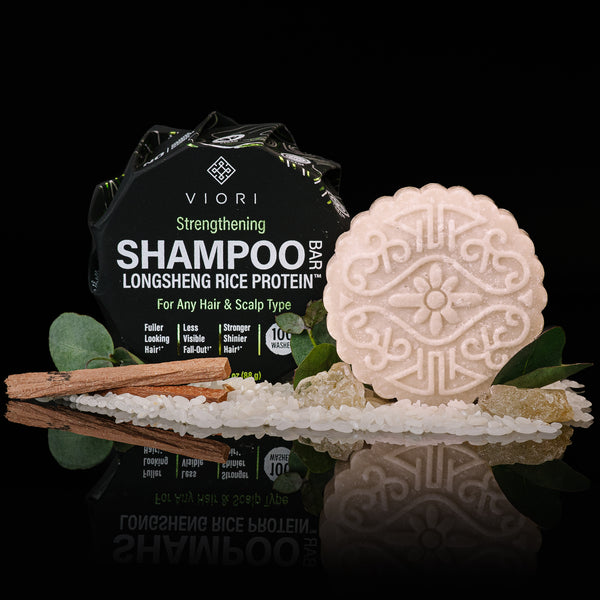
Viori's distinctive mooncake-inspired patterns aren't just beautiful-they also have significant implications for how the bar holds up over time.
Any groove, depression, or surface pattern in a solid structure creates what engineers call "stress concentration points." Those embossed patterns, while culturally meaningful and absolutely gorgeous, create numerous corners and valleys where stress naturally accumulates.
This is exactly why you might notice chipping happens preferentially along the edges of embossed patterns rather than on smooth surfaces. The geometry itself literally guides crack formation.
The solution lies in the formulation-ensuring the bar has sufficient flexibility (what engineers call "ductility") to bend slightly and redistribute stress rather than simply fracturing. The balance of soft butters to harder waxes and fatty alcohols determines this critical property.
Water Exposure: The Dissolution-Deposition Cycle
The Crusty Surface Mystery
Have you ever noticed a thin, slightly different-textured layer on your bar after it's dried? That's the result of a fascinating process that happens every time you use your bar.
When water flows over the surface, it dissolves some ingredients into a thin boundary layer. As the bar dries, this water evaporates-but some of the dissolved materials get redeposited onto the surface in altered forms, creating a thin "crust" with different properties than the bar beneath.
This crust is often brittle and prone to flaking, especially when the bar gets wet again. The sudden rehydration causes rapid expansion that the fragile crust simply can't accommodate, leading to those characteristic surface chips.
The Hard Water Complication
If you live in a hard water area, you're dealing with an additional challenge. Calcium and magnesium ions interact with surfactant molecules on your bar surface, forming insoluble complexes-essentially soap scum that builds up on the bar itself.
This chalky deposit makes the surface even more brittle and chip-prone. Viori's pH-balanced formulation, optimized to 3.5 to 6.5, helps minimize this reaction. Our carefully selected ingredient blend doesn't include traditional soap components that are most susceptible to hard water problems.
Storage Secrets: Your Bar Continues Evolving
The Ongoing Curing Process
Here's something that surprises almost everyone I talk to: Your shampoo bar continues to "cure" even after you start using it.
This extended curing involves several processes happening simultaneously:
- Moisture equilibration as the bar adjusts to your bathroom's specific humidity level
- Slow crystallization of fatty components into more stable forms
- Ingredient migration as more mobile components gradually redistribute throughout the bar
Proper storage becomes crucial when you understand this. Bars in excessively dry environments become brittle as they lose moisture. Those in very humid conditions may soften and lose their structural definition. The sweet spot is 40 to 60% relative humidity at moderate temperatures-roughly 60 to 75 degrees.
The Sunlight Factor (Almost Never Discussed)
Many botanical extracts in premium shampoo bars-including bamboo extract and aloe vera-contain compounds that break down when exposed to UV light. This degradation doesn't just affect scent or color. The breakdown products can actually disrupt the bar matrix, contributing to structural weakening.
This is precisely why you should store bars away from direct sunlight and why opaque packaging actually matters. It's not just aesthetic-it's about maintaining structural integrity over time.
How You Use It: Application Methods Matter
Direct Application vs. Palm Lathering
Your application method dramatically affects how quickly your bar chips and degrades. I've seen this play out with countless clients over the years.
Direct application-rubbing the bar directly on wet hair-creates significantly more mechanical stress than palm lathering, where you create lather in your hands first, then apply it to your hair.
When you rub the bar directly on hair, it encounters:
- Variable friction as it moves over different hair textures
- Uneven pressure creating localized high-stress zones
- Directional loading that can wedge apart weak points in the matrix
For those with color-treated hair, we specifically recommend palm lathering not only to preserve color but also to reduce mechanical stress on the bar itself, extending its life and minimizing chipping.
Temperature Shock During Use
When you apply a room-temperature bar to hot, water-soaked hair, the surface layer rapidly heats and softens while the core remains cool. This sudden thermal gradient creates internal stresses that accumulate over dozens of uses, eventually contributing to fatigue-induced cracking.
Professional formulation can mitigate this through ingredients that maintain more consistent properties across temperature ranges-but no bar can completely escape the basic physics of thermal stress.
The Bamboo Holder Question: Protection with Trade-offs
What Optimal Drying Actually Requires
Our bamboo holders serve an important protective function, but they also illustrate a fundamental tension in bar storage that's worth understanding.
For your bar to dry properly and maintain integrity, it needs:
- Unrestricted airflow on all surfaces for even evaporation
- Drainage to prevent water pooling underneath
- Elevation away from any standing water
The slotted design of bamboo holders addresses these requirements well, but there's an inherent limitation: Any holder creates contact points where airflow is restricted and water can be trapped.
The Bamboo Interaction
Untreated bamboo absorbs and releases moisture. While this can help buffer humidity fluctuations, it also means the holder may stay damp longer than the bar itself, potentially maintaining higher local humidity that keeps the bar's contact surface softer than exposed surfaces.
This differential softening can contribute to asymmetric degradation-the bottom weakens while the top stays firm-sometimes leading to major cracking or complete bar separation down the middle.
Pro tip: Follow the recommendation to cure bamboo holders with a food-safe oil. This creates a moisture barrier that significantly reduces this effect.
Why Conditioner Bars Are More Fragile
If you've noticed that conditioner bars seem more prone to breaking than shampoo bars, you're absolutely right-and there's a scientific reason for it.
WHAT CUSTOMERS ARE SAYING
Real reviews for Hidden Waterfall Barra de Champú
High-Butter Formulation
Conditioner bars contain much higher concentrations of butters and conditioning oils relative to surfactants. This makes sense-their purpose is to deposit nourishing ingredients rather than clean. But it also makes them:
- Softer overall with lower structural rigidity
- More temperature-sensitive since butters have relatively low melting points
- More prone to deformation under pressure or heat
The square shape of our conditioner bars (versus round shampoo bars) helps by distributing force more evenly across the surface, but they remain inherently more delicate by nature.
The Melting and Reforming Issue
Conditioner bars are more susceptible to partial melting in hot, steamy showers. When they cool and resolidify, the crystal structure of butter components may differ from the original state.
This recrystallization creates internal stress and weak planes. It's why conditioner bars sometimes suddenly crack down the middle after weeks of seemingly normal use-internal restructuring has created a weakness that finally propagates into visible failure.
The Natural Ingredient Trade-off
Our commitment to natural, ethically-sourced ingredients creates specific formulation constraints that are worth understanding if you're curious about why bars behave the way they do.
Synthetic polymers commonly used in conventional bars to improve structural integrity-like polyquaterniums or synthetic silicones-simply aren't options when you're committed to natural formulation.
Instead, we employ natural alternatives:
- Broccoli seed oil provides slip and smoothness without silicones
- Rice bran oil offers conditioning and film-forming properties
- Bamboo extract contributes strength-enhancing silica compounds
However, these natural ingredients have more variable properties from batch to batch and generally provide less dramatic structural reinforcement than synthetic alternatives. This is an inherent trade-off-you accept slightly greater variability in exchange for cleaner, more sustainable ingredients that are better for your hair and the environment.
The Quarter-Inch Threshold: When Breaking Apart is Completely Normal
Our guidance that "it's normal for a shampoo or conditioner bar to break apart once it reaches 1/4 inch thickness" isn't about formulation limitations-it's about fundamental physics.
Why Thin Bars Can't Stay Intact
As a bar thins through use, its structural properties change dramatically:
- Rigidity decreases exponentially with thickness-reduce thickness by half, and structural rigidity decreases by a factor of eight
- Thermal response accelerates, meaning thin bars experience more dramatic temperature cycling
- Surface-to-volume ratio increases, so absorbed water represents a larger fraction of total bar volume
Below approximately 1/4 inch, the bar simply lacks the mechanical strength to maintain integrity under normal handling. This isn't a flaw in the formulation-it's fundamental material science.
Making the Most of Small Pieces
When bars reach this terminal thickness, different recovery strategies work for different bar types:
Conditioner bars, being butter-rich, can be gently melted (microwave in 10-second intervals) and reformed in a small silicone mold because the butters melt and resolidify without permanently changing structure.


